“Please. That’s mine.”
The old man’s voice was quiet enough that most people in Gus’s Diner never looked up.
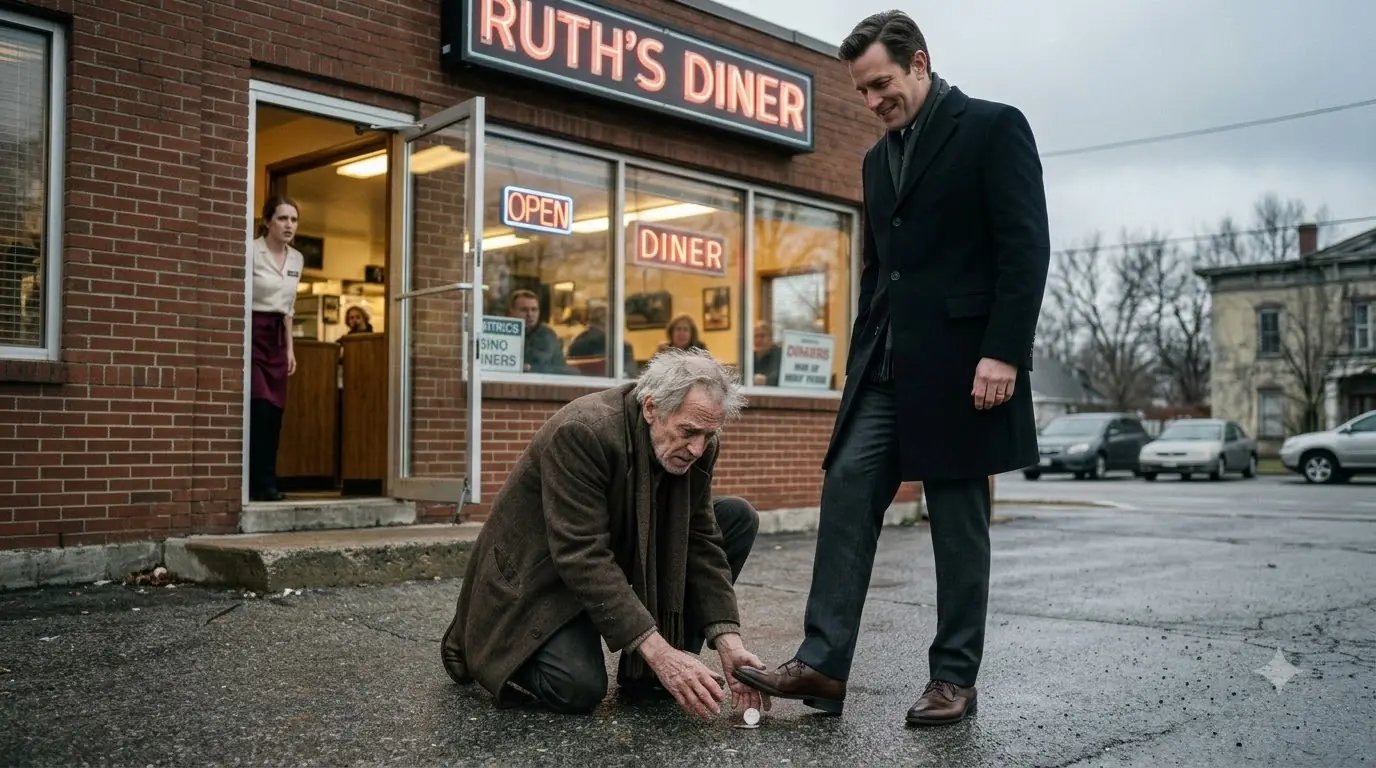
Danny Mercer did.
She was twenty-nine years old, six hours into a ten-hour shift, carrying two coffee mugs in one hand and a plate of scrambled eggs in the other when she saw the silver coin roll across the tile beneath booth seven.
The old man reached for it.
A woman in an expensive camel-colored coat reached first.
She trapped the coin beneath the toe of her boot, bent down, picked it up, and slipped it into her palm.
The old man looked at her.
“Please.”
He held out his hand.
“That’s mine.”
The woman glanced at the worn navy jacket hanging loose around his shoulders.
The coat had frayed cuffs.
His trousers were too large at the waist.
His boots had been polished once, perhaps years earlier, but winter salt had turned the leather gray around the seams.
She looked at the coin.
Then at him.
“Then maybe you should learn to hold on to your money.”
Danny stopped.
The woman began walking toward the register.
Danny put the coffee mugs down.
“Excuse me.”
The woman turned.
“Are you talking to me?”
“Yes, I am.”
Danny nodded toward her closed hand.
“You didn’t have to do that.”
The woman stared.
“Do what?”
“Take his money.”
“It’s just a coin.”
“Maybe to you.”
Danny’s voice remained calm.
“But it belongs to him.”
The woman rolled her eyes.
“Whatever.”
She opened her hand and dropped the coin onto the nearest table.
It bounced once.
Danny caught it before it rolled again.
The woman muttered something Danny did not hear and left.
Danny turned toward the old man.
He looked embarrassed.
Not grateful.
Embarrassed.
That bothered her more.
She handed him the coin.
“Here.”
He took it.
“Thank you.”
“You’re welcome.”
“I didn't want any trouble.”
Danny picked up the coffee mugs again.
“You’re not trouble.”
She looked through the front windows.
Wet snow blew sideways across Harrison Avenue.
“Come inside.”
“I’m already inside.”
“You’re standing three feet from the door like you're planning to escape.”
That produced the smallest hint of a smile.
Danny pointed toward the counter.
“Sit.”
The man hesitated.
“I don't have much.”
“I didn't ask.”
He looked toward the prices printed above the grill.
Danny understood.
“What can I get you?”
He studied the menu as though doing arithmetic.
“Dry toast.”
“That’s it?”
“That’s all.”
Then, after a pause:
“That’s all I can afford.”
Danny looked at him.
His face was lined but clean.
Late sixties, maybe early seventies.
Silver hair pushed beneath a faded knit cap.
Hands rougher than she expected.
No smell of alcohol.
No obvious sign that he had slept outside, though Danny knew better than to assume poverty always announced itself clearly.
“Toast.”
She wrote nothing.
She did not need to.
“Coffee?”
“No.”
“Coffee’s on me.”
“You don't have to.”
“Correct.”
She poured him some anyway.
He took the counter stool nearest the radiator.
Danny went through the swinging door into the kitchen.
Gus Pappas stood at the grill.
Sixty-two.
Balding.
Heavy eyebrows.
Apron permanently stained with evidence of forty years in food service.
He glanced at the ticket rail.
“Where’s the order?”
“No ticket.”
“That is generally bad for restaurant operations.”
“Toast.”
“That I can survive.”
Danny opened the warming drawer.
Then looked toward the grill.
Two eggs.
Hash browns.
One sausage patty.
Gus noticed.
“What are you doing?”
“Nothing.”
“That looks like food.”
“Very observant.”
“Danny.”
“He’s hungry.”
“You know that how?”