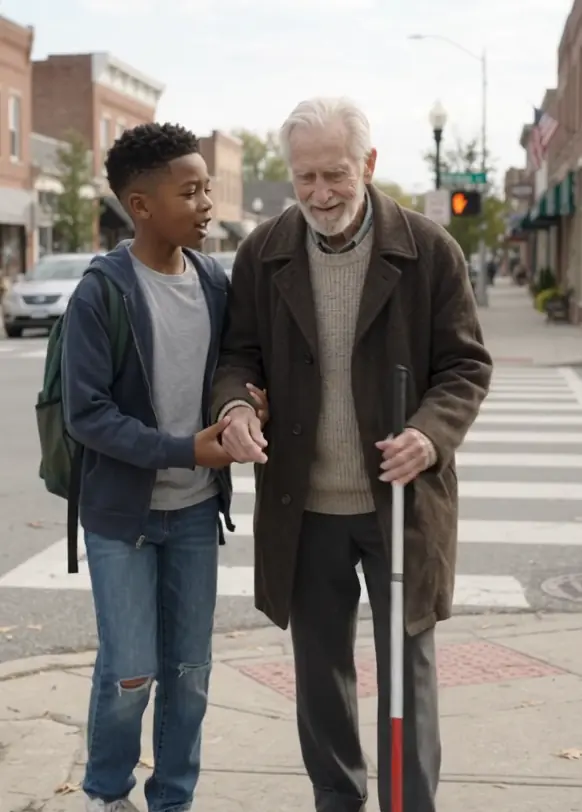
Twelve-year-old Caleb Turner was late for the bus when he saw an elderly man with a white cane step into a crowded crosswalk. A turning car edged forward while the driver looked toward oncoming traffic. Caleb ran to the corner and called out before the man took another step. The old man stopped immediately, steadying himself with his cane. Caleb touched his sleeve only after asking permission. 'Are you all right, sir?' he asked. The man introduced himself as Henry Ward and said he was fine, just unsure whether the crossing signal had changed. Caleb offered his arm, explaining where the curb ended and waiting until Henry was ready. They reached the opposite sidewalk together. Henry thanked him and asked whether he knew the way to the public library. Caleb had a bus to catch, but the library was only two blocks away.
The difficulty was not that anyone lacked feelings. It was that the important decisions arrived disguised as ordinary chores. A form needed signing, a call needed returning, someone had to decide whether to open a door. Those choices were easy to overlook later, when the story could be told in a single sentence. At the time, each person had incomplete information and responsibilities that would not wait.
No one suggested that good intentions could substitute for proper procedure. An invitation might provide comfort, but it could not secure a home or repair a dangerous crossing by itself. People needed names, dates, records, and someone responsible for the next step. At the same time, without an initial act of concern, there would have been no reason for the details to reach the right people.
An outsider might have assumed that the most important character was the person speaking the loudest. The people closest to the problem knew otherwise. Progress depended on those who kept appointments, saved original documents, admitted uncertainty, and made enough room for frightened people to say what had actually happened. Their patience gave the facts somewhere to stand.
At first, the conversation wandered. Someone repeated a question, and somebody else answered only half of it. They stopped to check the date and tried again. The pause felt embarrassing, yet it prevented them from building a whole conclusion on a misunderstood word. Little by little the question they needed to answer became clearer.
He had expected a grand explanation, perhaps the kind people delivered with an impressive envelope. Instead he received a practical instruction and a request to be careful. It was strangely reassuring. A person trying to tell the truth did not need every detail to sound extraordinary; the.
As they walked, Henry asked Caleb whether the crossing signal had made any sound at all.