The first thing fourteen-year-old Noah Carter noticed was that the woman was not waving for help. She was sitting perfectly still beneath a broken streetlight, watching cars pass as if she had already stopped expecting anyone to notice her. It was nearly nine on a November evening in Mill Creek, Pennsylvania. Noah was pedaling home from his shift stacking shelves at his uncle's grocery store when he saw her electric wheelchair beside the curb. The chair's front caster pointed sideways. A paper shopping bag rested across her knees, and her gloved hands gripped the armrests.
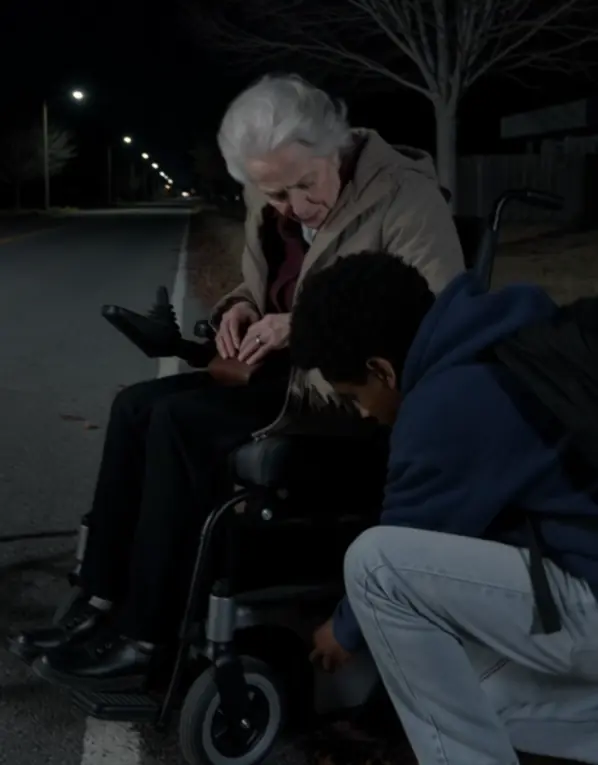
He coasted to a stop. “Ma'am, are you okay?” She gave him a practiced smile. “The chair isn't. I've called the service number three times.” Her name was Eleanor Whitcomb. She was seventy-nine and lived at Willow Gardens, a senior apartment complex six blocks away. Noah asked permission before touching the chair. He knew a little about wheels because his father repaired bicycles and mobility equipment in their garage before a stroke ended that work. Noah crouched and aimed his phone flashlight beneath the frame. The caster fork was loose, and the small wheel sat at an unnatural angle.
The more troubling thing was a bright metal fastener against the dirty black bracket. It was new, but it didn't fit. “Did someone fix this today?” he asked. Eleanor looked surprised. “Yesterday. They told me everything was safe.” Noah gently rocked the wheel, then stopped immediately. A thin crack ran through its mounting bracket. “Please don't try to drive it,” he said. “This could fold under you.” Eleanor stared down the empty road. “If I don't get home soon, they'll lock the front entrance.” Noah took off his backpack. He couldn't repair a cracked bracket with a bicycle tool. But he could help her find somewhere warm and someone qualified.
He called his mother. Then he asked Eleanor one more question. “Did they give you a receipt for yesterday's repair?” The old woman reached into her purse, unfolding a paper she had nearly thrown away. Noah shone the light on it. The receipt described a complete replacement of the front wheel assembly. Noah checked the gutter and saw the pavement was slick with fallen leaves. If the damaged wheel collapsed while Eleanor was moving, she could be thrown toward the traffic. The realization changed his voice. He stopped thinking about whether he could tighten a bolt and started thinking about how to keep her from getting hurt.
He would remember that quiet exchange long after the room emptied. What lay beneath the chair was clearly not a complete replacement. And the technician's signature at the bottom belonged to a man who had died nine months earlier.