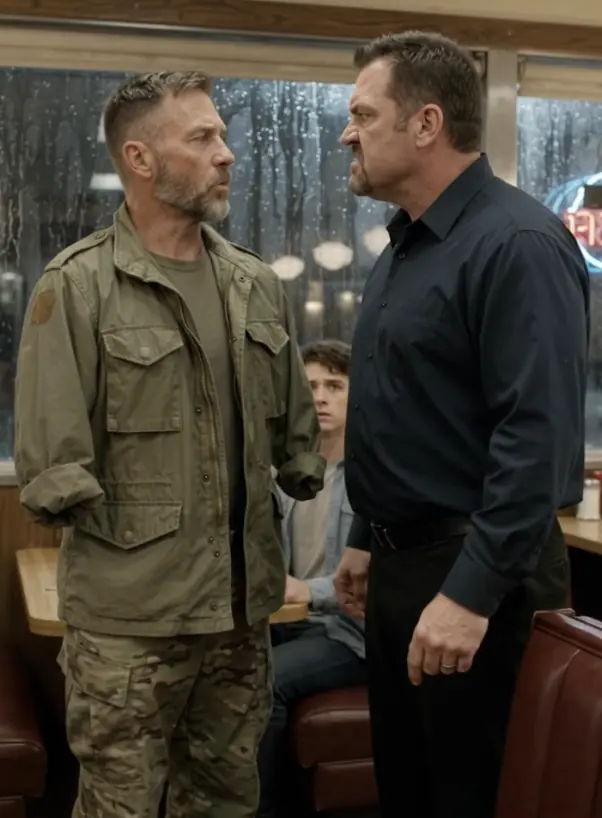
Victor Hale, manager of the Briar Creek Diner, preferred explanations that made him look powerful. He marched over as someone lifted a phone. "You think this is a nursing home?" he demanded. The veteran stared at his plate. Noah set the fork down, rose, and quietly answered, "He needs help eating. I'm on my break." Victor pointed at him, voice filling the room. "You don't get a break until I say so." Then he noticed the field jacket and laughed. "And you don't waste our time on freeloaders."
The stranger straightened with an effort that looked painful. Beneath his gray stubble, his face was weathered but alert. "You can talk to me," he said. Victor leaned closer. "Fine. Pay your bill and leave." Noah showed the register receipt. Paid in full. Victor snatched it and crumpled the paper. The stranger stood, bracing one hand on the table. Around them, the diner went silent. He looked Victor directly in the eye and asked a question that was stranger than any threat: "Does the name Daniel Mercer mean anything to you?" Victor's expression changed before he managed to hide it.
Briar Creek sat outside Columbus, Ohio, where trucking routes met old factory roads and veterans' memorial banners hung along the main street. The diner had opened before Noah was born. It served thick pancakes to truckers and bottomless coffee to county deputies, and its walls displayed photographs of former staff at summer picnics. Noah recognized almost none of the faces. His own mother had worked here years earlier, but Victor kept the older photographs in storage. Noah was saving for community college nursing classes. Since his mother's death, he had learned that small choices could exhaust a person's options: a replaced tire meant skipped groceries, and one lost shift meant a late rent notice. He knew how much the two dollars he had slipped into the tip jar mattered. Helping the man hold a fork had cost him nothing.
They waited for an answer.
Victor gripped the back of the booth, and the veteran said, almost gently, "You remember him. I can see that."
***
Victor recovered first. "I don't know any Mercer," he snapped. But his hand moved to his belt as though he were checking for a missing key. The veteran glanced at the wall above the register, where a framed newspaper clipping praised Victor for saving the diner during a recession. "Your father did," the stranger said. "So did the woman who used to run the morning shift." Noah felt something tighten behind his ribs. His mother, Elena Bennett, had once managed mornings, until an accusation ended her career.
Victor turned toward Noah. "Out. Now. You're fired." A customer protested, but Victor waved him down. Noah stood still, staring at the old man. "How do you know my mother?" The veteran looked startled. "Elena was your mother?" Then he glanced at a crooked scar near Noah's eyebrow. "Of course she was." Victor pushed between them. "This conversation is finished." The old man reached inside his jacket. A couple of diners drew back, alarmed. He withdrew only a plastic sleeve holding a battered black-and-white photograph.
The image showed four young soldiers beside a military ambulance, another young man in civilian clothes, and a woman with dark curls at a table spread with paperwork. On the bottom somebody had written, STATION HOUSE, APRIL 1994. Noah recognized his mother before the veteran pointed. Victor had taken three steps toward the exit, but when he saw the photograph, he stopped. The older man did not ask Noah to trust him; he offered the picture and let Noah examine it. In one corner stood a younger Victor, his face partly hidden behind a truck door.
"My name is Samuel Reed," the stranger said. "I was told Daniel Mercer died dishonored. Your mother was told the same thing. Both stories were lies."
Noah remembered his mother's last year, the way she folded letters into a cookie tin and changed the subject when he asked about the man in an old photograph. She had died after a short illness, leaving him a box of recipes, a watch with a broken strap, and an envelope labeled FOR WHEN YOU'RE READY. He had never opened it. He wasn't ready to learn there were more strangers in her life than he knew. Victor had convinced the town Elena stole from a veterans' charity linked to the diner. The police never charged her, yet employers stopped calling, and parents whispered when she volunteered at school. Noah had grown up knowing her as the woman who made dinner from leftovers and donated her coat when the shelter ran short.
They waited for an answer.
Samuel touched the photograph and whispered, "The man they said stole the money was the one who saved us all."
***
Two police cruisers arrived before anyone finished breakfast. Victor had called dispatch and reported a dangerous trespasser. Officer Leah Morales entered with her partner, expecting a fight. Instead she found an old man gripping a photograph, a waiter clutching a dismissal slip, and three customers offering recordings. Samuel gave his full name and folded his hands where everyone could see them. His voice stayed steady while Victor's explanations changed from sentence to sentence.
Leah separated the witnesses. She watched the first recording and then the second. One showed Noah helping Samuel eat; the other caught Victor threatening to withhold wages. "You can ask a customer to leave," she told the manager, "but you cannot turn a disability into probable cause." Victor insisted Samuel had made threats. Nobody else had heard one. Then Leah spotted something on Samuel's wrist: a small metal bracelet engraved with an Army medical unit. She had seen a similar bracelet in her late grandfather's keepsake box.
Samuel refused a ride to the station. "I've waited thirty-two years to be heard. I can wait another hour," he said. Outside, rain slid down the glass as the police left without arresting anyone. Victor stormed into his office and locked the door. Noah retrieved his jacket, but Samuel stopped him with a request: "Could you take me to where Elena is buried?" Noah had planned to go there Sunday. He agreed without thinking.
At the cemetery, Samuel stood quietly before Elena's modest stone. After several minutes he placed the photograph by the flowers. "I tried to find her after the hearing," he said. Noah asked which hearing. Samuel said there had never been one, not a lawful one. "They called it a review. They used uniforms, seals, and witnesses who weren't allowed to speak." He then told Noah the name of a government contractor Noah had seen on the diner walls: Harrow Logistics.
Leah wrote down the name before leaving because she had served in the National Guard and knew a story could disappear between agencies when everyone assumed someone else was responsible. At the cemetery Noah noticed Samuel's hands shook whenever he remembered the convoy. The man looked homeless, but his answers carried precise dates and names; even grief could not blur those details. The cemetery caretaker remembered Elena. Every Veterans Day she had scrubbed neglected headstones, not because she knew every soldier, but because she believed someone should. The caretaker also remembered a man in a gray sedan who watched Elena's funeral without approaching. He had worn an expensive black coat and left before the graveside prayers.
Nobody interrupted.
Then Samuel said something Noah had never heard: "Your mother kept the evidence after they took everything else."
***
Noah opened Elena's envelope that night at the kitchen table. His mother had written in careful blue ink, not as someone expecting rescue, but as someone trying to prevent another injury. The note began, If Samuel ever finds you, listen to him before you believe the town. She had included a brass key, a handwritten account number, and a name: Judith Coyle. Beneath it she wrote, She wasn't afraid of them. She was afraid of what would happen to our families.
The next morning Noah found Judith through an old church directory. She lived above a florist in nearby Delaware, Ohio, and answered the door with a walking cane. When she saw Elena's handwriting, she began to cry. "I begged her to burn this," she whispered. Judith had served as bookkeeper for the Veterans Relief Supper, a charity dinner Franklin Hale operated from the diner. The charity advertised emergency lodging and medical transportation for discharged soldiers. Donations came in through the till, mailed checks, and a trust administered by Harrow Logistics.
Judith showed Noah the original ledger sheets she had hidden in a sewing case. The figures looked ordinary until she placed two columns side by side. Meal expenses were recorded twice. Hotel vouchers were reimbursed for rooms that did not exist. Money intended for disabled veterans went to a shell company named Meridian Outreach. Noah looked at the signature approving transfers. Franklin Hale had signed some. Victor had signed others after his father supposedly retired. Judith said Elena uncovered the discrepancy when a veteran was turned away from a promised room during a snowstorm.
"Why didn't she go to the police?" Noah asked. Judith answered that she had, and the papers vanished. Later someone accused Elena of pocketing the donation envelopes. The town never saw proof; it merely heard that a trusted manager had investigated. Judith pushed a faded business card toward Noah. On it was the name of a retired investigator.
Judith was not heroic in her own telling. She had kept the books because she needed wages and stayed quiet because she was caring for a husband on dialysis. Her silence had protected her family in the short term and damaged people she knew for years. She did not excuse herself. She kept every canceled check she could, then hid them under the false bottom of a cedar chest. The brass key in Elena's letter belonged to a rented storage locker, Judith explained, but it would not open anything without a second key. Elena held one; Daniel Mercer had kept the other.
He checked the date. They waited for an answer.
The investigator's card carried the same surname as Officer Leah Morales. Noah picked up his phone.
***
Retired detective Carmen Morales listened without interruption as Noah spread papers across her dining table. She was Leah's aunt, a woman who had once investigated fraud for the county before losing a promotion after clashing with a politically connected prosecutor. Carmen remembered the Harrow file. "We thought we were building an embezzlement case," she said. "Then the records changed, and the complainant became the suspect."
Noah asked whether Elena had stolen anything. Carmen shook her head. "We couldn't prove she had. But someone leaked a false summary saying we had." She pulled out a thick binder with index tabs and showed him a photocopy of an incident report. The original report identified Franklin Hale as a person of interest. On a later copy, that name had been replaced with Elena's. The officer's signature appeared at the bottom of both versions, but Carmen had signed neither alteration. She had reported the change and been moved to another assignment.
Samuel sat near the window, tracing the rim of his coffee mug. When Carmen mentioned Daniel Mercer, he stood so suddenly the chair scraped the floor. "Mercer didn't disappear because he stole," he said. "He disappeared because he refused to sign a false statement about the convoy." Carmen turned toward him. "What convoy?" Samuel told them about a relief shipment from an Army depot to a rural veterans' clinic. The official manifest listed medical supplies. The actual cargo included sealed boxes that bypassed required inspection, carried under Harrow's contract.
Samuel had been a driver. Mercer had been the medic who questioned the route after an accident. The truck crashed at a washed-out bridge. Two soldiers survived, one was badly injured, and several containers vanished before investigators arrived. When Mercer objected to the replacement inventory, senior officers accused him of mishandling controlled supplies. A civilian witness promised to help prove the original cargo list. That witness was Elena.
Carmen had spent years expecting one missing report to reappear. Her retirement had not brought peace; her study was filled with case boxes she had legally retained as personal notes, not government originals. She never pretended notes alone could convict anyone. But they could guide a lawful request for the records she remembered. Noah recognized how carefully Samuel distinguished what he saw from what other people told him. He had witnessed the truck leave, the crash, and the arrival of men who removed boxes. He had not personally seen where the boxes went. That honesty persuaded Carmen more than dramatic claims.
The distinction mattered to the people whose names appeared on the page. The room quieted.
Carmen unfolded a map of the old convoy route and pointed to a building marked with the diner owner's name.
***
The building on Carmen's map was an abandoned cold-storage warehouse south of town, bought by Franklin Hale shortly after the 1994 crash. Noah had passed it for years without noticing the boarded windows. The county register still showed a lease to Harrow Logistics, renewed quietly every five years. Noah wanted to drive there immediately. Carmen stopped him. "Don't trespass into a case that needs to survive a courtroom," she said. Instead, they filed public-records requests and photographed the property from the road.
Samuel recognized the loading dock. He described the service entrance, the interior stairs, and a lift designed to move heavy pallets. "I helped unload there once," he said, then corrected himself. "Only once that I remember." The admission unsettled Noah. Samuel wasn't offering a perfect hero's testimony; he was reconstructing what he could. They took notes and sent everything to Leah, who helped them contact an investigator from the state attorney general's office.
That evening, Noah learned Victor had posted a statement online claiming the waiter had endangered an elderly customer by giving medical assistance without training. He had also published a photograph of Noah sitting beside Samuel, cropped to make it look as if Noah was holding him against his will. Neighbors debated the image. Some defended Noah; others believed the manager. Noah felt the same familiar shame Elena had endured, a punishment imposed before anyone knew the evidence.
An anonymous message arrived just after midnight: YOU DON'T KNOW WHAT YOUR MOTHER SIGNED. ATTACHED: three scanned pages with her handwriting. One page appeared to confess to diverting funds, while the others carried an oath about an Army incident. Noah nearly deleted the file. Carmen examined the scans and noticed the date was wrong. The charity had not opened until two months after the supposed confession.
There were practical stakes beyond reputation. Victor told payroll to hold Noah's last check pending "review of damages," and the landlord reminded him rent was due. Noah sold his old gaming console and took overnight warehouse shifts while Carmen pursued the records. Samuel offered him cash from an envelope hidden in his boot. Noah refused the money and asked Samuel to tell the truth instead. Judith called with another clue: an envelope mailed to Elena in 2003 had been returned unopened, but the return address belonged to a military legal assistance office.
Noah checked the warehouse again, not because a second look could change the past, but because it might protect Naomi from another mistake. Noah kept the conversation grounded in what they had actually witnessed, while Naomi listened without interruption.
At the bottom of the attachment was a witness signature belonging to someone who had been officially dead for seventeen years.
***
The dead witness was Daniel Mercer. Noah stared at the scanned signature until the letters blurred. Samuel insisted it was genuine; Carmen insisted authenticity required testing. They searched service records and found a casualty entry describing Mercer's death at the washed-out bridge. But another file, a benefits appeal, listed him as having appeared in person six years later. The government records contradicted each other, and Harrow's counsel had used the death certificate to discredit every later appeal.
Carmen called an attorney named Naomi Price, who specialized in veterans' benefits and administrative appeals. Naomi examined the certified documents, then warned them that proving corruption would take more than a dramatic reveal. A signed page could be forged. A living man could be mistaken for a dead one. They needed a chain of custody, reliable witnesses, and lawful access to original records. Samuel produced an old hospital bracelet from his coat and laid it on the table. It carried Mercer's patient identifier, but under a different name.
"After the crash they moved Daniel," Samuel explained. "Not to the Army hospital listed in the report. To a private facility where nobody asked about the missing shipment." He had learned about the transfer from a nurse who later died. She had left a letter with a minister, but Samuel lost contact with him after struggling with depression and years of unstable housing.
Naomi found the minister's old congregation. Its current pastor remembered boxes donated when the previous minister retired. One was labeled MERCER. The pastor agreed to let Naomi inventory it with a witness. Inside were postcards, receipts, and a handwritten visitor log. On October 12, 2000, a patient calling himself David Marsh received a visit from Franklin Hale. The note beside his name read, "Do not let him sign anything."
The postcards revealed less about crime than about suffering. They came from towns across three states and contained ordinary observations: a missing dog, a noisy train, a stubborn patch of tomatoes. The handwriting grew uneven and then strong again. Samuel looked at one and identified a childhood phrase Mercer used when someone was frightened: Keep the light where you can see it.
Noah thought of his mother's nightly habit of leaving the porch light on, even when money was tight. It might have been nothing. Or it might have been a small promise kept for a missing friend. The possibility made her absence feel both sharper and strangely less lonely.
Noah started a small notebook labeled QUESTIONS I CAN PROVE.
Naomi kept the conversation grounded in what they had actually witnessed, while Victor listened without interruption. Still.
Naomi turned the visitor log over and found a second name written beneath Franklin's: Victor Hale.
***
Victor summoned Noah to a meeting at the diner three days later. He called it an opportunity to settle their "misunderstanding." Naomi attended as Noah's attorney, and Carmen waited outside. Victor wore a polished watch and had rearranged the office so the framed newspaper clipping hung behind him. His proposed agreement offered Noah three months of wages if he withdrew his complaint, apologized publicly, and agreed not to discuss the charity or his mother's allegations.
Noah read every line, then slid the pages back. "You still think you can buy silence," he said. Victor kept smiling until Naomi asked why a wage settlement mentioned a decades-old charity. "Standard confidentiality," he answered. Naomi requested a copy of his version of the 1994 records. Victor's smile disappeared. He reached for his phone, then thought better of it. "You're making a mistake," he told Noah. "That veteran isn't the man you think he is."
Outside, Noah found Samuel sitting in the shelter of the bus stop. He looked exhausted. Someone had been following him between the library, clinic, and shelter. He described a white SUV without plates on the front and a driver who parked where he could watch the entrance. Leah took the report seriously and encouraged Samuel to move temporarily into a supervised transitional housing program. Samuel hated being treated like fragile property, but agreed after Noah promised to visit.
At dinner, Samuel spoke about the days immediately following the crash. Mercer had found inconsistencies in medication supplies destined for a hospital. The boxes marked as antibiotics were empty except for paperwork. Harrow was billing federal agencies for goods never delivered. The crash itself may have been an accident; the theft afterward was not. Mercer and Elena obtained copies of the invoices and hid them separately. Franklin offered to make the problem vanish, then turned on the witnesses when they refused.
Victor's leverage had deep roots. His father donated to local campaigns, funded a baseball field, and paid for the town's holiday decorations. Families had pictures with him at parades. People did not want to believe the man who bought their children's jerseys could steal from disabled veterans. He had understood that psychology better than the law. Naomi explained the difference between a confidential settlement and an illegal effort to obstruct an investigation. She did not promise an easy victory. An offer alone might not prove the old fraud. But its unusual wording, combined with the documents and Victor's public accusations, made it worth preserving.
Samuel kept the conversation grounded in what they had actually witnessed, while Daniel listened without interruption. Still.
As Samuel spoke, his phone rang; the screen showed a name he had not seen in thirty years: DANIEL.
***
The caller said almost nothing. "Sam, don't go to the warehouse," he whispered, then disconnected. Samuel sat frozen, the phone trembling in his hand. Naomi preserved the call log and asked him not to call back until they understood who had contacted him. An investigator traced the number to a prepaid service and found it had been activated near a long-term care facility in western Pennsylvania.
Carmen arranged a meeting with Special Agent Ava Sinclair of the state-level public corruption task force, who had federal partners on the contract side of the case. Sinclair requested records rather than promises. She listened while Samuel described the call, read the visitor log, and reviewed the charity ledger. She then contacted the federal agency that had paid Harrow's old invoices. A staff auditor discovered several contract amendments that lacked supporting delivery receipts.
Noah continued working nights, now at a bakery that paid in cash every Friday. He disliked feeling like the investigation had swallowed his identity. He missed regular shifts, the sound of spoons on diner plates, and customers who asked about his nursing classes. But his mother's name appeared again and again in the files, always beside someone else's decision. To keep going, he began writing her a letter each evening, describing what he knew and what he still did not understand.
The investigator obtained an order preserving warehouse records while the team prepared more formal process. Meanwhile a retired Army supply sergeant, Oliver Grant, came forward after seeing the diner video online. He remembered Daniel Mercer insisting that a certain shipment was not medicine at all; it was a paper trail disguised as boxes. Grant had one of the original shipping labels taped inside a photo album. Its serial number matched a ledger entry under Meridian Outreach.
Grant was seventy-one, lived alone, and had lost his brother to an untreated infection while waiting for a veterans' referral. He had carried bitterness for decades but kept his evidence because he hoped someone would ask him to testify. His photographs showed the trucks before the bridge, with seal numbers legible on their doors. They also showed civilian workers wearing Harrow badges at the crash site earlier than the official response logs claimed. Noah studied the photographs with Samuel, who recognized faces but refused to guess at names. One man, however, stood beside the lead vehicle in every frame. He wore a bright yellow raincoat and held a clipboard.
Sinclair checked the photographs again, not because a second look could change the past, but because it might protect Grant from another mistake. The room quieted.
Grant tapped the clipboard in the picture. "That man made the new inventory before anybody counted the missing supplies."
***
The man in the yellow coat was Martin Vale, formerly Harrow's regional operations chief and now a respected business consultant. He had testified that the military shipment arrived intact. His sworn statement gave Franklin Hale the cover he needed to call the missing funds a bookkeeping error. Sinclair interviewed Vale with two auditors present. He claimed a poor memory until shown the photographs. Then he asked for a lawyer.
The investigators used their new evidence to obtain a warrant for the warehouse records and sealed storage areas. Noah was not invited to the search. He waited at Naomi's office, pacing between the window and a vending machine. By evening Sinclair called to say investigators had found a locked filing cabinet containing carbon copies of invoices, delivery slips, and internal notes. The records supported parts of Judith's ledger and contradicted statements made during the original review.
More troubling were records showing hundreds of veterans had received denial letters for transportation and emergency housing while the corresponding grant funds were spent on nonexistent services. Each denial had a name and address. Naomi insisted the story should not become only Noah's vindication. "There are families who lost more than reputations," she said. She helped the task force establish a confidential way for affected people to submit records and request assistance.
One letter stood out. It was addressed to Daniel Mercer, sent two years after his documented death, and returned with a handwritten instruction: DO NOT FORWARD. The sender was Elena Bennett. The letter never reached him because Harrow maintained a false address for his file. Samuel asked to see it, but investigators needed to preserve the original. They provided a certified scan. Elena wrote that she had secured the final proof in a place neither Franklin nor Victor could open alone.
That night Noah returned to the little kitchen he had shared with his mother. He opened the recipe box, more for comfort than for clues. Elena had written small comments in margins: more cinnamon for winter; less sugar when Noah has a cold. Tucked beneath a stained card for peach cobbler was a receipt for a bank safe-deposit box. The handwritten date matched the day the charity publicly accused her of stealing. Noah called Naomi before touching anything else. She reminded him that searching his mother's belongings was lawful, but handling possible evidence required care. He photographed the receipt where he found it and placed it in a new envelope.
Noah checked the bank receipt again, not because a second look could change the past, but because it might protect Elena from another mistake. Nobody interrupted.
Across the bottom of the receipt she had written four words: ASK SAM FOR THE OTHER.
***
Samuel broke down when Noah showed him the bank receipt. He had spent years believing Elena blamed him for staying silent. In fact she had left him part of the key. From inside a worn leather wallet he removed a tiny brass tag stamped with two numbers. He admitted he had mistaken it for a dog tag fragment and carried it through shelters, hospital stays, and weeks sleeping outside bus stations.
Naomi arranged a legal appointment with the bank and confirmed Elena had maintained the box until her death, when fees began drawing from an old account. The bank required probate documents and identification before allowing Noah access as heir. Three days later, in a fluorescent room beside a row of locked compartments, Noah and Naomi opened it. Inside sat a manila envelope, a cassette tape, and a stack of signed affidavits. There was also a blue child's mitten Noah recognized from family photographs.
He wanted to listen to the cassette immediately, but Naomi sent it to an audio specialist to preserve the recording. The affidavits described the charity fraud and the falsified Army inventory. Elena had documented every conversation she could remember, dated her notes, and attached originals of letters from veterans who had been turned away. The signatures were witnessed by Judith and two former Harrow employees.
One affidavit, however, had been signed by Daniel Mercer in 2003. The signature appeared beside a photograph of Daniel sitting in a hospital bed, alive but gaunt, with a healing injury along his temple. Noah felt a startling rush of certainty: the men who had insisted Daniel was dead might still be hiding a living witness. The documents did not say where he had gone after 2003. Instead, Elena wrote one instruction on the final page: IF HE IS ALIVE, DON'T MAKE HIM PROVE IT IN PUBLIC BEFORE HE IS SAFE.
Samuel sat in the bank lobby when they emerged. He did not ask what the papers said first. He asked whether Elena had left anything about him. Noah found a small envelope labeled SAM, opened it with Naomi watching, and read a note thanking Samuel for carrying wounded men out of the river after the crash. Elena wrote that surviving did not make him guilty and that silence imposed by fear was not consent. Samuel began to cry quietly. He had collected medals but could never accept compliments. Elena's plain sentence reached a place official ceremonies never had.
Naomi kept the conversation grounded in what they had actually witnessed, while Daniel listened without interruption. The room quieted.
When the restored cassette arrived, the first voice Noah heard was his mother's saying, "Daniel, tell them whose signature is on the order."
***
The recording contained Elena's questions, Mercer's answers, and the ticking of a cheap kitchen clock. It had been made in 2003 when Daniel was recovering from years of treatment. He spoke slowly but precisely, identifying shipment numbers and describing how Franklin Hale and Martin Vale pressured him to certify delivery of supplies that had never arrived. He also named a military administrator who had approved the replacement inventory without checking the original. Then he said something that changed everything: Victor had been there when the envelopes were exchanged.
Victor was young in 1994, but he was not innocent. Daniel described him delivering a folder of forged signatures to a civilian review officer. The recording alone could not establish every allegation; the task force would need testimony, forensic review, and corroboration. Still, it established a lead no one had investigated when the case first collapsed.
Noah asked whether he should release the audio online. Naomi said no. Public attention had protected him from immediate retaliation, but premature publication could endanger witnesses and give suspects time to coordinate explanations. Instead the recording went to Sinclair under documented custody. The attorney also helped Noah file a formal wage complaint and a petition to correct the old public records that named Elena as a thief.
Victor responded with a glossy television interview in which he presented himself as a victim of online harassment. He said he valued every veteran, had never met Mercer, and believed the claims were part of an effort to seize his family's business. When the interviewer mentioned Noah, Victor called him "a confused boy with a troubled family history." Noah watched from the bakery break room while strangers argued in the comments. He turned off the screen and went back to kneading dough.
Not everyone turned away. A former waitress named Gloria King contacted Noah and described how Victor had instructed employees to discard food rather than offer it to people sleeping outside. She also remembered Elena staying late to deliver sandwiches to the transit center, paying from her own tips. Gloria had witnessed the day Franklin claimed money was missing from the charity cashbox. She recalled his unusual insistence that nobody count it until the press arrived. Gloria had saved a shift notebook because Elena gave it to her during a Christmas party. It contained ordinary table assignments, supply shortages, and a note about a truck backed into the alley behind the diner on the night the cashbox supposedly disappeared.
Gloria checked the notebook again, not because a second look could change the past, but because it might protect Elena from another mistake.
Two days after the interview, Sinclair told Naomi that federal investigators had located Daniel Mercer alive.
***
Daniel Mercer was living under a protected identity in a small Pennsylvania town. For years a disability advocate had helped him avoid unwanted attention while he recovered from trauma and memory loss. He had not been in hiding because he stole; he had been frightened by men who controlled his records and his access to treatment. The government had once designated him deceased, then corrected part of the mistake in a file that was never synchronized with the records used by Harrow's attorneys.
Sinclair arranged for Daniel to meet investigators and his lawyer before anyone else. When he heard Elena had died, he closed his eyes and asked whether her son was safe. He had never known Noah as a young adult. His strongest memory was of Elena standing between him and a hospital administrator who demanded that he sign a statement while heavily medicated. He had carried guilt for failing to contact her, just as Samuel had.
Noah did not meet Daniel immediately. Naomi explained that even well-intentioned reunions could turn a vulnerable witness into a spectacle. Instead she gave Noah a short handwritten note from Daniel: Your mother believed people before paperwork. Please tell Samuel I remember the bridge. Noah read it twice, then placed it beside Elena's recipe box.
Meanwhile agents discovered that Meridian Outreach had processed payments under several names well into the previous year. New victims were receiving the same kind of denial notices veterans had received decades earlier. The scheme was not merely historical. It was an ongoing operation that used a respected charity's reputation as cover. Victor had personally authorized recent transfers, and the bank records were difficult to explain away.
Naomi cautioned Noah against imagining prison doors closing overnight. Fraud investigations required careful accounting, and some officials would deny responsibility even when evidence was clear. Yet for the first time, the institutions that had dismissed Elena were asking the right questions.
Noah began nursing classes online at night with a small grant from the college. The instructors didn't know the entire story; they knew only that he asked unusually thoughtful questions about communicating with frightened older patients. Samuel moved from temporary shelter into supported housing near the bus route. He still experienced nightmares, but regular meals and a familiar neighborhood helped him sleep. Leah visited occasionally, bringing her grandmother's homemade soup and news about the town. She was careful not to disclose investigative secrets. Instead she asked Samuel which medical appointments needed rides and whether he had filed for overdue benefits. Their conversations taught Noah that help was not a grand revelation.
Nobody interrupted.
Then Daniel asked for one private meeting, and he specifically wanted Victor Hale to know it had happened.
***
The meeting took place at a veterans' legal clinic with an investigator outside the room. Noah entered expecting a heroic figure from the stories; he found a thin man in his late fifties, walking with a cane and looking anxious near the door. Daniel had no medals pinned to his clothes. His first question was whether Elena had been happy. Noah struggled to answer. "She laughed more than people knew," he finally said. "But she worked too hard."
Daniel told Noah that his mother had repeatedly refused offers to alter her testimony in exchange for money. "She wasn't fearless," he said. "She was terrified they could hurt you." Noah felt anger rise, not at her, but at the years he had mistaken her caution for shame. Daniel showed him a photograph from 1995. Elena was holding baby Noah in the diner kitchen. Samuel stood nearby in civilian clothes; he was smiling. Daniel had written on the back: HE IS WORTH TELLING THE TRUTH FOR.
Samuel arrived halfway through the meeting. The two veterans stared at each other before embracing. Neither offered a speech. Daniel whispered, "I was on the bank when you pulled the others out." Samuel shook his head. "I thought I left you there." Daniel held his shoulders and told him he had not. They sat together for a long time, talking about ordinary things such as weather, badly cooked military coffee, and the names of people they had missed.
Afterward, Daniel gave Sinclair permission to tell Victor he was prepared to testify. Victor called an old lawyer, then dismissed him when the lawyer asked for complete records. He hired a crisis consultant instead. The consultant recommended a public community meeting at the diner, with photographs of Victor serving veterans and a donation pledge. Victor accepted immediately. He believed the public could still be persuaded by a staged performance.
Noah attended the meeting only after Naomi secured agreement that no one would interrogate him without counsel. He brought Elena's photograph, not to use as a prop, but because he wanted his mother represented by something more honest than Victor's account. Samuel refused to wear a uniform for the occasion. He chose the faded field jacket that had made Victor dismiss him in the first place. The town council room filled with customers, reporters, charity recipients, and former staff. Some came hoping Victor would be vindicated. Others wanted to see him apologize.
Noah checked the meeting again, not because a second look could change the past, but because it might protect Daniel from another mistake. They waited for an answer.
Victor raised his microphone and said, "Before anybody speaks, I need to show you who really betrayed this community."
***
Victor displayed a slide claiming Elena Bennett had been dismissed after an internal audit and that the family was now attempting to profit from old grievances. He showed a cropped scan of the apparent confession and a newspaper clipping about the charity's losses. The room became tense. Noah gripped the back of his chair, but Naomi signaled for patience.
Then Carmen Morales stood. She identified herself as the investigator whose report Victor had invoked and held up certified copies of the original document and its altered version. "The summary on this screen was not my finding," she said. "My report named a different person of interest." Victor interrupted and accused her of trying to revive a failed career. Carmen continued calmly, explaining that the original was preserved in county archives and the alterations were now under formal investigation.
Judith followed with her ledger, and Gloria described the diner cashbox incident. Naomi projected the false charity dates without showing evidence that might compromise the criminal case. The arithmetic was easy enough for anyone to understand: the charity supposedly lost money before it legally existed. Victor tried to call it an administrative mistake, but the audience had heard him use the document as proof of a woman's dishonesty.
Samuel stood at the aisle. He did not shout. "You called me a freeloader because I couldn't hold my fork," he said. "Then you called Elena a thief because she wouldn't sign a lie. You didn't know one woman raised a son who would still stop to help me." Noah looked down, overwhelmed. Victor said Samuel had no credibility because of his homelessness. A man at the back of the room rose and identified himself as Daniel Mercer.
Daniel had insisted on attending with legal support, despite Sinclair's concerns, because the meeting was public and Victor had repeatedly called him dead. He did not testify about ongoing charges. He stated only his name, his survival, and the fact that records falsely marked him deceased. A reporter checked his identification before asking whether he had served in the unit pictured on screen. He answered yes.
The audience did not erupt in celebration. People looked at one another, recalculating years of easy assumptions. Some apologized immediately. Others sat stunned. Naomi preferred that silence; it meant they were finally listening instead of choosing sides by instinct. Victor's consultant slipped toward the exit with his tablet tucked under his coat.
Rosa invited two former coworkers to the public meeting even though both had moved away.
He checked the date. They waited for an answer.
Daniel faced Victor and asked, "Would you like to tell them why your father's charity knew my new name before my own family did?"
***
Victor refused to answer Daniel's question and ended the meeting. Security did not remove him; he simply walked away from the microphone, past employees who no longer looked at him for permission. Outside, cameras recorded him driving through the rain. The next morning the diner opened late and closed before lunch. A handwritten sign said STAFFING DIFFICULTIES. Several longtime employees received notices that their schedules were suspended.
Noah could have celebrated Victor's humiliation. Instead he worried about Rosa, the cook who was paying for her daughter's braces, and Leon, the dishwasher with a newborn. The same company that had mistreated him still held their rent money in the form of wages. Naomi connected the workers with a labor attorney who helped them preserve pay stubs and file claims. Noah volunteered to coordinate meals from the bakery while they searched for temporary jobs.
The public corruption task force moved carefully. Agents subpoenaed banking records and interviewed former Harrow officials. Martin Vale agreed to cooperate after his counsel reviewed the warehouse invoices and photographs. He admitted he had prepared false delivery reports and said Franklin Hale ordered him to replace the original manifests. He also described Victor's later efforts to continue diverting charity money after his father's death. The investigators verified his claims against independent documents before considering formal charges.
Leah found Samuel outside the courthouse one afternoon, watching rain gather in the gutter. He said he had dreamed for decades of seeing men arrested, but now worried the story would turn people he cared about into headlines. Leah reminded him that he could choose how much to speak about his private life. The case belonged to the public; his pain did not. For the first time Samuel imagined his future with room for something other than the old convoy.
Noah also received a letter from the college financial-aid office. An anonymous donor had funded a scholarship in Elena Bennett's name for students entering elder care and nursing. He was touched but uncomfortable. His mother had never asked for monuments. He asked the college to allow recipients to volunteer with older residents, not as punishment or publicity, but as a way of honoring everyday attention.
Judith began working with a restitution coordinator to identify victims whose benefits had been diverted. Some families had moved; some people had died. Each recovered name represented an ordinary life that the missing money had changed. The scale made Noah understand that winning a public argument was only the beginning.
The diner closure brought practical problems.
He checked the date. The receipt stayed on the table. Nobody interrupted.
Then a sealed court filing named Victor Hale as a defendant in a case much larger than the diner.
***
The witness was Franklin Hale's former driver, Edwin Pike, a quiet man who had retired to a trailer near the state line. Edwin brought a small notebook containing mileage logs and cash reimbursements from the years the charity had operated. He had delayed coming forward because he feared losing his pension, a fear that no longer applied. His notes corroborated late-night visits to the warehouse and deliveries to the hospital where Daniel had been held.
Edwin remembered Elena confronting Franklin in the diner parking lot after she found unauthorized withdrawals. He heard only part of their conversation, but one sentence stayed with him: "You can call me a thief, but you cannot erase the people you turned away." Franklin had laughed, then instructed Edwin to drive past the clinic and retrieve a folder. Edwin had written the trip down because the mileage reimbursement was disputed. His ordinary bookkeeping now mattered more than a polished speech.
Naomi referred Edwin to prosecutors, who evaluated his recollection independently. The defense challenged his memory, but his logs matched old fuel receipts. Combined with the bank and warehouse records, they undermined Victor's claim that the suspicious payments were routine. A forensic accountant reconstructed how donation money moved through related companies and into personal accounts, while witnesses described services never delivered.
The trial lasted weeks. Noah attended when he could, juggling classes and work. He saw Victor occasionally glance at him, no longer with the casual contempt of the diner but with the wary expression of someone who finally recognized that the young waiter would not go away. Noah felt no pleasure in that look. He had once wanted Victor to suffer exactly as his mother had. Now he wanted the record to be accurate and the victims to receive what they were owed.
The courtroom also heard from people who had nothing to do with Elena or the convoy. A widow described selling her wedding ring to pay for a wheelchair ramp after a promised grant failed to arrive. A former sailor testified about sleeping in his car during cancer treatment because the travel assistance fund sent him rejection letters. Their stories gave the figures in the accountant's charts faces and consequences.
Samuel waited outside during difficult testimony. The suffering of other veterans reminded him how close he had come to giving up. Daniel sat beside him and pointed out a robin hopping along the courthouse steps. They found themselves laughing at the bird's determined attempt to steal a crumb from a lawyer's sandwich.
During trial preparations Naomi rehearsed testimony with Noah, but never told him what answer to give.
Still.
When closing arguments ended, Noah found one last letter his mother had never mailed.
***
The letter was tucked into an old cookbook that Gloria returned after clearing a storage shelf. Elena had addressed it to the town, not to any one person. She described the charity's missing money and the humiliation of being accused without evidence. But the final pages were about Noah. She wrote that she did not want her son to learn that surviving cruelty required becoming cruel. She wanted him to keep noticing the people everyone else passed by.
Noah read the letter alone after midnight. He remembered his mother's hand on his shoulder at bus stops, her insistence on holding doors for people with walkers, and the way she told him not to judge anyone by what they wore. His tears were not only sorrow. For years he had wondered whether kindness was a luxury poor people could not afford. Now he understood she had treated it as a responsibility people shared, whatever money they had.
The jury returned guilty verdicts on several fraud and conspiracy counts, while acquitting Victor on one narrower charge the prosecution had not proved. Victor's attorney said he would appeal. Naomi reminded reporters that the verdict was not the end of restitution or record correction. It was one stage in a longer process that included sentencing, civil claims, and administrative reviews.
At sentencing months later, the judge considered the financial evidence and harm statements from veterans and their families. Victor received a prison sentence and restitution obligations. The order could not fully compensate everyone, especially people who had died before their claims were recognized. A court-appointed administrator began tracing recoverable assets. The charity's remaining board was removed and a supervised organization took responsibility for outstanding applications.
Noah stood with Samuel and Daniel outside the courthouse. Reporters asked whether he felt vindicated. He said the jury had heard evidence his mother had tried to share, and that mattered. He refused to turn the moment into a celebration of anyone's ruin. Leah handed him a copy of the official notice reopening Elena's case for correction. Noah read her name in print and felt the weight of thirty years settle into a single line.
Carmen told him that the first report she wrote had finally been located in an old archive box. Its original findings were now publicly acknowledged. She did not ask for an apology from the office that had sidelined her. She wanted training changes that would make document tampering harder for the next investigator.
Edwin did not bring his notebook as a demand for absolution. He knew he should have spoken sooner.
He checked the date. She kept the copy.
That evening the diner lights came on again, but Victor no longer had the keys.
***
A letter arrived from a woman named Margaret Ellis, whose father had applied for emergency lodging through the veterans' charity in 1997. He had died before a response arrived. Margaret wrote that she was not seeking money or publicity. She wanted Noah to know that Elena had visited her family's apartment with groceries after discovering the rejection notice. She had stayed until the children finished their homework and then left without asking to be thanked.
The letter contained a photograph of Noah's mother sitting cross-legged on the floor, helping a little girl build a cardboard model of a house. On the back someone had written, When people kept their doors shut, Elena knocked. Noah stood beneath the diner lights reading the sentence again and again. This was a part of his mother's life he had never known, yet it felt exactly like her.
Months passed. Samuel grew tomatoes in the veterans' garden and complained affectionately that Noah never took enough home. Daniel continued therapy and occasionally helped with the diner breakfast. His corrected service records were still working through an administrative maze, but one official letter had finally acknowledged his survival and restored portions of his eligibility. The process was not magically finished. It was at least moving in the right direction.
Noah graduated from his first year of nursing classes and began a supervised clinical rotation at a rehabilitation center. On his first day he met a patient who was embarrassed to need help eating. Noah pulled up a chair, asked permission, and waited patiently. The patient looked at him with surprise. "Don't you have more important things to do?" he asked. Noah remembered Victor's voice, Samuel's hands, and Elena's note. "Not right now," he answered.
The revived diner earned enough to pay workers fairly, though its margins stayed small. They posted monthly summaries of charity contributions and used an independent bookkeeper. No one accepted the idea that good intentions excused hidden accounts. Judith visited once a month and inspected the numbers with formidable attention. On her birthday Rosa made her a lemon cake, and the staff sang badly enough to make her laugh.
The town never became perfect. People still argued, businesses still failed, and many families continued carrying the effects of the stolen assistance. But the diner developed a habit: when someone needed help, a worker asked what would actually be useful. Sometimes it was food. Sometimes a phone call, a ride, or simply enough time to hold a fork.
The cooperative held an open meeting about its finances before signing the lease.
Nobody interrupted.
One rainy evening, a boy entered the diner carrying a photograph and asked Noah, "Are you the man who helped my grandfather?"
***
The boy was about thirteen, wearing a school backpack and shoes soaked from the rain. His grandfather had been one of the veterans denied temporary housing years earlier. The boy's family received a small restitution payment and an official apology; his mother wanted to bring a thank-you card but was working late. The boy placed a folded drawing on the counter. It showed the diner window glowing against dark clouds, with three people sitting around a table.
Noah asked the boy his name. "Eli," he said, and then blushed because he had already forgotten his planned speech. Noah unfolded the card carefully. Inside, Eli had written that his grandfather no longer believed everybody had forgotten him. Noah asked whether Eli wanted hot chocolate while he waited for his ride. The boy nodded and took a seat near Samuel, who was sorting seed packets for spring planting.
Samuel and Eli struck up a conversation about tomatoes. By the time Eli's mother arrived, they had settled a serious dispute over whether cherry tomatoes counted as proper garden produce. The boy left laughing, promising to bring photographs of his own seedlings. Noah watched him go and thought about how strangely the largest changes began: a fork held steady, a letter preserved, a name spoken in public after years of silence.
Noah visited Elena's grave the next day. He brought no newspaper clipping, no court transcript, and no grand statement. He brought the photograph Margaret had sent and a fresh copy of the community breakfast schedule. He told his mother he was studying hard, that Samuel had found a home, and that Daniel could finally sign his own name without people calling him a ghost. Then he admitted he still missed her most on ordinary days.
Before leaving, Noah set a small stone on the corner of the photograph so the wind would not carry it away. He remembered how Elena had loved conversations that ended without dramatic promises. People rarely knew which moment would stay with somebody forever, she used to say, so they should pay attention even when nobody was watching.
Back at Briar Creek Table, Rosa prepared the next day's breakfast and Leon counted the cash drawer with the new bookkeeper. Samuel left a basket of garden tomatoes behind the counter. Leah stopped for coffee after her shift. No one mentioned Victor. Their attention belonged to the people present, not the man who had once demanded it all.
On a shelf near the entrance stood a small stack of cards inviting customers to request discreet assistance with a meal.
They waited for an answer.
And the next time a stranger needed help holding a fork, Noah knew exactly where to sit.