By the end of August 1977, the drought had changed the Mercer farm so completely that thirteen-year-old Toby Mercer sometimes felt as though he were walking across somebody else's land.
The hills of western Missouri were usually green even in late summer, faded perhaps, but still soft enough that cattle could tear mouthfuls of grass from the pasture without working very hard for it.
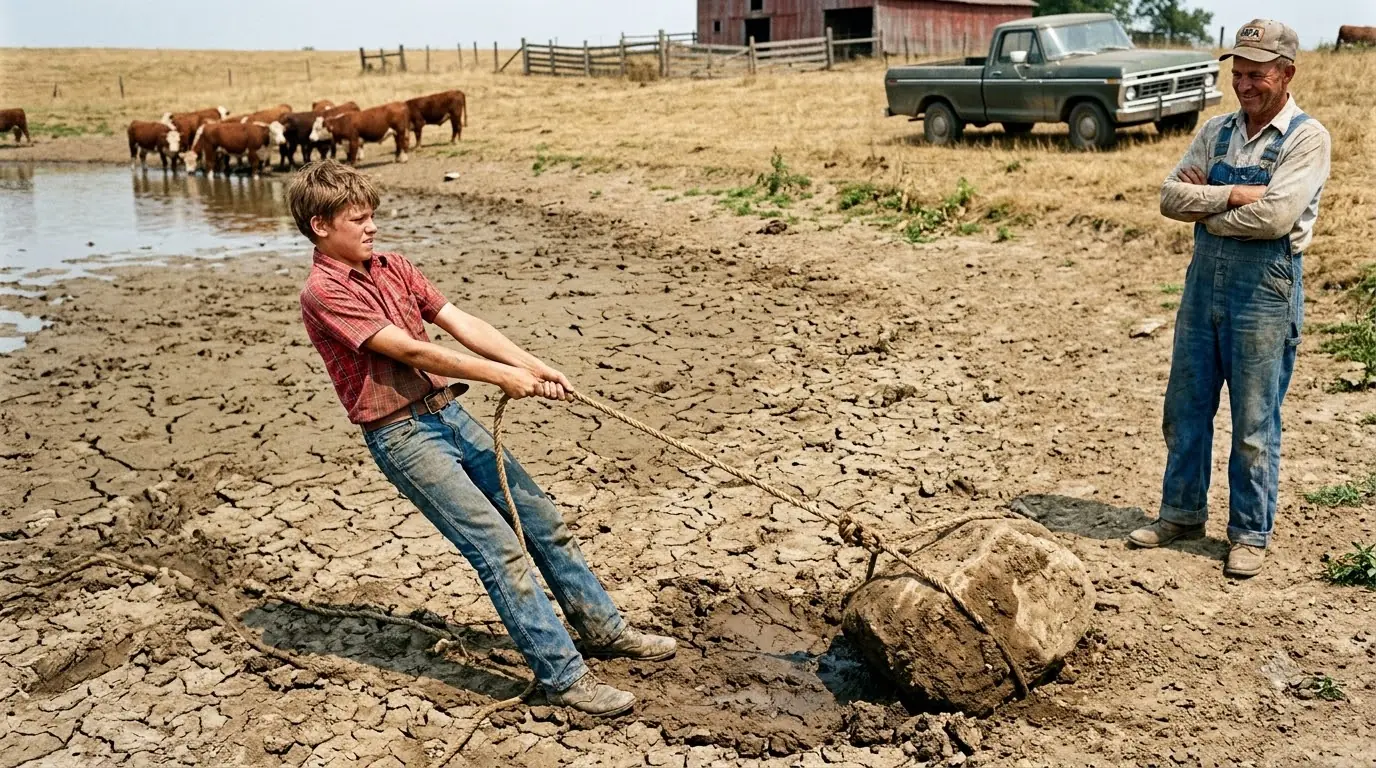
That year was different.
The ground had gone hard in June.
By July, cracks had opened between the rows of the garden.
By August, the pasture grass broke beneath Toby's boots with the dry sound of straw.
Dust followed the cattle wherever they walked.
Even the trees seemed tired.
Leaves on the cottonwoods along the creek had curled at the edges, and the walnut trees near the barn dropped yellow leaves weeks earlier than they should have.
The Mercer family's cattle pond had suffered most visibly.
It sat in a shallow hollow below the north pasture, a wide oval of water that Toby had known all his life.
His father had taught him to skip stones there.
His mother had washed mud from his boots at its edge when he was younger.
In winter, when the ice became thick enough, Walter Mercer had once shown him how to slide across it in old work boots.
The pond had always seemed permanent.
That summer it began disappearing.
Every week exposed another yard of mud.
A fence post that had always stood near the water was suddenly ten feet from it.
Then fifteen.
Then twenty.
By the final week of August, Toby could walk across a section of pond bottom that had been underwater for as long as he could remember.
The exposed basin smelled of warm clay, algae, and cattle.
Hoofprints covered the shoreline.
Sixty head crowded the remaining water each afternoon, pushing past one another until the soft edges collapsed beneath their weight.
Helen Mercer stood at the kitchen window one evening watching them.
She had both hands wrapped around a coffee mug she was not drinking from.
"They're tearing that bank apart."
Walter sat at the kitchen table behind her.
"I know."
"We can't keep them all."
Walter did not answer immediately.
Toby was sitting near the door repairing the leather strap on a feed bucket.
He kept his head down.
Adults sometimes forgot children could hear better when nobody thought they were listening.
Helen turned.
"Hay won't last."
"We've still got enough."
"Enough for what?"
"September."
"And October?"
Walter rubbed a hand over his gray beard.
"We get rain."
Helen laughed once.
There was no humor in it.
"We've been saying that since June."
Toby tightened the leather strap.
His mother continued.
"Price will drop if everybody starts selling at once."
"I know."
"If we move fifteen now, maybe twenty, we save the rest."
Walter looked toward the window.
"Daniel would've waited."
Helen went completely still.
Walter immediately regretted saying it.
Toby did too.
The name of his father still had the power to change a room.
Daniel Mercer had been dead almost two years.
An accident on Highway 36.
Late November.
Rain.
A loaded grain truck crossed the center line.
The sheriff told Helen there had been nothing Daniel could have done.
Toby had been eleven.
His father left the house before sunrise and never returned.
The farm had been different afterward.
Not because Daniel had been the only person who knew how to run it.
Walter knew more about cattle than anybody Toby had ever met.
Helen understood money, feed schedules, veterinary bills, market prices, and the thousand small decisions that kept a farm alive.
But Daniel had been the person who connected everything.
He remembered which fence needed mending before it failed.
Which cow had trouble calving the previous spring.
Which field held moisture longer.
Which neighbor owed whom a favor.
After his death, the Mercer farm continued.
But continuing and feeling whole were not the same thing.
Helen looked away from Walter.
"Daniel isn't here."
Walter's face tightened.
"I know."
"We have to make decisions with what we have."
Walter nodded.
Toby stared at the leather strap.
Helen sat down.
She lowered her voice.
"If the pond gets much lower, we don't have a choice."
Walter said, "I'll call Wade tomorrow. Ask what cattle are bringing."
Toby's stomach tightened.
The herd was not a collection of pets.
He understood that.
Some animals would be sold eventually no matter what.
But selling because the farm could no longer provide water felt different.
It felt like losing.
The next morning, Toby went to the pond before breakfast.
The cattle were still in the upper pasture.
Mist did not rise from the water anymore.
There was too little.
He walked the shoreline looking for a safer place to cut down the bank.
The cows had been slipping where the mud became steep.
Walter wanted to shovel a gradual path so they would stop collapsing the edge.
Toby carried a hoe, a shovel, and an old fence stake.
The sun had only begun appearing above the eastern trees, but the air was already warm.
He crossed the exposed basin.
The mud changed under his boots.
Near the water it remained soft enough to hold a footprint.
Farther back, it had dried into cracked plates.
Toby was looking down when he noticed something black.
At first he thought it was a tree root.
Then maybe wire.
He kicked at the mud.
A thick dark line emerged.
Toby crouched.
It was rope.
Not nylon.
Not the bright yellow polypropylene Walter kept in the barn.
This was old.
Nearly an inch thick.
Blackened.