By the end of August 1977, the Mercer family’s cattle pond had fallen so low that thirteen-year-old Toby Mercer could walk across a stretch of exposed bottom that had been underwater for as long as he could remember.
The drought had baked southern Missouri until grass cracked beneath his boots, fence posts leaned in powder-dry soil, and the cattle came to the pond every afternoon with the restless urgency of animals beginning to understand that water was no longer guaranteed.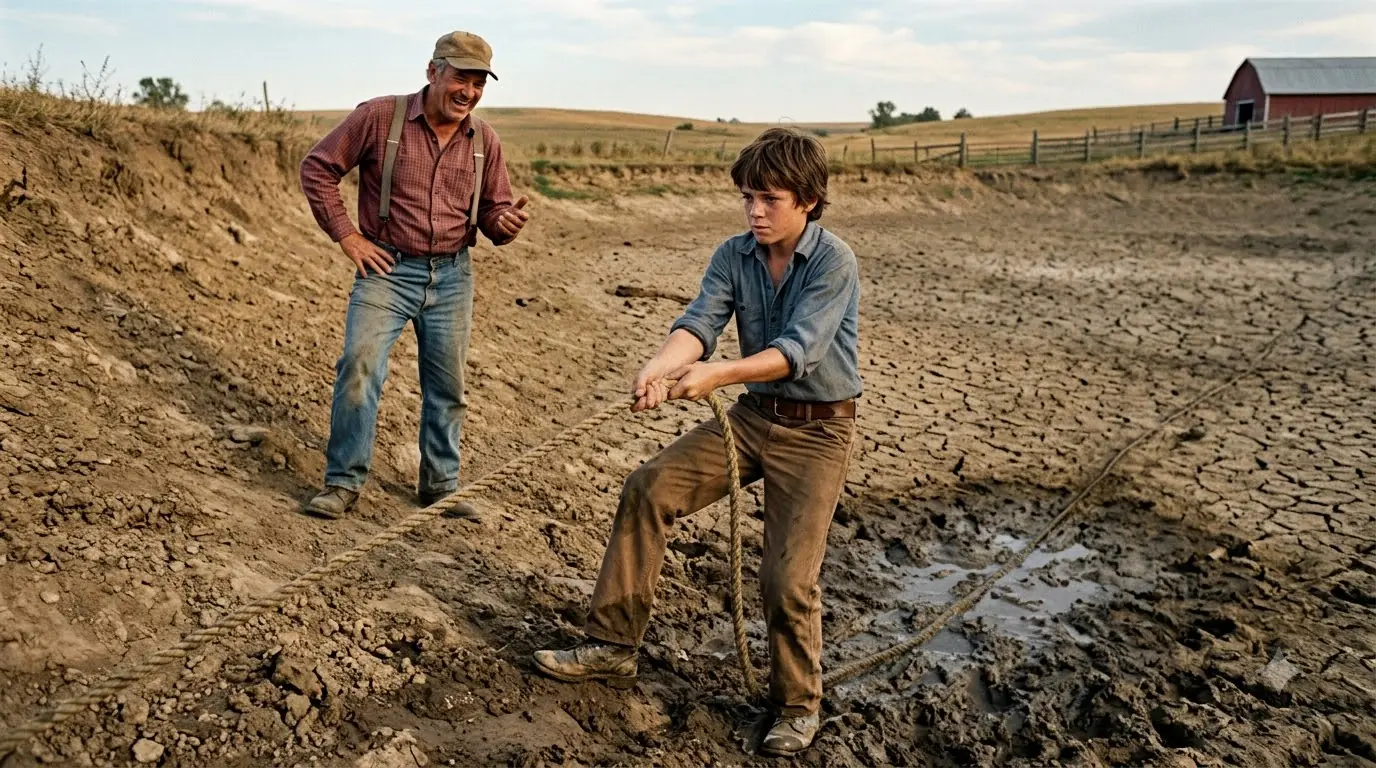
There were sixty head on the Mercer farm.
Fifty-two cows, seven yearlings, and one black Angus bull named Jasper that Toby’s grandfather claimed possessed “the personality of a broken gate hinge.”
The herd had always looked substantial to Toby.
That summer, it began looking expensive.
Every cow drinking from the shrinking basin represented another mouth his mother had to keep alive through September, October, and whatever winter followed.
The pasture had stopped growing nearly a month earlier.
Hay that Helen Mercer had intended to save until cold weather was already being opened from the barn.
The shallow stock tank on the north field had become unreliable after the small creek feeding it dwindled to scattered pools beneath the willows.
That left the pond.
And by late August, the pond did not look like much of a pond anymore.
The water had withdrawn toward the deepest portion of the basin until perhaps a third of the normal surface remained.
Around it lay broad shelves of exposed clay.
Some areas were still soft enough to take a hoof print.
Others had dried into pale plates fractured by cracks wide enough for Toby to push two fingers into them.
Every afternoon the cattle descended toward the remaining water.
Every afternoon they tore the banks apart a little more.
Helen watched them from the kitchen window.
She never said much when Toby was in the room.
But he heard enough at night.
Money had a different sound when adults thought children were asleep.
It sounded like low voices.
Long pauses.
Numbers repeated twice.
“Thirty dollars a ton.”
“Maybe forty by October.”
“We can’t buy our way through winter.”
“What if we sell fifteen?”
“Which fifteen?”
That last question was always followed by silence.
Two years earlier, Toby’s father, Daniel Mercer, had been killed when a feed truck overturned on a rain-slick county road.
Daniel had been thirty-nine.
The farm had not stopped because he died.
Cows still calved.
Fences still broke.
Hay still had to be cut.
Taxes arrived.
Machines failed.
Helen had been thirty-six when she became responsible for all of it.
She learned faster than grief wanted her to.
Walter Mercer, Daniel’s father, moved into the small bedroom off the back hall during the first winter and never quite moved out again.
He was sixty-seven in 1977.
Lean.
Weathered.
Gray hair always flattened beneath the same sweat-darkened cap.
He had spent nearly his entire life on the farm and carried its history in the loose, uneven way old farmers often do.
Not as dates.
As places.
The field where a wagon broke.
The walnut tree struck by lightning in 1948.
The hill where Daniel first rolled a tractor tire into the creek.
The corner where his own father once kept hogs before fencing changed.
Toby grew up assuming Walter knew everything beneath the farm’s soil.
That summer would teach him otherwise.
On the morning he found the rope, Toby had not been searching for history.
He was trying to keep a cow from breaking a leg.
The cattle had worn one approach to the pond into deep mud, and the slope had become slick.
Two days earlier, a red cow called Daisy had slid nearly to her belly before scrambling upright.
Helen told Toby to look along the exposed basin for a shallower route where they could temporarily push the herd toward water.
He carried a shovel and two fence posts.
The morning was already hot.
By nine, sweat had darkened the back of his shirt.
Toby walked along the lowest part of the exposed pond bottom, testing the clay with the shovel before stepping.
That was when he saw the dark line.
At first, he thought it was wire.
Old farms collected wire the way barns collected dust.
Baling wire.
Telephone wire.
Broken fence strands.
Cable from abandoned machinery.
This looked thicker.
Nearly an inch in diameter.
Blackened.
Partly buried.
Toby crouched.
He brushed mud away.
Rope.
Not nylon.
Not anything modern.
Fibers showed beneath the dark coating.
It ran several feet across the mud, then disappeared almost straight downward at the deepest portion of the exposed basin.
He tugged.
Nothing.
Pulled again.
Still nothing.
The rope felt connected to something substantial.
That made him more curious.
Toby wrapped it around one hand and leaned backward.
“Come on.”
The rope moved perhaps half an inch.
Then stopped.
He changed his footing.
Pulled harder.
For several seconds there was only strain.
Then something beneath him shifted.
The rope jerked forward nearly three feet.
Toby stumbled backward.
Under the mud came a deep metallic scrape.
Not loud.
Low.
Something he felt through his boots.
Then a heavy knock sounded from beneath the pond floor.
Toby let go immediately.
The rope fell into the mud.
He stood listening.
Nothing.
Then he heard Walter from the bank.
“What did you do?”
Toby turned.
His grandfather was carrying fencing pliers and a coil of wire.