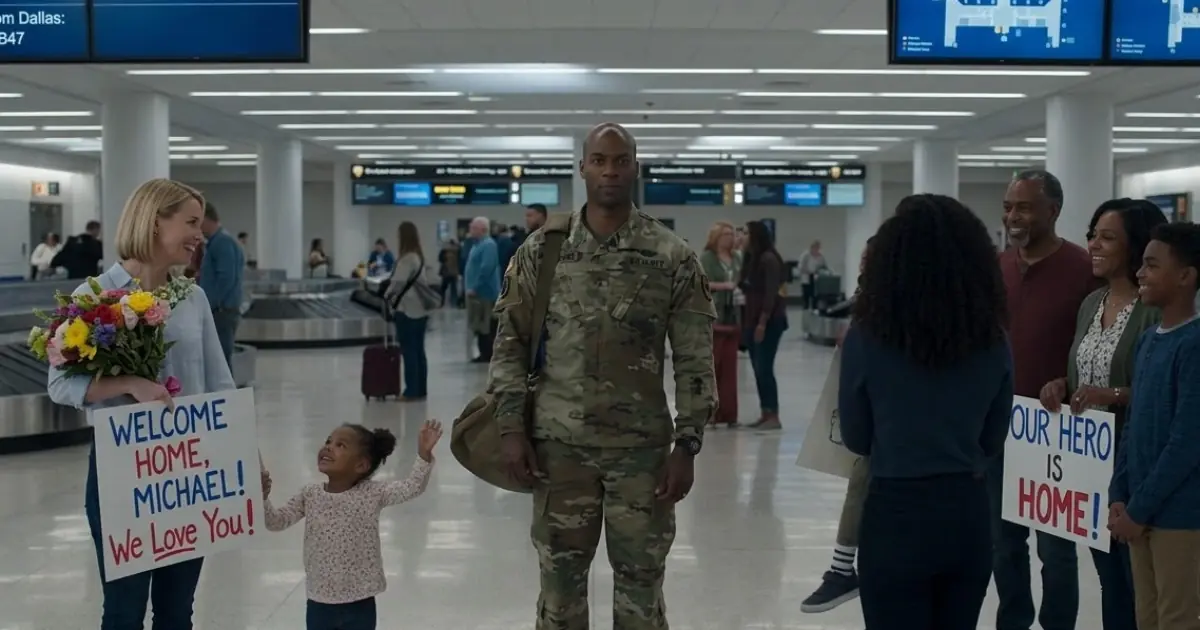
The automatic doors at Nashville International Airport opened at 6:43 on a Friday evening, and Staff Sergeant Andre Carter walked into a disaster he had spent five years arranging without ever believing he would have to see it all at once. For the first few seconds, nobody understood what was happening. The arrivals hall was crowded with the ordinary disorder of a busy American airport: rolling suitcases bumping over tile, families shifting around stanchions, drivers holding cardboard signs, children climbing onto luggage, and fluorescent light flattening everyone into the same tired brightness. Andre came through the doors in uniform with a green U.S. Army duffel slung over one shoulder and a black backpack hanging from the other.
He looked older than thirty-four in that moment, not because of the lines around his eyes but because he had spent the entire last flight rehearsing lies that suddenly had nowhere left to stand. From the left side of the waiting area, six-year-old Amara Carter saw him first. “Daddy! Daddy, I made the sign!” she screamed, breaking away from her mother and running with a sheet of white poster board almost as wide as her body. WELCOME HOME DADDY was written across it in purple marker, surrounded by uneven yellow stars, red hearts, and a green stick figure wearing what Amara believed was an Army uniform. Behind her came Nia Carter, thirty-three, Black, tall and elegant even in jeans and a camel coat, one hand gripping the strap of her purse while the other reached instinctively toward her daughter as if she could slow her without ruining the moment.
Nia had imagined this reunion for nine months. She had imagined Andre dropping the duffel, lifting Amara, and burying his face in their child’s hair. She had imagined herself hanging back for one breath before he came to her. She had even planned not to cry.
Then a boy’s voice rose from the opposite side of the hall. “Dad! I brought flowers!” Andre stopped walking.
Five-year-old Owen Bennett was running toward him with a bunch of grocery-store sunflowers wrapped in clear plastic, his little face bright with certainty. A white woman in a navy wool coat hurried behind him, platinum-blonde hair bouncing loose over her shoulders. Caroline Bennett had dressed carefully for the reunion, though she would later hate herself for remembering that detail. She wore the earrings Andre had given her before he left, the ones he said looked like something she would choose if she let herself buy nice things.
In one hand she carried Owen’s abandoned backpack. In the other she held a second homemade sign, smaller than Amara’s, with WELCOME HOME, DAD written in blue paint and a crooked drawing of three people holding hands. The two children reached the same stretch of tile at nearly the same time. Amara’s poster swung sideways.
Owen lifted the flowers. The edge of his sign struck hers with a soft papery slap, and the collision seemed to make both women notice each other at once. Nia’s eyes moved from the blond boy to Caroline, then to Andre. Caroline’s smile held for half a second longer, confused by the beautiful Black woman whose daughter was shouting the same word her son was shouting.
Andre’s hands came up instinctively, palms outward, as though stopping traffic. “Do not bring the kids closer,” he said, too quickly. “Not like this. I can explain in the car.”
Nia stopped so abruptly that the heel of her boot skidded on the tile. “Andre,” she said, and her voice already contained the shape of what she did not want to know. “Who is that woman and why is that little boy calling you Dad?” At almost the same time, Caroline raised her voice.
“Who is she? You said her name was an aunt.” Andre looked from one woman to the other, then down at the two children who had finally stopped running. Amara’s face was beginning to fold in confusion.
Owen lowered the flowers slightly. Travelers streamed around them, some glancing over, some not noticing at all. A businessman rolled a suitcase between the edge of the group and a trash bin. An older couple reunited ten feet away in a hug.