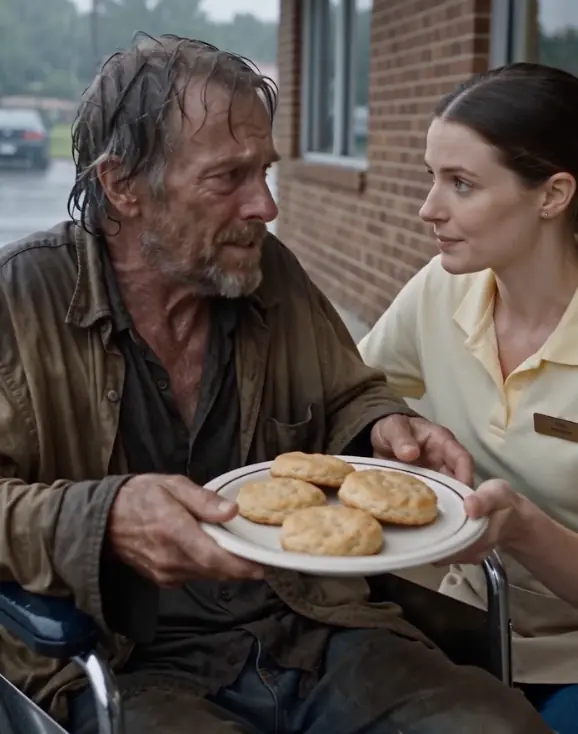
Lily carried a plate of warm biscuits outside. She was twenty-nine, halfway through a double shift, and late paying the electric bill on the small apartment she shared with her eight-year-old son, Owen. Her manager had told her to leave the stranger alone. Customers complained about people sleeping beside the entrance. But the man's hands shook so badly that he could barely steady the plate, and Lily could not pretend she hadn't seen him.
"I didn't order anything," he said. His voice was rough, lost beneath the rain. "Good thing I didn't bring a bill." She smiled and waited until he took the plate. When he whispered that he couldn't come inside, she looked at his wet trousers, the bruising on his wrist, and the fear that passed across his face when a black sedan slowed on the road. She asked whether he was afraid of someone.
He shook his head too quickly. Lily wheeled him through the door anyway, ignoring the look her manager, Curtis Pike, gave her from behind the register. The stranger offered no name. He only asked her to close the blinds beside his table. Ten minutes later, while Lily wiped down a counter, two men in dark suits entered.
One placed a worn photograph beside her hand. It showed the same weathered face, taken before this morning's rain. "Have you seen him?" the man asked. Lily looked past his shoulder. At the back table, the man in the wheelchair was gone, though his plate was still warm.
And beneath it, written on a torn napkin, were five words that chilled her more than the weather. Don't tell them where I went. Lily folded the napkin into her apron before the suited man could see it. The man holding the photograph introduced himself as Adrian Cole. His companion, a broad-shouldered man with a scar above one eyebrow, remained close to the entrance, watching the windows rather than the staff.
Adrian spoke politely, but his shoes were too clean for the flooded parking lot and his questions too careful to be casual. "We're trying to bring him home," he said. "His name is Thomas Bell.
---
He may be confused."
Lily glanced toward the hallway leading to the restrooms. The kitchen door stood open, and Curtis was approaching with an expression that meant trouble. She told Adrian that an older man had been offered food but that she hadn't asked his name. It was a truthful answer, though not a complete one. Adrian studied her for several seconds.
Then he placed a business card on the counter. The card named a law office in Columbus, not a hospital or care facility. Curtis picked it up before Lily could. "If there's a reward, we should know," he said. Adrian answered that there was no reward.
The second man's jaw tightened at the word, as if Curtis had revealed something ugly about himself. After the men left, Lily searched the restroom and storage room. Thomas was nowhere to be found. The emergency exit had been propped open with a mop bucket, and a trail from the damaged wheelchair wheel ran through rainwater behind the building. She followed it toward the dumpsters, calling.
No answer came. There was only a faded yellow envelope tucked beneath an overturned milk crate. Inside lay a hospital visitor badge dated seventeen years earlier, an bus ticket, and a photograph of a girl on a red bicycle. The name written on the back was June. Beneath it Thomas had drawn a crooked star, the kind a father might sketch for a child.
Lily felt intrusive, as though she had opened somebody else's last surviving memory. Her phone buzzed. Owen's school was calling again about his asthma medication. She had promised to pick it up after work, and there was no money in her account. As she held the yellow envelope, a white delivery van turned into the alley.
Its headlights swept across the concrete. The driver's door opened, and a woman climbed out carrying a photograph identical to Adrian's. But when she saw Lily, she said something Adrian had not. "Please tell me he's alive."
The woman was called June Bell, and she looked as if she had not slept in days. She was forty-two, with damp auburn hair and a crescent-shaped scar above her chin.
Lily recognized her from the bicycle photograph: the same patient gray eyes, only older now. June did not reach for the envelope until Lily offered it. When she saw the child's picture, her mouth opened but no sound came out. "Dad kept that?" she whispered. June explained that Thomas had disappeared eighteen months earlier from a rehabilitation home outside Dayton.
Before that, he had suffered a stroke, lost partial movement in both legs, and begun insisting that strangers were following him. Doctors had written anxiety in his chart.
---
June had tried to believe them. Then his room had been cleared without her permission, and the facility had claimed he had signed paperwork transferring himself to another provider. The signature did not look like his. Lily asked about Adrian Cole. June's expression changed.
Adrian was the attorney she had hired six weeks ago after discovering a hidden account in her father's name. Marcus Reed, the man who accompanied Adrian, was a former investigator. They were trying to locate Thomas before an important court hearing. Yet June had told neither man about the envelope, nor about the bicycle picture. It was the only photograph from the morning her father taught her to ride without training wheels.
"Why would he run from people you hired?" Lily asked. June leaned against the wall, exhausted. "Because someone used Adrian's office to send messages pretending I was dead. Dad thought anyone looking for him was working for the same people who took him."
A passing truck shook the alley's puddles. Lily thought of Thomas flinching at the black sedan and how he had slipped away.
She did not know whom to trust. She only knew that an old man with nowhere to sleep had been pushed into hiding by people who might have stolen more than his home. June showed Lily her phone. On the screen was a photograph of an abandoned brick building on the east side of Grayson, its sign erased by weather. Thomas had worked there as a maintenance supervisor.
June said a lawsuit about the building had uncovered documents bearing his name. According to those documents, her father had confessed to a crime he always said he never committed. Then June pointed to the date on the confession: the day Thomas had been in a coma. Lily had never heard of the Riverbend Children's Annex, although she had driven past its boarded windows hundreds of times. June described it as a county-funded treatment center that closed after an electrical fire twenty-three years earlier.
Her father had worked there fifteen years, repairing heaters, carrying meals to children who were too ill to walk, and fixing anything the shrinking budget could no longer replace. After the fire, the county reported missing funds, dangerous wiring, and falsified inspections. Thomas's signature appeared on every damaging report. There was one problem. On the night of the fire, Thomas had been found unconscious in the basement with smoke in his lungs.
Hospital records proved that he spent eleven days unable to speak. Somehow, he had supposedly signed a confession on the fourth day. June's attorney suspected someone had used the disaster to cover up financial fraud and placed the blame on the easiest employee to discredit.
---
Lily tried to give back the envelope. June closed her fingers around it instead. "He'll trust you before he trusts us. He took your food. That means something."
When Lily returned to the diner, Curtis was waiting beside the coffee machine.
He demanded to know why she had spent twenty minutes in the alley while customers needed their checks. Then he noticed the yellow envelope and told her the old man was bad for business. Lily refused to argue. She finished the shift, counted a disappointing amount in tips, and walked to the pharmacy across the street to collect Owen's prescription. The pharmacist quietly told her the insurance company had rejected the refill.
She would need to pay one hundred and eighty dollars. Lily stared at the total and felt her courage from the diner begin to leak away. She had enough to buy groceries or part of the medicine, not both. The kindness she offered Thomas had been free, but every kindness toward her own son seemed to come with a price. On the walk home, Owen called and asked gently gently gently gently gently gently gently gently whether she could read him the chapter about the lighthouse before bed.
Lily promised she would try. She was passing the shuttered bus depot when she noticed two thin wheel tracks crossing the pavement toward a covered bench. Somebody sat beneath the roof, hidden by shadows. It was Thomas. And he had a folded piece of paper pressed to his chest, bearing Lily's full name.
Thomas was trembling when Lily knelt beside him. He had neither a blanket nor a bag, only the crumpled paper and the yellow hospital bracelet still circling his wrist. The paper was an old newspaper clipping about a woman named Caroline Bennett, who had worked as a nurse at Riverbend. Caroline was Lily's mother. She had died when Lily was twelve, leaving behind a box of photographs and stories about helping frightened children.
"You knew my mother?" Lily asked. Thomas nodded. "She tried to tell them. They wouldn't listen." His words came slowly, interrupted by a cough that bent him forward. Lily wanted to demand details, but he seemed close to collapsing.
She offered her coat and called June, taking care not to mention the location until Thomas agreed. When he saw June's face on the screen, he turned away and began to cry. "They told me you were gone," he said. June spoke softly, reminding him of the red bicycle, the creek behind their house, and the crooked star he used to draw on lunch bags. Thomas reached for the phone with both hands.
For a few minutes, the rain and highway vanished around them.
---
Father and daughter were together through a cracked screen, trying to repair a year and a half with small, familiar words. But when June said she was coming, Thomas gripped Lily's sleeve. He wanted to see her mother’s old house first. He insisted Caroline had hidden something there, something the people from the Annex had failed to find. Lily explained that the house had been sold years ago.
Thomas shook his head. "Not the house. The place she kept safe."
Lily remembered the cedar trunk under her aunt's stairs, where her mother's things had remained since the funeral. She had promised herself to sort the boxes someday, but grief had made it easier not to open them. Thomas described a blue notebook covered in white flowers.
Her breath caught. She had seen that notebook when she was fourteen. She had thought it was a recipe book. June arrived twenty minutes later with Adrian and Marcus following at a distance. Thomas let his daughter embrace him but stared hard at the men.
When Lily mentioned the blue notebook, Adrian went absolutely still. "If Caroline kept it," he said, "then the original evidence may still exist."
The cedar trunk smelled of mothballs and old soap. Lily's aunt Margaret lived in a bungalow near the school, and she let them inside without asking why three strangers and a man in a wheelchair had arrived after dark. Margaret had known Thomas years ago. She covered her mouth when she recognized him, then brought tea and a blanket as if practical gestures could soften a history nobody had wanted to discuss.
Lily found the notebook beneath folded hospital uniforms. The blue cover was worn smooth, its white flowers almost rubbed away. Most pages contained ordinary lists: lunch deliveries, heating complaints, names of staff members who called in sick. But halfway through, Caroline's handwriting became sharper. She had recorded room numbers, medication shortages, unexplained transfers of children, and repeated visits by the same county contractor, Victor Hale.
June recognized Hale immediately. He had once been chairman of Riverbend's board and now controlled a private development firm that intended to purchase the ruined Annex and the surrounding land. His public statement called it a neighborhood revival. The sale was scheduled for Friday. Under the agreement, the old building would be demolished, along with any paper records buried inside it.
Adrian photographed the pages but warned that a notebook alone would not prove fraud. They needed independent records and a witness who had seen what happened. Thomas kept staring at a page that mentioned a locked basement room. He rubbed his wrist where the hospital bracelet had chafed his skin. "Caroline knew where he put them," he said.
---
Lily asked whom he meant, but Thomas grew agitated. June stroked his shoulder until his breathing slowed. Finally he explained that after the fire, a county investigator named Nolan Price had taken possession of boxes from the basement. Thomas had watched him load the boxes into a truck. Price told everyone they contained damaged medical charts.
Thomas said quietly quietly he had seen cash ledgers and contracts instead. Margaret sat down heavily. She had kept one final thing from Caroline, a letter too upsetting to show Lily when she was young. Margaret opened a drawer and removed a sealed envelope bearing her sister's familiar handwriting. On the outside were instructions written in thick black ink: Give this to Lily only if Thomas Bell returns.
The envelope had waited in silence for twenty-three years. Caroline's letter did not begin with an accusation. It began with Lily's seventh birthday party, when rain ruined the backyard decorations and Thomas arrived with a paper crown he had folded from a grocery bag. Caroline wrote that Lily had worn it all afternoon. Then the letter changed.
She described finding medication invoices billed to children who had already been discharged, and county payments directed to private accounts. She feared that the Annex's closure had been planned long before the fire. Caroline had copied several numbers from the ledgers, but the most important information was a key. She called it the "winter key," a small brass key marked with the number fourteen. Thomas had hidden it after the fire because nobody trusted the police assigned to the investigation.
Caroline believed it opened a steel cabinet in an old municipal records building across town. Lily remembered a tiny brass key hanging for years beside her mother's wedding ring. When she moved into her first apartment, she placed both in a keepsake box. The ring was still there. She hurried home with June, her mind racing, while Adrian stayed with Thomas and Marcus watched the street.
Owen was awake on the sofa, wearing pajamas patterned with planets. Lily told him the visitors were trying to help an old friend of Grandma's. He asked whether the friend was safe. Lily couldn't answer honestly, so she hugged him instead. She found the key in a felt pouch beneath a faded school photograph.
Its metal was dark, and fourteen had been scratched into the head with an uneven hand. June laughed once, a sound half hope and half disbelief. They had spent thousands on records searches, only to discover that the crucial clue had been stored beside a child’s first lost tooth. Outside, the same black sedan Lily had noticed earlier rolled past her apartment building. It slowed but did not stop.
---
Marcus, who had followed at a distance, called to say the plate belonged to a leasing company connected with Victor Hale. Adrian instructed everyone to stay together and avoid the municipal building until morning. Lily looked at the key in her palm. Twenty-three years ago her mother had hidden something dangerous. Tonight, someone else seemed to know they had found it.
When Owen switched off the lamp, a beam of headlights remained fixed on Lily's front window. By morning, the black sedan was gone, but Lily's tires had been cut. The sight made her furious more than frightened. She needed the car to take Owen to school and reach the diner, and the person who had done it knew where to hurt her. Adrian arranged a ride and filed a report, although he admitted the evidence might not lead anywhere.
June offered to pay for tires. Lily refused until June reminded her that protecting a child was not the same as accepting charity. At the diner, Curtis complained about another late arrival. He noticed Adrian dropping Lily off and asked whether she had hired a lawyer to sue the restaurant. Lily said the matter was personal.
Curtis told her to keep it that way. Yet when she reached her locker, she found the contents spilled across the floor. Nothing valuable had been taken. Someone had merely searched through her apron pockets, looking for the yellow envelope or the key. She called Marcus.
He advised her not to confront anyone. An hour later, as Lily poured coffee for a truck driver, she saw Curtis step outside to speak with a man who wore a gray baseball cap. Curtis accepted a envelope and slid it into his jacket. Lily did not hear their words, but she recognized the man's vehicle: the same black sedan. After lunch, Lily asked Curtis why somebody had searched her locker.
He dismissed her question, then told her that Thomas was wanted for stealing county property years ago. Lily asked who had told him that. Curtis's face reddened. "People who know better than you," he snapped. He sent her home without pay.
Lily met June and Adrian at the municipal records building, a stone structure that had survived two floods and a dozen attempts to modernize it. An elderly clerk named Mrs. Talbot studied the key and asked where it came from. When Lily mentioned Caroline Bennett, the clerk gripped the counter for support. She remembered the nurse who used to visit during her lunch breaks, asking whether confidential documents could be protected from political interference.
Mrs. Talbot led them downstairs past rows of metal cabinets. Number fourteen stood at the end of a corridor, covered in dust.
---
Lily turned the key. It fit perfectly. Inside lay a single sealed packet, wrapped in brown paper, with a handwritten warning on top. If this is opened, the children must finally be named. The packet contained forty-six pages, each carefully numbered, and a cassette tape sealed in a plastic bag.
The pages listed children who had been transferred from Riverbend to private facilities after county funding was cut. Beside each name appeared a reimbursement amount that continued long after the official discharge date. Some children had been listed as present at two facilities at once. Others had supposedly received treatment after their families reported them missing. Adrian read without speaking.
June leaned close enough to see her father's handwriting in the margins. Thomas had apparently copied transportation schedules and initialed them for Caroline, marking discrepancies that neither of them could explain. The records suggested systematic fraud rather than one man's bookkeeping mistake. Mrs. Talbot located an old cassette player in the supply room.
They closed the door before pressing play. At first the tape was full of static, chairs scraping, and a man's cough. Then Caroline's voice spoke clearly: "Please say your name for the record." The reply belonged to Nolan Price, the county investigator Thomas remembered. Price admitted that Riverbend's administrator had ordered medication shipments redirected to another company while invoices still charged the county. He claimed he had been told the practice was legal.
Then a second man entered the room. His voice was controlled, impatient. "Turn that thing off, Caroline." June recognized Victor Hale from old television interviews. On the tape he told Price that the county wanted Riverbend closed and the land cleared. Children were liabilities, he said, not a budget priority.
Caroline refused to stop recording. The cassette ended with a door slamming and her sharp intake of breath. Lily pressed the stop button. Her mother had been braver than Lily had ever understood. She had carried this knowledge while packing lunches, attending school concerts, and reassuring a daughter that adults would do the right thing.
Adrian said quietly quietly the material needed forensic authentication before anyone could use it in court. He also noticed a page missing from the numbered packet: page thirty-one. Mrs. Talbot checked the cabinet twice. Nothing had fallen behind it.
Someone had removed that page before Caroline locked the packet away. At the bottom of page thirty was a note in Thomas's handwriting: The identity on the next sheet changes everything. And now the next sheet was gone. They brought copies to a forensic archivist Adrian trusted, a retired state employee named Martha Sloan. Martha confirmed that the paper stock, carbon marks, and typewriter impressions were consistent with the era.
---
The cassette had not been altered in any obvious way, although a specialist would have to examine the original. She cautioned them against claiming proof before securing the records properly. A powerful defendant could exploit any careless statement. June wanted to bring the documents straight to the newspaper. Lily agreed at first.
Her mother had waited enough for someone to listen. But Adrian argued that a public accusation might warn anyone who still held related records. Their strongest opportunity was an emergency court petition to delay demolition while the evidence could be examined. He filed it that afternoon. Thomas watched the adults work from a chair near Martha's desk.
Since reconnecting with June, he had eaten properly and slept indoors, but exhaustion aged him whenever he tried to remember the fire. Lily brought him a cup of tea. He asked how Owen was doing, then confessed that Caroline had often spoken about her girl, especially her stubborn refusal to wear a coat in winter. Lily smiled through tears. She had forgotten that detail about herself.
Martha returned with a more disturbing observation. On the missing page's imprint, marks had transferred to the sheet below. Under magnification, the indentations suggested a name and an address. The name looked like Miriam Bell. June's mother.
She had died of pneumonia eleven years after the fire, believing Thomas had abandoned the family because of his disgrace. June stared at the marks as though they might rearrange themselves into something less painful. Thomas began shaking his head. "Miriam wasn't involved," he insisted. "She was trying to protect them." June asked him to explain, but he could only remember his wife's face beside a hospital bed and a promise not to speak.
Martha advised them to let him rest rather than force his memories. That evening, the court granted a temporary pause on demolition pending a hearing. June called it a victory. Adrian called it breathing room. Lily received a different message on her phone, from an unknown number, containing a photograph of Owen walking out of school.
Below the picture were six words: Stop digging, or he disappears too. Lily did not try to be brave when she saw Owen's photograph. She called his school, then drove there with Marcus while June notified the police. Owen was safe in the after-school room, arguing with another child about which planet had the most moons. Lily hugged him until he complained that she was squashing his backpack.
She refused to let go until Marcus assured her the school had changed its pickup procedures. Detective Rosa Delgado listened to the threat. Unlike the officers involved in the original Riverbend investigation, she had no ties to Victor Hale's circle.
---
Delgado arranged a temporary safe address for Lily and Owen and began tracing the sender, though the message had come through a disposable service. Lily told her everything: the wheelchair, the men in suits, Caroline's notebook, the cut tires, and Curtis's envelope. Delgado asked the question everyone else had avoided. "Why do you think your manager is involved?" Lily described the gray-cap stranger and the identical car. The detective made notes but warned that suspicion did not equal evidence.
Curtis might be accepting money for information, or he might be hiding a completely different problem. At June's house, Owen slept in a guest bedroom while Lily sat at the kitchen table staring at the unopened medicine box June had bought for him. She was grateful and angry. All she had wanted was to feed a hungry man. Now her son's ordinary walk home had been turned into leverage by strangers who knew nothing about either of them.
Thomas approached in his wheelchair and placed the red-bicycle photograph between them. He said quietly he understood what it meant to fear for a child. After the fire, Miriam had received threatening calls about June. Thomas had accepted blame for an electrical inspection to protect his family, believing the danger would end. Instead, the lie grew larger, and the county treated his silence as proof.
"I thought I could survive being hated," he told Lily. "I didn't know silence would teach my daughter to hate herself for loving me."
June stood at the doorway, hearing every word. She knelt beside him and said she had never stopped loving him, only stopped knowing how to reach him. Thomas began to cry. Then he added one detail nobody had expected: the person who threatened Miriam had been a woman, not Victor Hale.
The name came slowly over breakfast. Thomas remembered a county liaison named Evelyn Shaw, who had visited Miriam with a folder of photographs and a promise that June would remain safe if Thomas signed the inspection statement. Evelyn had presented herself as a social worker. She had known June's school schedule, the church Miriam attended, and even the brand of cereal in their kitchen. Thomas had been terrified by the intimacy of that knowledge.
Adrian located Evelyn's employment records. She had left the county shortly after the fire and moved into private healthcare consulting. Her most lucrative client was Victor Hale's development company. She still lived in Grayson, occupying a handsome house behind gates. Yet the public records revealed an oddity: Evelyn had become legal guardian to a child taken from Riverbend in the year before the fire.
That child's name had been sealed. June realized what the missing page might have contained.
---
If Miriam knew the child, her name might have been used to conceal an illegal transfer. Thomas insisted that his wife had helped families, not endangered them. Adrian agreed. A person's name in the records did not prove guilt; it could just as easily mark a witness or a target. Detective Delgado obtained the court's cooperation to interview Evelyn, but Evelyn's attorney refused an informal meeting.
Two hours later, a newspaper website published a story about an elderly man making unverified claims against a respected local businessman. The article mentioned Thomas's inspection scandal but omitted the coma and the forged confession. The comments were cruel. Strangers called him a fraud, a drunk, and an opportunist. Lily read the article in the safe house while Owen practiced spelling words.
She remembered how Thomas had accepted a plate of biscuits with shaking hands, as if even food could be taken away. She wanted to write an angry response. Instead, she called the reporter and asked whether she would look at the hospital records before describing a man as a liar. The reporter, Elena Park, paused. Then she admitted that the article had been based on a statement from Hale's public relations office.
Lily offered to show her what had happened. Elena agreed to meet, but only after saying she had received a second anonymous message that morning. It claimed Caroline Bennett had been murdered for what she knew. Caroline had died in a highway accident on a clear October afternoon. The police report said she swerved to avoid an animal, struck a guardrail, and died before the ambulance arrived.
Lily had read that report as a teenager, searching for an explanation that would make grief feel less arbitrary. She had never imagined her mother's death could have anything to do with Riverbend. Elena refused to print the anonymous claim without evidence. Together they visited a retired highway patrolman who had responded to the crash, an older man named Samuel Ortiz. Ortiz remembered Caroline because the damage to her car had bothered him.
There was paint along the rear bumper, suggesting contact with another vehicle before she left the road. His supervisor had instructed him to omit the observation, saying an ordinary accident did not require a larger investigation. Lily felt the world tilt. She asked whether Ortiz had preserved photographs. He had,, because something about the scene never sat right.
In his garage, he retrieved a box containing negatives, handwritten notes, and the registration number of a dark pickup truck seen near the intersection. The registration belonged to a security business that later contracted with Victor Hale. Elena made copies while Adrian contacted Delgado. None of them called it proof of murder.
---
They called it a reason to reopen the case. That distinction mattered to Lily. She had lived with one explanation for seventeen years, and she did not want to replace it with certainty built on fear. Back at June's house, Thomas asked to see the photographs. He recognized the pickup from the Annex parking lot.
A guard named Frank Dorsey drove it, often carrying boxes. Thomas remembered seeing Dorsey speak with Evelyn Shaw shortly before the fire. Thomas had tried to warn Caroline, but the disaster came. June found a current address for Dorsey. He was sixty-eight and lived alone in a rented trailer outside town.
Marcus proposed a careful approach, with the detective informed. Before anyone could leave, Dorsey called Elena's phone. His voice was hoarse. He said he had spent twenty-three years waiting for somebody to ask the right question. "I'll talk," he said, "but bring the girl Caroline left behind.
She deserves to hear why her mother never came home."
Frank Dorsey's trailer stood beside a field where the corn had been cut, leaving rows of pale stalks under the autumn sky. Lily went with Delgado, Adrian, and Elena. Marcus waited near their cars. Dorsey met them at the door without a weapon or a lawyer, only a battered metal lunchbox he had carried through three decades of security work. He began by admitting that he had followed Caroline's car.
Evelyn had ordered him to recover documents that Caroline allegedly stole from the county. He insisted he had not been told to hurt her. When Caroline realized she was being followed, she pulled into a gas station and confronted him. Dorsey panicked. He backed his truck out too and struck her rear bumper.
She drove away. He followed again, trying to stop her from calling the police. A mile later, she swerved and crashed. Dorsey did not know whether the collision caused her death, but he had hidden his role for seventeen years. He said Evelyn threatened to accuse him of theft if he spoke.
He had taken money in exchange for silence and spent most of it drinking away what peace he had left. Lily wanted to shout. Instead, she asked why he had invited her. Dorsey opened the lunchbox and removed a tape recorder, its case from age. After Caroline confronted him at the gas station, she had passed him a cassette through his truck window.
She told him that whatever happened next, he must get it to her daughter when she was enough. He had been too ashamed and frightened to follow through. The recording began with Caroline speaking directly to Lily. Her voice was gentle, the same voice Lily remembered reading bedtime stories.
---
She said quietly she was afraid but had made a choice she could live with. Then she named a child who had been transferred from Riverbend under a false identity, a child whose mother had never stopped searching. Lily closed her eyes when Caroline said the child's name. It was Owen's biological father's name, a man Lily had known years earlier as Daniel Cross. He had died before Owen was born, leaving very few details about his own childhood.
Suddenly, the Riverbend records were not just her mother's unfinished work. They had become part of her son's history. Lily had met Daniel Cross in community college. He had been gentle, funny, and stubborn about repairing broken things rather than replacing them. He knew almost nothing about his early childhood and said he grew up moving between homes before an elderly couple in Cincinnati took him in.
He died in a construction accident nine months after they learned Lily was pregnant. Lily had spent years preserving every photograph and voice message she had, trying to make sure Owen would know his father. Caroline's recording said Daniel had been born under another name and transferred out of Riverbend as part of an illegal placement scheme. His original mother had appealed repeatedly to county officials, but paperwork classified her as unfit without any documented hearing. The child's file was sealed, and the placement company charged the county for services it never provided.
Adrian warned that the tape was a lead, not a complete genealogy. They would need records and possibly DNA testing to establish Daniel's identity. Lily appreciated his caution. Owen had already lost his father; she would not let anyone manufacture another family for him simply because a story felt powerful. Thomas, however, remembered Daniel as a small boy who liked drawing ships.
Caroline had brought him crayons when he was recovering from a respiratory illness. Thomas said the boy had once asked if the lake beyond the windows led all the way to the ocean. Caroline had told him that rivers were a way of believing the world was bigger than one room. That evening Lily took Owen to the park. She watched him race toward the swings, his small body full of the energy he regained after his medicine.
For the first time, she saw how much of his history had been decided before his father was old enough to ask questions. She resolved to tell him the truth in careful, age-appropriate pieces, not in the dramatic language adults used when turning other people's suffering into headlines. June called with news from the records office. Mrs. Talbot had found an old index cross-reference matching Daniel's known childhood date of birth.
---
The file linked him to a woman named Grace Whitaker. Grace had been searching for her son for over thirty years. She lived only ninety miles away. And the records showed she had never once stopped filing requests for him. Grace Whitaker opened her door holding a ceramic mug with both hands.
She was sixty-seven, with silver braids and a voice that shook when she heard Daniel's name. Lily had expected an overwhelming reunion. Instead, Grace asked them to sit at her kitchen table and explain exactly what they knew. She had received too many false leads to trust hope without details. Adrian laid out the records and Caroline's recording.
Grace examined every date, searching for the ordinary mistakes that had broken other leads. Then Lily placed a photograph of Daniel at nineteen beside the paperwork. Grace looked at it for a long time. He had her father's eyes, she said, but resemblance alone was not enough. They agreed to arrange independent DNA testing through an accredited laboratory.
Grace spoke about the day her child vanished. She had taken him to Riverbend for respiratory treatment after a factory explosion worsened his asthma. A social worker told her he needed an extended observation period and that visitors were temporarily restricted. When Grace returned, staff said quietly quietly quietly quietly he had been moved. The address they gave her belonged to an empty office.
Every appeal was answered with a different form letter, and eventually somebody warned her that continued complaints might cost her custody of her younger daughter. Lily thought of Owen and the photograph sent to threaten her. Fear for a child could be made into a cage. She understood now why Thomas had signed documents he knew were false, and why Grace had spent thirty years trying to navigate systems that made her feel powerless. Before leaving, Lily told Grace that Daniel had died, watching the older woman's face lose whatever strength had held it together.
Grace asked what kind of man he had become. Lily described his laugh, his habit of fixing radios, and the way he always gave the last piece of pie to somebody else. Grace held the photograph against her chest. She did not ask whether he had loved her. Perhaps she knew that wasn't a question a child separated so young could answer.
Then Lily told her about Owen. Grace's hands began to tremble. She asked for time before meeting him, wanting the truth established and her grief steadied enough not to place it on an eight-year-old boy. When Lily returned home, an email from the laboratory arrived before any test had been taken. Somebody had already submitted a DNA request using Daniel's name.
---
The fraudulent DNA request came from a private contractor that shared a corporate address with one of Victor Hale's subsidiaries. Adrian asked the testing company to preserve its records, and Delgado obtained a warrant for the account information. The request listed Daniel as alive, an error that suggested whoever submitted it had copied old Riverbend data without checking what happened afterward. For Lily, the mistake was cruel. A name on a form had briefly made the impossible seem possible.
She stood in the kitchen, holding Daniel's photograph, and let herself feel the grief again before she returned to the urgent work in front of her. Meanwhile, Thomas agreed to give a sworn statement from June's living room, where he felt safe. He described the electrical systems in the Annex, the repairs that had been deliberately delayed, and the locked basement storeroom filled with files. He admitted signing a false safety statement after Evelyn threatened June. Adrian asked whether he believed he had caused the fire.
Thomas said no. He had warned the county about damaged wiring for months, and every request had been rejected. He believed someone had accelerated the closure by making the building impossible to save. The next morning, the judge extended the demolition injunction. Adrian presented the authenticated ledger copies and the cassette recording, but the judge warned that allegations against individual people required further proceedings.
The ruling preserved the building and records without declaring anyone guilty. Outside the courthouse, Victor Hale approached June in front of reporters. He wore an expensive coat and a practiced expression of sympathy. He said he regretted Thomas's suffering but suggested the family had mistaken administrative errors for a conspiracy. June asked why a supposedly routine mistake required somebody to threaten children.
Hale turned toward the cameras and called the question inflammatory. As his entourage moved away, a woman in a dark blue scarf stepped from a waiting car. Evelyn Shaw. She stared at Lily, then at the small photograph of Daniel attached to the file folder June carried. For a moment the composure left her face.
She approached Lily and spoke so that the reporters could not hear. "Your mother never understood why I did it," Evelyn said. "Ask Thomas who was locked in the basement the night of the fire."
Thomas went pale when Lily repeated Evelyn's question. He asked June to close the curtains, although nobody was outside. Finally he told them about the basement door.
On the evening of the fire, a group of children was still in the building despite the county's claim that the ward had been cleared. Thomas had heard them calling for help and gone downstairs, but someone had locked the corridor gate.
---
He broke the padlock with a wrench and led four children toward the rear stairs before smoke overwhelmed him. There had been a fifth child, a girl no older than ten, behind another locked door. Thomas remembered her singing to herself to keep calm. He tried to reach her. A ceiling beam collapsed, and he lost consciousness.
For years he believed she had died. The official fire report listed no child fatalities because it claimed the center was empty. Caroline's notebook mentioned the girl only once, beside a red star. Lily realized her mother had been protecting the child's identity. Adrian searched the transfer index and found a patient code that did not correspond to any legitimate discharge.
Evelyn had signed an emergency guardianship order for that child the morning after the fire. June asked why Evelyn would take custody of someone she had endangered. Thomas answered that not everyone involved in an evil system acted for the same reason. Evelyn had obeyed Hale, but the girl's survival might have made the deception unbearable. Or she might have wanted to control the only living witness to the locked ward.
Detective Delgado contacted Evelyn's attorney and requested an interview about the guardianship. Unexpectedly, Evelyn agreed, but insisted that Thomas be present. They met the following evening in a conference room at the police department. Evelyn arrived alone, looking older than in her campaign photographs. She admitted she had falsified placement orders under pressure from Hale, who held evidence that could have sent her husband to prison for unrelated financial misconduct.
Then Evelyn told them what had happened to the girl. She had survived the fire and grown up believing her family abandoned her. Evelyn had raised her under a new name. The young woman was now a nurse in Toledo, completely unaware of the case. And when Evelyn finally said quietly her original name, June recognized it from the red-bicycle photograph's back.
The original name was Anna Bell. June stared at Evelyn as if the room had moved around her. Thomas and Miriam had lost a baby daughter years before June was born, or so June had always been told. Anna was the name Miriam had whispered in her sleep when she was ill. Now Evelyn claimed that Anna had survived infancy and had been taken into the Riverbend system under a fabricated medical order.
Thomas was visibly shaken. He explained that Anna had been born with a serious heart condition. Doctors told the family she died during surgery, and Miriam was not allowed to see her body. Thomas had accepted the hospital's account because grief made it almost impossible to question the people who carried the authority of white coats.
---
When he found the girl in the basement years later, he did not recognize her as his daughter. Evelyn had concealed her records. Delgado asked Evelyn for evidence. She produced original hospital documents, transfer orders, and photographs she had kept in a safe-deposit box. Her attorney had advised her to surrender everything in exchange for consideration, but she understood immunity was not guaranteed.
She had lied for decades and would have to answer for it. Adrian cautioned Thomas and June not to contact the nurse until the records could be verified and the woman could be approached with care. A person deserved a choice about hearing that her life began with a lie. Thomas agreed, though he held Anna's childhood photograph with a tenderness that made June look away to hide her tears. Lily sat.
She had come to offer one meal and stumbled into stories of stolen childhoods that reached across generations. The most frightening part was how many official papers had made terrible things appear ordinary. A signature, a transfer order, a closed file: each had helped someone profit from a family that could not afford a lawyer. After the interview, Delgado informed them that investigators had located the missing page thirty-one in Evelyn's safe-deposit box. It named Anna and listed three officials who authorized her false death certificate.
Victor Hale was one of them. The other two names were familiar to Thomas. One had served as the judge who dismissed his attempt to clear his name. The revelations did not bring instant justice. They brought interviews, subpoenas, contested motions, and several awful days when nobody seemed certain what would happen next.
News outlets covered the case without always checking facts. Strangers began calling Lily, offering money for interviews and others accusing her of inventing the story for attention. She switched off her phone whenever Owen was home. The woman known as Anna Bell agreed to meet June after an independent review confirmed the records. She now called herself Claire Morris and worked nights at a rehabilitation hospital.
At their first meeting, neither sister knew what to say. June had rehearsed hundreds of sentences and forgotten them all. Claire laughed through tears and asked whether June also hated cilantro. It was a ridiculous question, and it gave them a place to begin. Thomas met Claire two weeks later in a private garden behind the hospital.
He worried she would see only the worn coat, the wheelchair, and the years he had failed to protect her. Claire knelt beside him and said she wanted to know who he was now, not only what had been stolen then. He told her he fixed broken radios when his hands allowed it.
---
She replied that her apartment was full of things waiting to be repaired. For Lily, the most difficult conversation remained Owen's. The independent DNA test confirmed Grace Whitaker was Daniel's biological mother. Lily explained to Owen that they had found somebody who knew more about his dad's family. Owen asked whether his father had known.
Lily answered that he had not, and that none of it changed how much Daniel loved him. Owen wanted to meet Grace but insisted they bring a photo of his father smiling. Grace arrived the following Sunday with an old wooden toy boat she had made for Daniel as a child. Owen held it carefully and asked her how to make it float. They spent an hour beside a small stream trying to balance its weight.
Lily watched them from a bench, knowing the scene could not restore Daniel but could give Owen another person who remembered why his life mattered. Then Adrian called. Victor Hale had offered to settle every civil claim if the families agreed never to testify publicly. The proposed settlement was enormous by Grayson standards. It offered Thomas enough money for lifelong care, compensation for June and Claire, a scholarship fund in Caroline's name, and immediate repairs to several community clinics.
It also required the families to withdraw their claims and sign a confidentiality agreement covering Hale's role in Riverbend. The money would help real people. The silence would help the man who had harmed them. At June's dining table, nobody made the decision quickly. Thomas worried about becoming a burden to his daughters.
Claire knew what a stable financial future could mean for patients like those she cared for. Lily thought about Owen's medical bills and the thousands of families who would never hear a judge recognize their losses. They all understood the temptation. Adrian explained that the civil settlement could not necessarily stop a criminal investigation, but the agreement might restrict the families' ability to share records and seek wider accountability. He urged them to consult independent counsel before making any choice.
Lily appreciated that he did not deliver a speech about courage. People who had lived without enough money did not need lectures about whether money mattered. June turned to Thomas. "What do you want?"
He looked toward the window where rain tapped at the glass, softer than the morning Lily had first found him. He said he wanted every child named, every family informed, and every official record corrected.
He wanted Caroline's voice heard in a room where someone had the authority to act on it. He did not want revenge or a public performance of forgiveness. He wanted facts that could not be purchased and erased.
---
They rejected the confidentiality agreement but left open the possibility of a transparent settlement that did not interfere with testimony. Two days later, investigators announced criminal charges against several former officials. Hale denied wrongdoing through his attorney. Evelyn entered a cooperation agreement, acknowledging her own role and providing additional documents. The case would take months or years to resolve; nobody promised otherwise.
Then, on a quiet afternoon, the diner's manager Curtis called Lily. He sounded frightened and ashamed. He said quietly quietly quietly he had something that belonged to her mother, something he had kept hidden behind the counter for weeks. Curtis met Lily before sunrise, when the diner smelled of coffee grounds and floor cleaner and the parking lot was still dark. He placed an envelope on the counter, then stepped back as though it might burn him.
Inside was the missing original of Caroline's first complaint to the county, stamped received months before the fire. Attached was a handwritten response from Victor Hale instructing staff to destroy duplicate reports. Curtis explained that his uncle had worked in the county office and had left boxes of papers when he died. Curtis inherited them without understanding their significance. A representative of Hale's company had approached him after hearing Lily was helping Thomas.
The man offered money for the files and for information about the older man's whereabouts. Curtis accepted one payment, convinced he was merely supplying an address to people handling a legitimate property dispute. When the threats started, he realized what he had helped unleash. He had been afraid to confess, but seeing Lily dismissed from the diner and her child threatened finally broke through his excuses. He offered to speak with Delgado and return the money.
Lily listened without promising forgiveness. What Curtis had done put people in danger, and remorse could not undo it. Still, the documents might help establish how early county leaders knew of Riverbend's problems. After Delgado collected the envelope, Curtis told Lily her job was available if she wanted it. She considered the diner: the chipped mugs, the cracked booths, the place where her mother once brought her for pancakes after school.
She said she would return only if the staff had clear safety policies, a fair schedule, and no one was punished for helping a person in need. Curtis agreed to discuss written changes with everyone, not merely with her. Months passed. The courts corrected Thomas's inspection record while the wider criminal case continued. June and Claire rebuilt their relationship in imperfect, ordinary visits.
Grace attended Owen's school concert and cried without hiding it. Lily kept working, paid down her bills, and began training as a patient advocate at a local clinic.
---
She discovered she liked helping people navigate confusing paperwork, perhaps because she knew what those forms could conceal. On the first anniversary of the rainy morning, Thomas rolled into the diner carrying a small package wrapped in brown paper. He told Lily it was the one thing Caroline had wanted her daughter to receive. Inside the package was the paper crown Thomas had folded for Lily's seventh birthday. The grocery bag had yellowed, and one of the points was torn away, but Caroline had pressed it between two sheets of cardboard.
On the back she had written a date and a sentence in blue ink: Some people spend their lives making room for others. Lily sat beside Thomas in the booth closest to the window. He told her Caroline had kept the crown in her hospital locker, saying that when the days felt impossible, it reminded her why she went home and tried again. Thomas had found it among the things packed after her death and, too ashamed of his own failure, had never known how to return it. The package contained a second note from him, apologizing for the years he remained silent.
Lily read the apology twice. She told him she wished he had come sooner, and that she understood fear could make even decent people disappear from the lives they loved. She would not pretend the lost years were harmless. But he was here now, and that mattered. Outside, Owen helped Grace carry a small toy boat toward the car.
June was speaking with Claire under the awning, and Marcus held the door for an elderly customer who needed a walker. Adrian had stopped by with an update: the first group of affected Riverbend families would receive corrected records and access to a victim support fund, though litigation remained ongoing. Caroline's complaint had become part of the official investigative history, no longer a secret tucked beneath old uniforms. Curtis emerged from the kitchen with a fresh plate of biscuits. He did not offer a grand apology in front of customers.
He asked Thomas whether he wanted butter or jam and treated him as a guest who belonged there. Thomas chose both. Lily laughed, surprised by how easy the sound came. A young waitress on her first week approached and asked why everyone was gathered around one table. Lily looked at the man she had once found shivering in the rain, at the family slowly being restored around him, and at the little crown in her hands.
She told the young woman the simplest part of the story, the part from which everything else had followed. "He was hungry," Lily said. "So I brought him something to eat."