The woman stood outside Miller’s Diner with her hands cupped against the glass, watching people eat. Inside, steam rose from bowls of soup and plates of meatloaf. A little boy dipped fries into ketchup while his mother cut his sandwich in half. The woman watched without asking anyone for anything. Her coat was too thin for the cold, and the canvas bag at her feet had been repaired with blue thread.
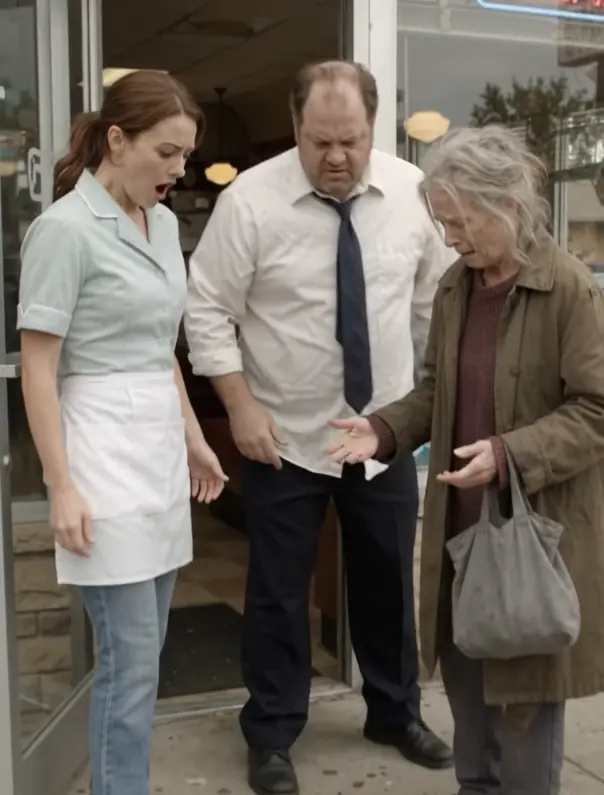
Nora Ellis noticed her while carrying a pot of coffee to table six. She had worked at Miller’s for four years, long enough to know the difference between someone waiting for a ride and someone trying to decide whether it was safe to ask for help. The woman had been there twenty minutes. Twice she started toward the door, then stepped back when customers came out.
Nora brought a plate from the kitchen: roast chicken, mashed potatoes, carrots, and a roll wrapped in a napkin. She paid for it at the register with money from the tip envelope she kept for bus fare. Then she carried it outside.
“Ma’am, would you like something warm?”
The woman looked startled. “I don’t have money.”
“I didn’t ask if you did.” Nora smiled gently. “It’s paid for.”
The woman reached for the plate with both hands. Before her fingers touched it, the diner door banged open behind Nora.
Manager Dean Holloway strode out in his white shirt and loosened tie. He knocked the plate from Nora’s hands. It struck the pavement, scattering potatoes and chicken across the wet concrete.
“What are you doing?” he shouted. “You’re wasting my money on this woman?”
Nora stared at the food on the ground, then at the woman, who had flinched as if she expected to be struck next.
“I paid for it myself,” Nora said. “It came out of my tips.”
Dean gave a contemptuous laugh. “Your tips don’t keep this place open. Without my money, you wouldn’t survive a week. If you think you can tell me how to run my business, quit.”
Nora’s hands shook, but her voice did not. “You don’t need to challenge me. I quit.”
She untied her apron and laid it over the back of a chair by the door. Then she crouched to gather the clean napkin and the woman’s fallen bag, while Dean stood over her, certain he had won.
The woman touched Nora’s wrist. “You shouldn’t lose your job for me.”
Nora looked at the ruined meal. “I didn’t lose it for you. I left because of him.”
The woman’s eyes moved toward the diner sign. “Then perhaps,” she whispered, “you’re the first person who has done the right thing here in a very long time.”