Sixty tractors.
Every one of them broken.
Some had seized engines.
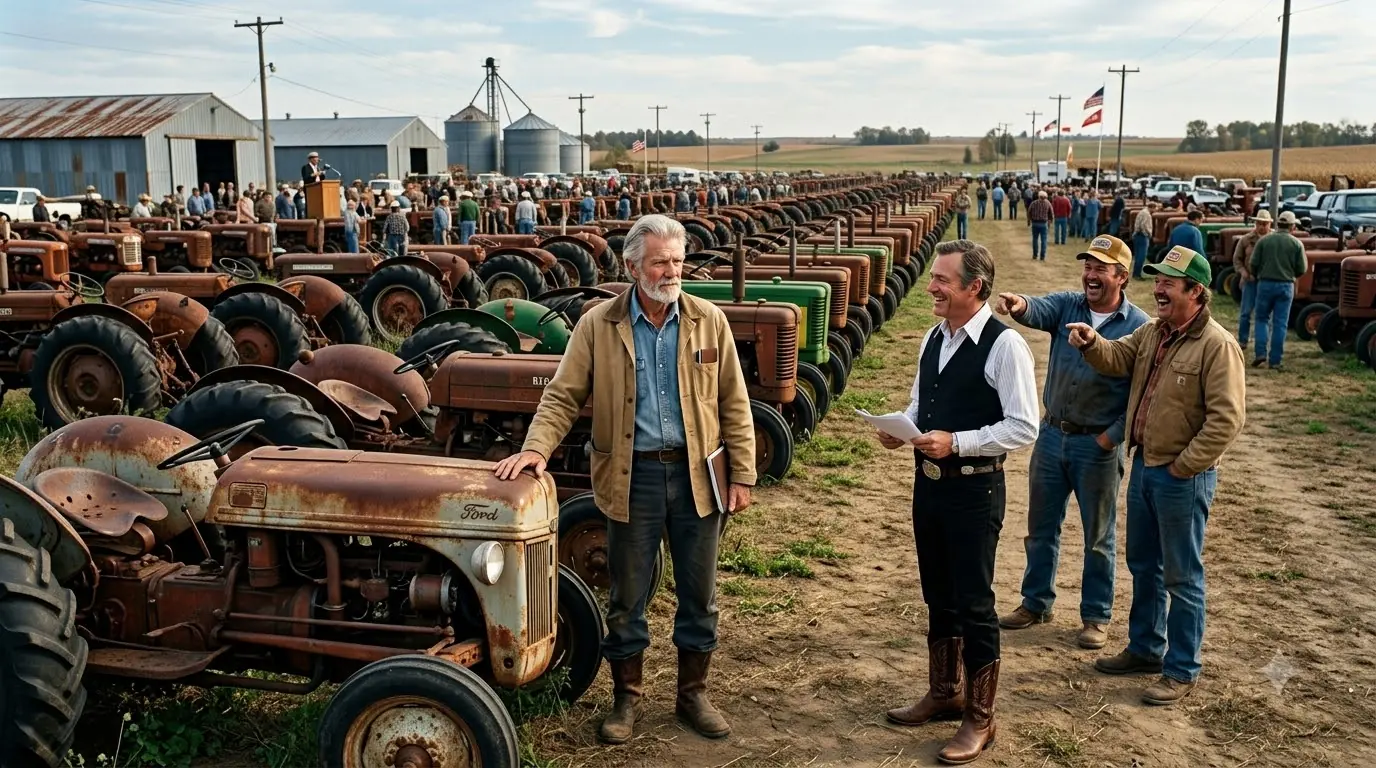
Others had transmissions that would no longer move.
Several were missing starters, alternators, hydraulic pumps, seats, batteries, or entire sections of sheet metal.
One had a rear wheel removed and was resting crookedly on a stack of weathered railroad ties.
Another had been sitting without an exhaust cap long enough for rainwater to find its way into the engine.
Cracked tires sagged into the dirt.
Old oil stained the ground beneath several machines.
Weeds had grown through drawbars and around axles.
Faded red, green, blue, and orange paint showed through layers of dust like colors beneath old barn boards.
Most buyers at the county equipment liquidation had walked past the row before the auctioneer even reached it.
They had already made their decision.
Junk.
Then seventy-year-old Earl Whitaker paid one thousand dollars for all sixty.
The laughter began before the auctioneer's hammer came down.
Earl heard it.
He simply didn't care.
The auction was being held on a hot Saturday morning at the former Hensley Farm Equipment Rental yard, a thirty-acre property outside the small farming town of Bell Crossing.
For almost twenty-five years, Hensley had rented tractors, loaders, mowers, post-hole diggers, and other equipment to farmers who needed a machine temporarily but could not justify buying one.
The business had done well for a long time.
Then the county changed.
Farms became larger.
Smaller operators disappeared.
Dealership financing became easier.
Newer rental companies opened closer to the highway.
Hensley began losing customers.
Maintenance was delayed.
New purchases stopped.
When one tractor needed a hydraulic pump, employees sometimes removed one from a machine already waiting for repair.
When another needed a starter, they robbed the starter from something that had a bad transmission.
Machines that might once have been repaired became donors for other machines.
The process continued for years.
By the time the company finally failed, there were sixty tractors lined behind an equipment shed in various stages of mechanical death.
The auction company had grouped them into one final lot because nobody wanted the responsibility of selling them individually.
Even the auctioneer sounded tired when he reached them.
"All right, gentlemen, last big lot of the morning."
A few buyers remained standing nearby.
Most were equipment dealers.
Scrap buyers.
Farmers searching for inexpensive machinery.
One of them was Gordon Hail.
Gordon was fifty-eight, broad-shouldered, loud, and successful enough that people listened when he talked about machinery.
He had bought and sold tractors in the county for more than thirty years.
He walked the broken row early that morning, opened several hoods, kicked tires, checked drawbars, and announced his professional conclusion.
"Scrap."
A younger farmer asked, "All of them?"
"Pretty much."
Gordon pointed toward a faded utility tractor with its engine partly disassembled.
"That one's missing half the top end."
Then another.
"Transmission's locked."
Another.
"Rear hydraulics are dead."
He laughed.
"By the time you haul them home and start buying parts, you'll wish you'd bought one running tractor instead."
The men around him agreed.
Earl had been standing twenty feet away.
He didn't argue.
That was important.
He had spent more than forty years repairing agricultural equipment.
He knew Gordon's assessment of the individual tractors was probably correct.
Most were not worth restoring as individual machines.
That did not mean they were worthless.
Earl wore faded overalls over a blue work shirt.
His gray hair showed beneath an old cap advertising a dealership that had closed fifteen years earlier.
A small notebook sat inside his shirt pocket.
At first nobody noticed what he was doing.
He approached the first tractor.
Opened the hood.
Looked inside.
Then did something that seemed strange.
He stopped looking at the engine.
Instead he wiped dirt from a metal identification plate riveted near the frame.
He wrote something in his notebook.
Then walked to the second tractor.
Same thing.
Model number.
Production year.
Engine code.
Transmission designation.
Hydraulic identification.
Serial number where he could still read it.
He moved to the third.
Then the fourth.
By the time Earl reached machine number twelve, Gordon noticed.
"What are you writing, Whitaker?"
Earl looked over.
"Numbers."
"What numbers?"
"The ones on the tractors."
Gordon laughed.
"That much I figured."
Several men smiled.
Earl went back to work.
He had learned long ago that explaining an idea too early usually attracted arguments from people who had not spent enough time understanding it.
He kept walking.
By tractor twenty, the pattern in his notebook was beginning to matter.
The sixty machines appeared chaotic from a distance.
Different colors.
Different years.
Different horsepower.
Different body styles.
But many belonged to only a handful of mechanical families.
Manufacturers had often reused major components.
One transmission might appear in three tractor models.
A hydraulic control valve might be shared across five years of production.
An engine block used in one utility tractor might also appear in an industrial version.
Rear axle housings.
Steering components.
Pumps.
Differentials.
Electrical assemblies.
Manufacturers changed badges and sheet metal more often than they redesigned every component underneath.
Earl knew that.