Everyone laughed when Clara Jennings planted two hundred dead-looking sticks in six inches of floodwater.
The men stood along the fence with their boots planted on dry ground, their faded overalls powdered with dust from the road, and watched a nineteen-year-old girl wade through black mud carrying bundles of gray branches beneath one arm.
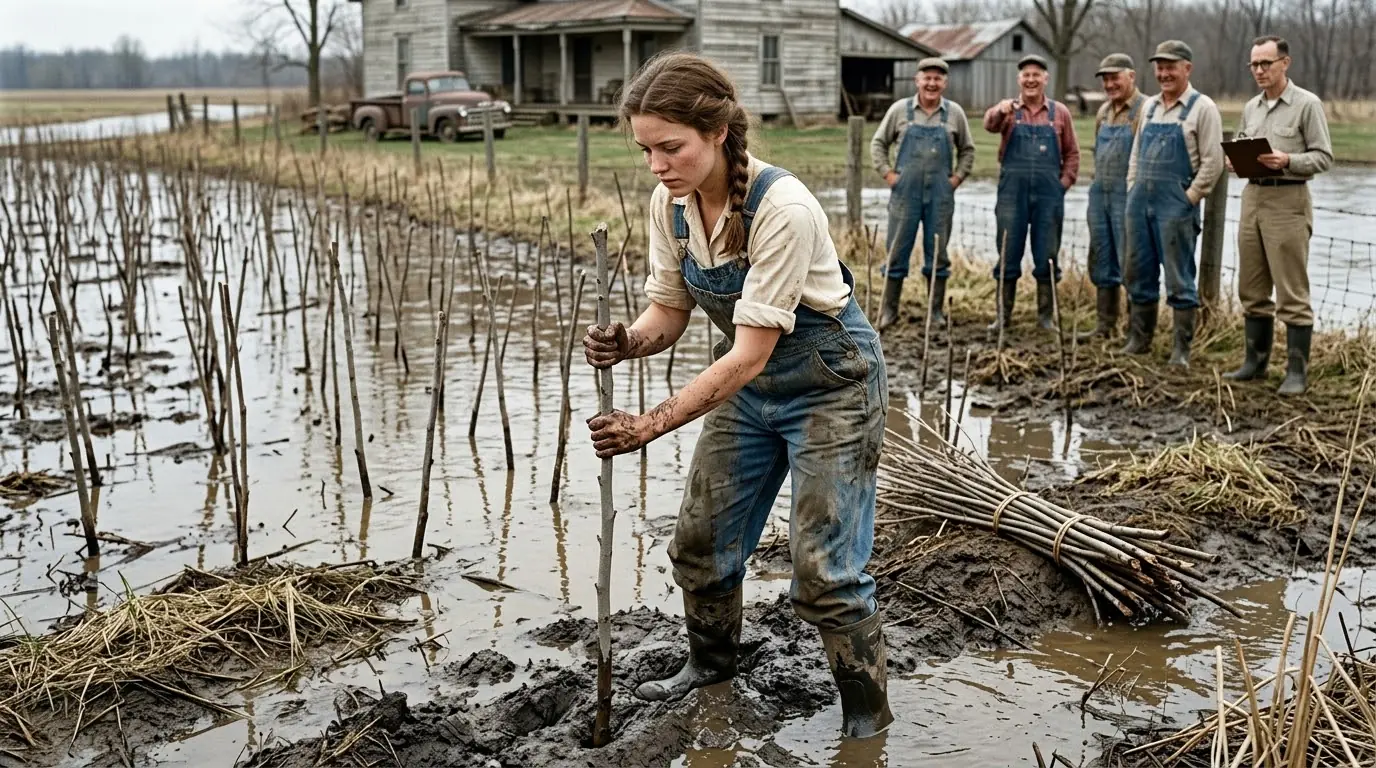
Some laughed quietly.
Some did not bother hiding it.
Tom Blackwell laughed hardest.
He owned more farmland than anyone else within ten miles of Miller’s Creek, and his booming voice carried across the flooded field.
“Clara!”
He cupped both hands around his mouth.
“You planning to grow fence posts?”
The men beside him broke into another round of laughter.
Clara heard every word.
She kept planting.
Her rubber boots sank nearly to the ankles with every step.
Cold brown water soaked the hem of her work dress.
Mud worked its way inside one glove and packed beneath her fingernails.
She pushed another cutting twelve inches into the soft ground, pressed the mud firmly around it, and moved six feet farther down the row.
The stick looked dead.
Every one of them did.
No leaves.
No flowers.
No visible roots.
Just lengths of dull gray wood roughly two feet long and as thick as a woman’s finger.
Tom shouted again.
“You know lumber’s usually supposed to go into the ground after you build something with it!”
More laughter.
Clara did not turn around.
The men could laugh.
The banker could laugh.
The county extension agent could write warnings until his pencil disappeared.
Her father could refuse to speak to her for three weeks.
None of that mattered as much as the folded piece of yellow paper tucked safely inside the pocket over her heart.
It contained seven lines in the handwriting of her dead grandmother.
So Clara planted.
One hundred ninety-seven.
One hundred ninety-eight.
One hundred ninety-nine.
Then the final cutting.
She pressed it into the mud with both hands.
Her back felt as though someone had driven a spike between her shoulders.
The rain had been falling steadily for almost an hour.
Water ran down her face.
Some of it was rain.
Some was not.
Clara straightened slowly.
Across the bottomland stood two hundred crooked gray sticks.
The rows were imperfect.
Some leaned.
Some had disappeared so deeply into the mud that barely ten inches remained above the water.
From the fence, the whole thing looked ridiculous.
Like a graveyard for broom handles.
The laughter began fading as the men climbed into their trucks.
Tom Blackwell was the last to leave.
Before getting behind the wheel, he shook his head toward Clara.
“Your grandmother filled your head with too much foolishness.”
Clara finally looked at him.
She said nothing.
Tom drove away.
Only Harold Vance remained.
The county extension agent stood beside his government Ford holding a clipboard beneath his coat to protect it from the rain.
Harold was forty-six, thin as a fence rail, with wire-framed glasses and the permanent expression of a man who had spent his life discovering that nature refused to organize itself as neatly as his forms.
He waited until Clara reached the fence.
“You understand my position.”
He said.
Clara pulled one glove off with her teeth.
“I understand you think I’m foolish.”
“That is not what I said.”
“You wrote three pages explaining why I’m foolish.”
“I wrote a technical recommendation.”
“That happened to be three pages long.”
Harold sighed.
“Miss Jennings, those cuttings may not even be viable.”
“They’ve been stored too long.”
“They appear desiccated.”
“The field is heavily saturated.”
“You’ve planted them in low-oxygen soil during active flooding.”
Clara looked across the water.
“Grandma said that’s where they belong.”
Harold’s mouth tightened.
“Your grandmother was an accomplished gardener.”
“She was not an agronomist.”
“She lived on this farm sixty years.”
“That is not the same thing.”
“No.”
Clara replied.
“It isn’t.”
Something in her tone made Harold glance at her.
She pulled the folded note from her pocket but did not hand it to him.
“My grandmother never claimed she knew more science than you.”
“She just knew this forty acres better.”
Harold looked toward the field.
“And if these fail?”
“Then they fail.”
“And if the bank forecloses while you’re waiting for them?”
Clara folded the note again.
“Then at least I won’t spend the rest of my life wondering whether I sold the place one month before it could have saved itself.”
Harold seemed to want to answer.
Instead, he closed the clipboard.