The front door of the Rust Fangs clubhouse opened at 4:17 on a cold Monday afternoon, and almost every conversation inside stopped.
Not because anyone recognized the person standing there.
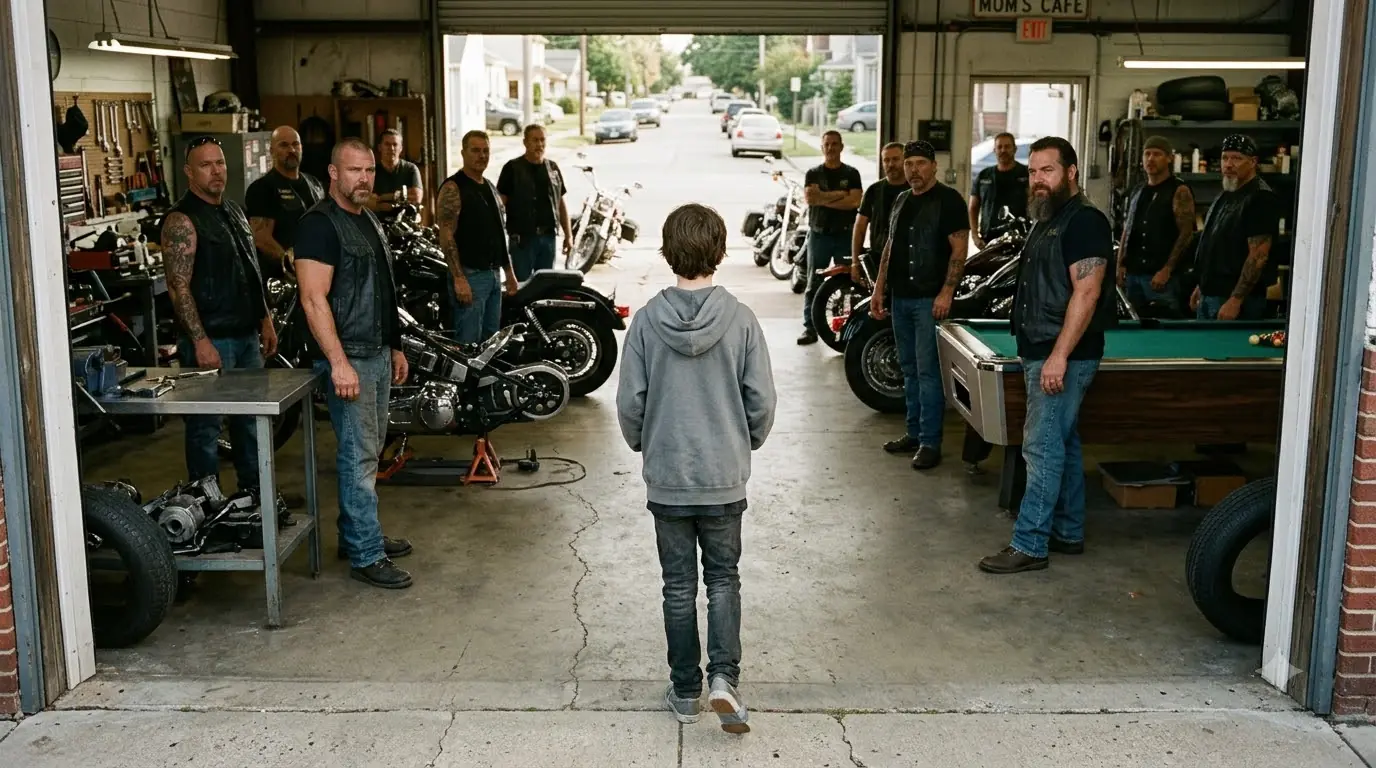
Because nobody expected a child.
He looked twelve.
Maybe younger.
A gray hoodie swallowed most of his thin frame, the sleeves pulled halfway over his hands despite the fact that the elbows were already worn nearly white.
His black sneakers were held together with silver duct tape.
The repair had been done carefully.
Two neat wraps around the left shoe.
Three around the right.
Not fashion.
Necessity.
There was a bruise spreading across his left cheekbone, purple in the middle and yellow near the edges.
A smaller mark sat beneath his jaw.
The boy kept his head slightly lowered, but not enough to hide either one.
Someone near the pool table laughed.
“Wrong address, kid.”
A few men chuckled.
The boy did not.
He stepped fully inside.
The heavy door closed behind him.
That sound changed the room.
The Rust Fangs clubhouse was not technically dangerous.
Not anymore.
The club had started in the late 1980s among factory workers, military veterans, mechanics, truck drivers, and men who liked motorcycles more than they liked explaining themselves.
The old generation had accumulated stories.
Some true.
Some exaggerated.
A few best left in the past.
These days, most Rust Fangs had ordinary jobs.
They repaired motorcycles.
Ran a towing company.
Owned a welding shop.
Worked construction.
Drove trucks.
Held charity rides twice a year.
But the clubhouse still carried a reputation.
Parents told teenagers not to hang around there.
Police knew the address.
People lowered their voices when black leather vests with the Rust Fangs patch entered a restaurant.
And yet this twelve-year-old boy had walked through the door alone.
He stopped beside an old wooden table.
“I’m looking for work.”
That got a bigger laugh.
Razer Dawson, a broad man with a steel-gray beard and arms covered in faded tattoos, slapped one hand against his knee.
“You hear that?”
He looked around.
“Kid wants a job.”
Another man called:
“We hiring middle school now?”
The boy’s face reddened.
But he did not leave.
“I can sweep.”
He said.
“Clean stuff.”
“Organize parts.”
“Take trash out.”
“Whatever.”
Razer opened his mouth again.
Then saw Keller standing.
That ended the jokes.
Nathan Keller was forty-eight years old and served as the club’s sergeant at arms, although the title meant something quieter now than it had decades earlier.
He handled disputes.
Security.
Clubhouse rules.
People who arrived angry.
People who drank too much and forgot where the line was.
He had spent sixteen years in the Marines before returning to Arizona with a damaged knee, a scar running from his temple to the edge of his jaw, and an understanding that fear was usually loudest in people pretending not to feel it.
Keller had learned to watch hands.
Breathing.
Eyes.
Posture.
People told stories with their bodies long before their mouths caught up.
He looked at the boy.
The bruise mattered.
The shoes mattered.
The hoodie mattered.
But what bothered Keller most was the boy’s stance.
His weight stayed balanced on both feet.
His shoulders were tense.
His eyes kept moving between exits.
Not curious.
Mapping.
Children did that when they were used to needing a way out.
Keller crossed the room slowly.
The boy noticed him immediately.
His chin lifted a fraction.
“What’s your name?”
Keller asked.
“Noah.”
“Noah what?”
A pause.
“Collins.”
“How old are you?”
“Twelve.”
“That legal?”
Razer called from behind them.
A few men laughed nervously.
Keller ignored him.
“Twelve exactly?”
“Thirteen in March.”
“You go to Jefferson Middle?”
Noah’s eyes narrowed.
“Yes.”
“You live around here?”
Another hesitation.
“Oak Street.”
“What number?”
Noah’s expression changed.