She asked me in the paint aisle on a Wednesday afternoon while holding a color swatch she was not actually looking at.
“Dean, can you be the father of my baby just for one day?”
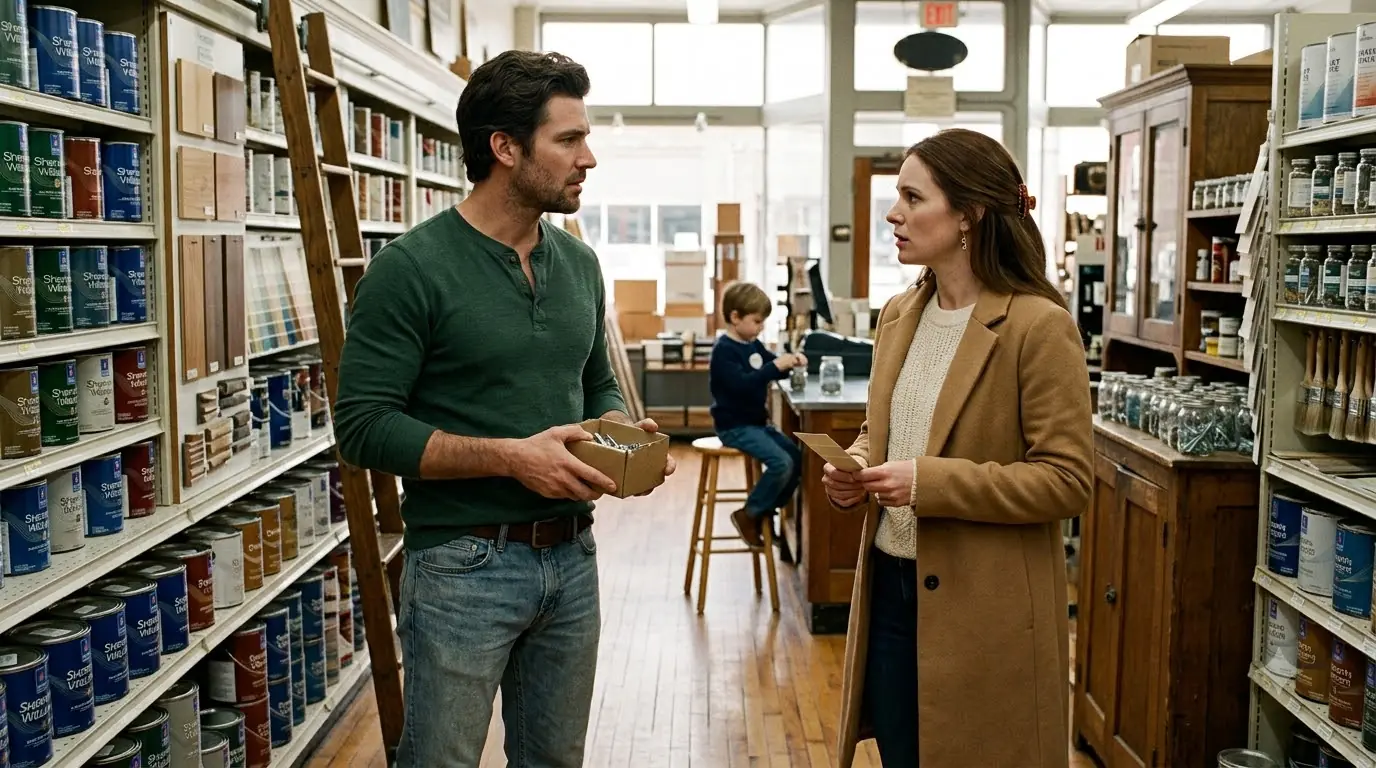
I was holding a box of cabinet hinges when she said it.
I put the box down.
Slowly.
Because there are some sentences your brain refuses to process at normal speed.
I had known Clare Bennett for about four months.
Long enough to know she drank her coffee black with one sugar.
Long enough to know she hated raisins, always forgot to bring an umbrella, and apologized every single time her son sat in my hardware store after school.
Not long enough for that question.
I looked toward the front counter.
Her six-year-old boy, Charlie, sat on an old wooden stool behind my register with his tongue pressed against the corner of his mouth as he sorted screws into three coffee cans.
Wood screws.
Sheet metal.
Drywall.
His serious work.
Charlie had no idea his mother was standing twenty feet away asking me to become his father for a morning.
I looked back at Clare.
Her fingers were shaking around the little blue paint card.
“Only if you tell me why.”
She swallowed.
Three years before that moment, a doctor had sat me down in a cold little office and told me I was almost certainly never going to father a child biologically.
Eleven months later, my wife left.
And now a woman I barely knew was standing beneath a rack of interior paint samples asking me to be a dad.
Just for one day.
Here is the strange part.
Clare gave me three answers over the next year.
Each answer was honest.
Each answer was more true than the one before it.
But the real answer did not come from Clare at all.
It came from a seven-year-old boy sitting at my kitchen table with a pencil in his hand, looking at two adults as if we were both embarrassingly slow.
Let me back up.
My name is Dean Whitaker.
I am thirty-four years old at the beginning of this story.
I own Whitaker Hardware on Main Street in a town called Millbrook, Ohio.
Population a little over four thousand.
The kind of town where people still say “the old pharmacy” even though the pharmacy closed fourteen years ago.
High school football scores are printed on the marquee outside First County Bank.
The diner waitress knows what you want before you sit down.
And if an ambulance turns down your street at three in the morning, twelve people will know whose house it stopped at before breakfast.
Whitaker Hardware sits between Bennett Insurance and Miller’s Barber Shop.
Red brick building.
Green awning.
Original hardwood floor.
A front door that sticks every July because the frame swells.
My father, Harold Whitaker, opened the store in 1986.
I grew up there.
Some kids remember playgrounds.
I remember aisle four.
Bolts on the left.
Plumbing fittings on the right.
I knew the smell of pipe cement before I knew multiplication.
My first job was filling paper bags with nails because Dad sold them by weight.
By ten, I could cut a house key.
By thirteen, I knew enough electrical terminology to sound dangerous.
By sixteen, I could rebuild a screen door faster than most adults could explain what was wrong with it.
Dad was not sentimental.
He was not particularly talkative either.
He had thick hands, gray eyes, and a habit of answering questions with the fewest possible syllables.
“Dad, should we order more half-inch copper?”
“Yep.”
“Dad, Mrs. Jensen says this faucet washer doesn’t fit.”
“Other drawer.”
“Dad, are you coming to my baseball game Friday?”
“What time?”
That was practically a paragraph.
He loved me.
I know that now.
At fourteen, I was not always sure.
He never said much.
Never hugged me unless someone had died.
Never gave long speeches about values.
But he was there.
Every morning.
Six forty-five, his truck turned into the alley.
Seven o’clock, the front sign flipped to OPEN.
Six o’clock, he locked the door.
Six days a week.
For thirty years.
Rain.
Snow.
Flu.
Back pain.
Bad economy.
Good economy.
My mother left when I was twelve.
Not dramatically.
She met someone.
Moved to Cincinnati.
Called for birthdays.
Visited sometimes.
Dad never insulted her.
He also never explained why she left.
When I asked once, he said:
“Some people stay better than others.”
That was the entire conversation.
Maybe that was why the hardware store became so important to him.
People knew where to find him.
A pipe burst at six in the morning?
Harold Whitaker would probably be there by seven.
Kid broke his bicycle chain?
Bring it through the side door.
Old Mrs. Dalton could not replace the batteries in her smoke detector?