The summer Della Pruitt turned eleven, she began collecting things other farmers had already decided were useless.
Bent aluminum irrigation pipe.
Old gate valves.
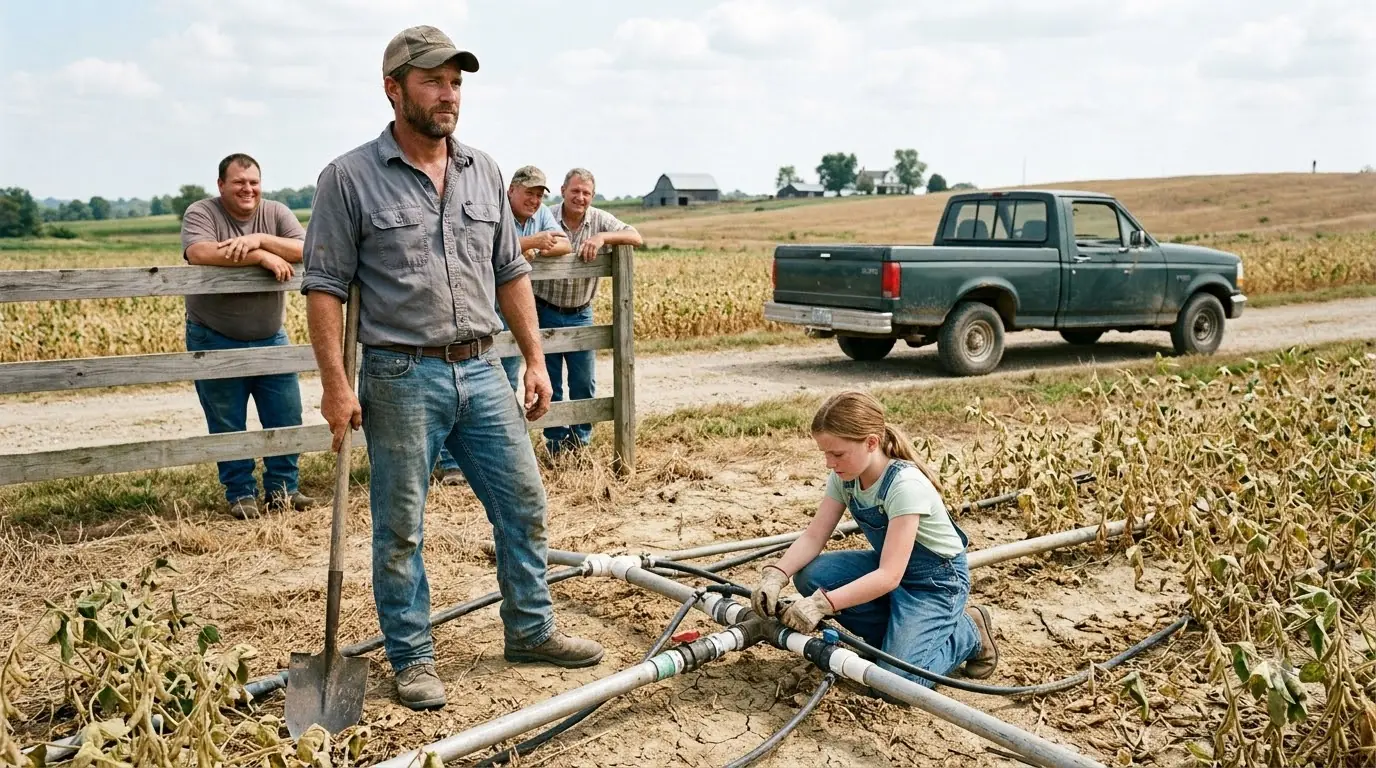
Cracked PVC fittings.
Lengths of black polyethylene tubing faded gray by twenty summers of Kentucky sun.
Clogged filters.
Broken hose couplers.
Sections of lateral line that had been lying in weeds so long that field grass grew through them.
Every Saturday morning, Della tied a wooden trailer behind her blue bicycle and rode the dirt roads of Calloway County.
The trailer had been built by her father, Harlan, three years earlier when Della decided she needed something to haul pumpkins from her grandmother’s garden.
It was never designed to carry eight-foot lengths of irrigation pipe.
Della did not care.
She carried a coil of rope beneath the seat.
When a piece was too long, she tied it diagonally across the trailer.
When it was too heavy, she dragged one end.
When that failed, she knocked on the farmer’s door and asked politely if he would help her load it.
That was usually when the questions started.
“What you doing with all that pipe, honey?”
Della always gave the same answer.
“Working on something.”
“What kind of something?”
“I’m not sure yet.”
That part was technically true.
She knew exactly what she wanted.
She simply had no idea whether it would work.
The farmers usually smiled.
Some chuckled.
Not cruelly.
Calloway County was full of people who had known Della since she was born.
They had watched her ride in the Murray Christmas parade sitting on her father’s tractor.
They had seen her sell lemonade outside the feed store.
They remembered when she was five and followed Harlan through the co-op carrying a plastic watering can because she believed farmers were required to carry water with them.
Nobody thought she was stupid.
They thought she was eleven.
There was a difference.
Wendell Coe was the first farmer to take her seriously.
He was seventy-two and lived six miles north of the Pruitt farm in a white farmhouse surrounded by equipment he had never managed to throw away.
Della noticed three sections of aluminum pipe leaning against an abandoned tobacco barn.
She knocked.
Wendell opened the door wearing overalls with only one strap fastened.
“Morning, Mr. Coe.”
“Morning, Della.”
“Those pipes by your barn.”
“What about them?”
“Do you need them?”
Wendell leaned around her and looked toward the barn as though he had forgotten the pipes existed.
“Haven’t needed them since 2009.”
“Could I have them?”
“What for?”
Della paused.
“Something.”
Wendell narrowed his eyes.
“You building an illegal moonshine operation?”
“No, sir.”
“Good.”
“Your grandmother would drink the evidence.”
Della tried not to laugh.
Wendell walked down with her.
The pipes were ten feet long, larger than anything she had collected before.
Two were usable.
The third had been flattened where a tractor tire drove over it years earlier.
Wendell helped load the good ones.
Then he noticed Della’s trailer.
“Your daddy know you’re hauling half the county home?”
“Some of it.”
“That means no.”
“He knows about the trailer.”
Wendell laughed.
“Take the couplers too.”
He disappeared into the barn and returned with a box of old fittings.
Della’s eyes widened.
“How much?”
“Nothing.”
“That’s too much.”
“It’s junk.”
“Not if I can use it.”
Wendell stopped smiling.
He looked at her for a second.
“That right?”
“Yes, sir.”
He handed her the box.
“Then bring it back when you prove me wrong.”
Della pedaled away with the trailer wobbling dangerously behind her.
Wendell watched from the driveway until she disappeared around the bend.
That evening, he told his wife:
“Harlan’s little girl is either building something smart or something that’ll flood half the county.”
He was closer to the truth than he knew.
The Pruitt farm sat about eight miles south of Murray, Kentucky.
Forty-one acres.
Not a large farm by regional standards.
Not small enough to treat like a hobby either.
Harlan Pruitt grew soybeans and corn on most of it.
Some years he planted a small tobacco allotment when contract prices made the extra labor worthwhile.
He also cut hay from a six-acre section bordering the creek.
The land had been in June Pruitt’s family before she married Harlan.
Her father had farmed it.
Her grandfather too.
The bottom acres were heavy and dark.
They held water.
The upper eastern field was different.
Sandier.
Slightly higher.
Good in wet years.