The summer everyone else in Millbrook Hollow cleared rocks from their fields, fourteen-year-old Eli Barnett spent every afternoon carrying them back.
That was why people started slowing their trucks when they passed the Barnett farm.
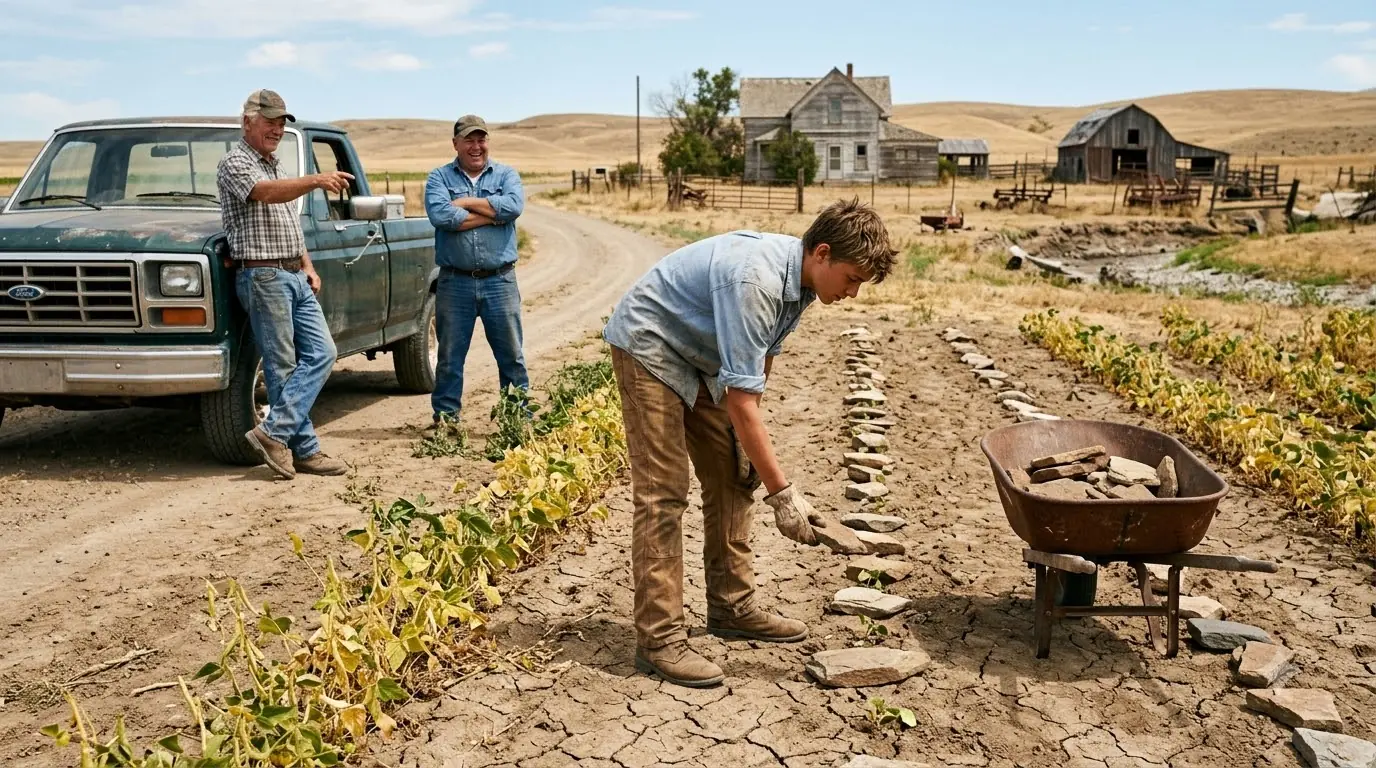
At first, they thought he was cleaning up the collapsed stone wall beside the property line.
Then they realized the stones were moving in the wrong direction.
Eli was loading them into a rusted wheelbarrow and pushing them directly into the driest section of his family’s field.
One stone at a time.
Morning after morning.
Afternoon after afternoon.
The wheelbarrow had belonged to his grandfather.
One handle had been replaced with a piece of oak that did not quite match the other.
The metal tray was patched in two places and squealed whenever the front wheel rotated.
By noon, that squeal could be heard from the dirt road.
People learned to listen for it.
Old pickup trucks would slow.
Windows came down.
Men who had spent their entire lives farming would lean toward the road and watch the thin Barnett boy haul another load of stones toward land that had barely produced enough beans to justify harvesting the previous year.
Sometimes they laughed.
Sometimes they shouted advice.
“Wrong direction, Eli!”
Another farmer called one afternoon.
“Rocks come out of the field!”
His passenger laughed so hard he slapped the dashboard.
Eli kept walking.
The wheelbarrow rattled.
Stone dust covered his boots.
Sweat soaked through the back of his shirt.
He did not answer.
Another man stopped several days later.
“You building yourself a house out there?”
Eli shook his head.
“A fort?”
“No, sir.”
“Graveyard?”
The man grinned.
Eli pushed the wheelbarrow forward again.
By the second week, jokes about the Barnett boy had become a regular feature of conversation at Millbrook Feed and Supply.
People speculated about what he was doing.
Rock garden.
Fence.
Terrace.
Some strange school project.
One man claimed Eli had read something in a magazine and was trying to grow potatoes between stones.
Nobody knew.
Not even Eli’s father.
Thomas Barnett knew only that his son was moving rocks into the worst corner of four acres that had been failing for three years.
He also knew he was too tired to stop him.
The Barnett farm sat on the western edge of Millbrook Hollow, where the road narrowed between two low ridges before dropping toward the river.
Four acres.
A small barn.
A farmhouse built before Thomas was born.
A chicken coop with seven hens that produced eggs whenever they felt cooperative.
It was not much compared with the hundred-acre farms farther east.
But the land belonged to the Barnetts.
Thomas’s grandfather had bought the first two acres after returning from war.
His son added another two.
Thomas inherited all four.
There had been good years.
Years when corn reached above a grown man’s shoulders.
Years when bean vines covered the poles so thickly that Ruth spent August afternoons filling baskets faster than Eli could carry them.
Years when rain arrived when it was supposed to.
Then the summers changed.
The first dry year had been treated like bad luck.
The second became a problem.
The third became fear.
By June, the ground had hardened.
The surface broke into wide cracks.
Some were large enough for Eli to push his fingers into.
When the wind came from the west, dust lifted from the fields in thin brown sheets and settled across porch steps, windowsills, and laundry hung outside.
The river still moved.
But barely.
Children who used to swim in one deep bend now crossed it in shoes without getting water above their ankles.
The soil had once been dark and loose.
Now the driest areas looked almost gray.
Corn germinated unevenly.
Beans emerged weak.
Then stopped.
Thomas worked harder.
That was his answer to almost everything.
He rose at 4:45 every morning.
Fed the chickens.
Checked the pump.
Walked the field.
Repaired whatever had broken overnight.
Then spent several hours doing paid work for neighboring farms because the Barnett land no longer produced enough cash on its own.
Some days he repaired fencing.
Some days he drove equipment.
Sometimes he hauled feed from town.
He returned home after sunset and still checked his own crops before eating.
His hands developed deeper cracks than the field.
Ruth noticed.
She kept a jar of salve beside the kitchen sink.
Thomas rarely used it unless she made him.
Money became a quiet subject in the Barnett house.
Nobody announced that they were struggling.
They simply stopped buying things.
First new clothes.
Then meat more than twice a week.
Then repairs that could wait.
Ruth began saving jars.
Thomas stopped replacing tools and started repairing them.
Eli learned which bills arrived in white envelopes and which came in yellow.
The bank letters came in white.
Thomas always opened them after dinner.
Always when he thought Eli had gone upstairs.
Eli had not.