Pearl Bennett had written everything down twice.
Twenty invitations.
Cream paper.
Thin blue border.
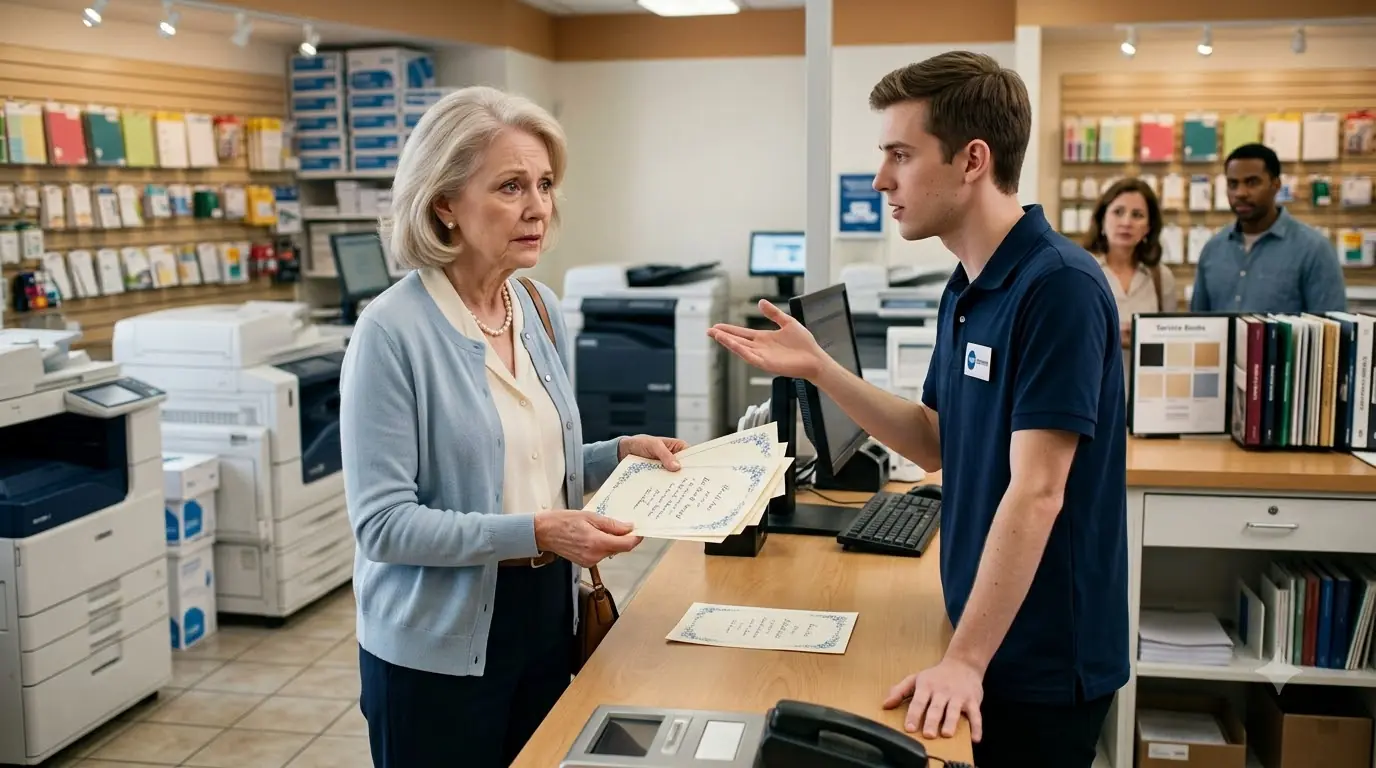
Small flowers in the corners.
Dark navy lettering.
Her mother’s name centered at the top.
April 12.
Two o’clock in the afternoon.
Fifty guests.
St. Matthew’s Fellowship Hall.
Pearl had even written the wording exactly as she wanted it to appear.
Nothing had been left to memory.
That mattered because Pearl did not trust her memory the way she once had.
At seventy-one, she could still remember the telephone number of the house where she grew up in 1967.
She could tell you exactly what dress her mother wore to Pearl’s high school graduation.
She could remember her late husband’s license plate from the first car they bought together.
But ask Pearl where she had placed her reading glasses ten minutes ago and she might search the kitchen for half an hour before realizing they were tucked into the front of her blouse.
So she wrote things down.
Shopping lists.
Appointments.
Medication times.
Birthday reminders.
Names.
Addresses.
Anything important went onto paper.
That was why the envelope in her purse contained three carefully folded pages written in neat blue ink.
Her mother, Evelyn Bennett, was turning eighty.
Pearl wanted the invitations to be special.
Not expensive.
Not impressive.
Special.
There was a difference.
Evelyn had never been the kind of woman who cared about luxury.
She had raised three children in a narrow brick house where the dining room table doubled as a homework desk, sewing station, birthday cake table, and occasionally emergency ironing board.
She had made costumes from old curtains.
She had packed lunches even when money was tight.
She had once stayed awake all night sewing a blue flower onto Pearl’s eighth-grade dance dress because Pearl had cried after another girl called it plain.
“Plain is only plain until you put yourself into it,” Evelyn had said.
Pearl remembered that sentence.
She remembered almost everything her mother had done for other people.
That was why the invitations mattered.
Evelyn had spent eighty years making other people feel remembered.
Pearl wanted one afternoon where everybody came together because of her.
The plan had started three months earlier.
Pearl’s younger brother Howard wanted to reserve a restaurant.
Her sister Denise wanted catered food and professional decorations.
Pearl suggested St. Matthew’s.
Their mother had attended the church for forty-seven years.
She had taught Sunday school there.
Organized holiday drives.
Cooked casseroles for funerals.
Held babies while exhausted mothers drank coffee after services.
When Evelyn’s husband died, people from St. Matthew’s filled their refrigerator for almost a month.
Pearl said:
“Mom would rather have fifty people in that fellowship hall than fifteen people staring at fancy plates.”
Howard admitted she was probably right.
Denise agreed after complaining for forty-eight hours.
The invitations became Pearl’s responsibility.
That had been partly voluntary.
Partly strategic.
Pearl knew her siblings.
If Howard handled them, the invitation would look like a corporate meeting notice.
If Denise handled them, each card would somehow cost twelve dollars and arrive tied with ribbon.
Pearl wanted something that looked like Evelyn.
Soft.
Simple.
Warm.
A little old-fashioned.
She spent an evening at her kitchen table sketching possibilities.
Cream paper because pure white felt too cold.
Blue because it had always been Evelyn’s favorite color.
Small blue flowers because Evelyn still planted forget-me-nots beside her porch every spring.
No glossy finish.
No gold foil.
No photograph.
Just words.
Pearl had been nervous about actually making them.
She could use email.
She could send pictures from her phone if someone showed her where to press.
She could check her bank account online.
But design programs made her uneasy.
Too many buttons.
Too many menus.
Tiny symbols that apparently meant obvious things to everyone except her.
Whenever a computer asked her to choose between “save,” “save as,” “export,” and “download,” Pearl felt as though she had wandered into an argument she did not understand.
Still, she was determined.
A neighbor told her about a print and copy shop called QuickPrint Studio.
“They help with invitations all the time.”
Pearl looked at the website.
CUSTOM PRINTING.
DESIGN ASSISTANCE.
INVITATIONS.
BUSINESS CARDS.
ANNOUNCEMENTS.
HELP AVAILABLE.
That final phrase reassured her.
So on Tuesday morning, Pearl put her handwritten pages into a large brown envelope.
She checked them three times.
Then drove across town.
The shop occupied a bright storefront between a cellular phone store and a sandwich café.
Inside, the air smelled of warm paper and printer toner.
Color samples covered one wall.
Stacks of cardstock filled another.
Several self-service computers stood along the windows.
Behind a long counter, a young man was typing rapidly.
He looked about twenty-four.
Dark hair.
Black polo shirt with the QuickPrint logo.
Name tag: Evan.
Pearl approached.
He did not look up immediately.
She waited.
Thirty seconds.
Maybe forty.
Finally, he said:
“Pickup?”