The morning the whole county started talking about her, twenty-year-old Marin Holt stood at the western edge of her family’s wheat field, arms crossed, watching nearly every other farmer in Cedar Valley race against the sky.
Combines roared across the Hendricks place next door.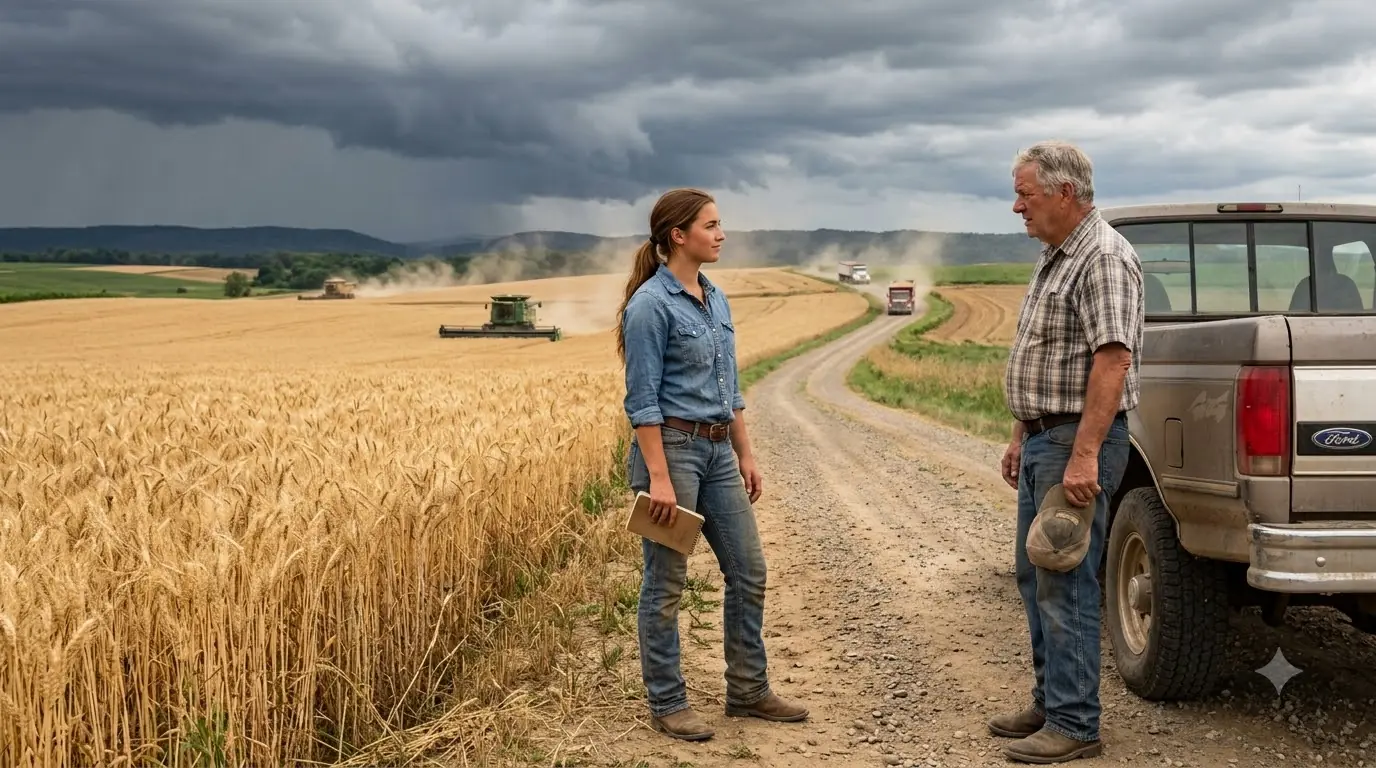
Grain trucks rattled down gravel roads toward the elevator with yellow dust boiling behind their tires.
Men shouted over engines.
Sons ran fuel.
Wives carried sandwiches to field edges.
Neighbors who normally guarded their harvest plans like family secrets were lending trucks and drivers to one another because the storm coming out of the west did not care whose name was painted on a mailbox.
And Marin Holt was doing none of it.
Forty acres of winter wheat stood untouched in front of her.
Gold.
Heavy.
Dry enough from the road to look ready.
Three days past the date nearly everyone in the county thought she should have started cutting.
A black wall of weather sat low on the western horizon.
The radio in Marin’s pickup had been repeating the warning since dawn.
Strong thunderstorms.
Damaging winds.
Heavy rainfall.
Localized flash flooding.
Possible hail.
The announcer used the phrase “significant agricultural impact” twice before seven in the morning.
Marin listened.
Then turned the radio off.
Behind her, the old John Deere combine remained parked inside the machinery shed.
Fuel tank full.
Header greased.
Belts checked.
Knives sharpened.
The machine was ready.
Marin was ready.
The wheat was not.
At least not in the way everyone assumed.
By eight-thirty, Walt Hendricks drove past slowly enough to look directly into the Holt field.
By nine, somebody mentioned it at Benson Feed and Seed.
“Marin hasn’t started.”
“Machine broken?”
“No.”
“Waiting on parts?”
“No.”
“Then what’s she doing?”
Nobody knew.
That made the story better.
By ten, the question had moved to the grain elevator.
By noon, it was being discussed over burgers at Ruby’s Diner.
By evening, half the county had decided twenty-year-old Marin Holt was about to lose forty acres of wheat because she was too stubborn to listen to men who had been farming longer than she had been alive.
The other half thought grief and exhaustion had finally caught up with her.
Nobody imagined she might have a reason.
That was the first mistake.
The second was assuming Marin was doing nothing.
She had spent the previous three weeks preparing more carefully than any of them knew.
To understand why, you had to go back four months.
Spring planting had barely begun when Marin’s father, Thomas Holt, collapsed in the machinery shed.
He had been replacing a hydraulic hose on the drill.
Marin was fifty yards away carrying seed bags when she heard the wrench hit concrete.
She found him sitting against the rear tire of the tractor, one side of his face sagging and his right hand refusing to close.
“Dad?”
Thomas tried to answer.
The words came wrong.
Marin dropped to her knees.
She knew enough to understand what she was seeing.
The ambulance arrived seventeen minutes later.
The stroke did not kill Thomas.
That was the good news.
The bad news arrived slowly.
His right side weakened.
Speech returned, but not immediately.
Fatigue became constant.
Doctors told him he might regain much of what he had lost, but nobody could promise he would return to twelve-hour days on tractors and combines.
Thomas Holt had farmed three hundred and fourteen acres outside Ash Creek, Kansas, for almost thirty-five years.
Two hundred acres were leased.
The rest belonged to the family.
Wheat.
Hay.
Some sorghum depending on rotation.
Twenty-eight head of cattle.
Enough ground to make a living if everything went mostly right.
Not enough to survive many serious mistakes.
Marin’s older brother, Caleb, lived in Wichita.
He had left at twenty-one, studied electrical systems, and built a life he loved.
Thomas never resented him for it.
Neither did Marin.
But when their father came home from the hospital, there was no question who would run the farm.
Marin.
Twenty years old.
Two years of community college agriculture courses.
A lifetime of helping.
Almost no experience carrying the whole thing alone.
Neighbors came.
That first week, support arrived faster than Marin could refuse it.
Walt Hendricks finished planting twelve acres Thomas had not reached.
Clyde Benson delivered mineral feed and told Marin not to worry about the bill until summer.
Women from the church brought casseroles.
Somebody repaired a broken gate.
Somebody else sharpened mower blades.
Marin was grateful.
Truly.
But she noticed how people talked to her.
“You just keep things going until your dad gets stronger.”
“Don’t worry about making big decisions.”
“Call one of us before you do anything expensive.”
“Your father will be back.”
All kind.
All well meaning.
All carrying the same assumption.
Marin was temporary.