The boy was six when he watched his father quietly push a plate of food toward his mother and pretend he wasn't hungry.
The clock above the grill was seven minutes slow, although Evan had been promising to fix it for months. The father kept checking it, as if a longer stay might cost money the family did not possess. Outside, buses hissed past without stopping. Rosa watched Evan from the kitchen doorway, knowing that his wages barely stretched across his own expenses. Evan carried another glass of water over and pretended the meal was nothing unusual. He listened.
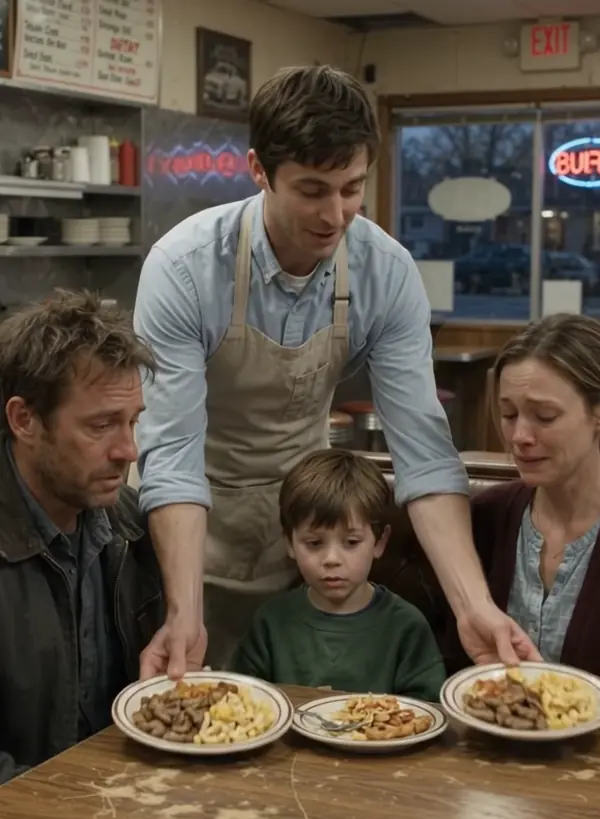
It was February in Mill Creek, Pennsylvania, and the windows of the Corner Table Diner were clouded with sleet. A young waiter named Evan Brooks stood beside the coffee station, listening without meaning to. "Just one dinner," the father murmured. "You and Ben can share it. I'll eat when we get home." His wife looked at the coins spread on the table. "Thomas, there's nothing at home." Their little boy stared at the plate of eggs and potatoes without touching it. Evan had heard customers argue about money before. What made him stop was the father's gentle insistence that everything would be fine, followed by the mother's silence. Evan returned to the kitchen and asked the cook, Rosa Delgado, for two more plates. "On whose ticket?" she asked. "Mine." He pulled twenty-seven dollars from the envelope where he kept his tips for the week. It was money he had intended to use for new brakes on his aging car. He knew the repair couldn't wait much longer. He knew his landlord expected rent on Monday. He placed the bills beside the register anyway. The owner, Mr. Pritchard, glanced up. "You can't keep feeding everyone who walks in broke." "I'm not feeding everyone," Evan answered. "I'm feeding three people." When he carried the meals to the family, the boy's face changed first. The father's face changed last. "We didn't order all this," Thomas said. Evan placed the plates carefully, making sure the largest serving sat in front of the child. "Kitchen made extra. It's taken care of." Thomas studied Evan's apron and the nervous way he avoided eye contact. He understood. "Son, we can't accept—" "You can," Evan said. "Please." The father swallowed and nodded. The boy finally lifted his fork. Later, as Evan wiped another table, the child approached him holding a folded paper napkin. On it was a drawing of three stick figures beside a square building. Underneath, in imperfect letters, he had written THANK YOU FOR DINNER. Evan tucked the drawing into his apron pocket. He had no reason to imagine what that napkin would mean twenty years later.