I never wanted a war with Oakhaven Estates. I wanted silence.
Four hundred acres of forest, forty-five acres of water, one century-old house, an aging dam, and enough distance between me and the nearest neighbor that I could stand on my porch at midnight and hear nothing except frogs, wind, and water touching the dock.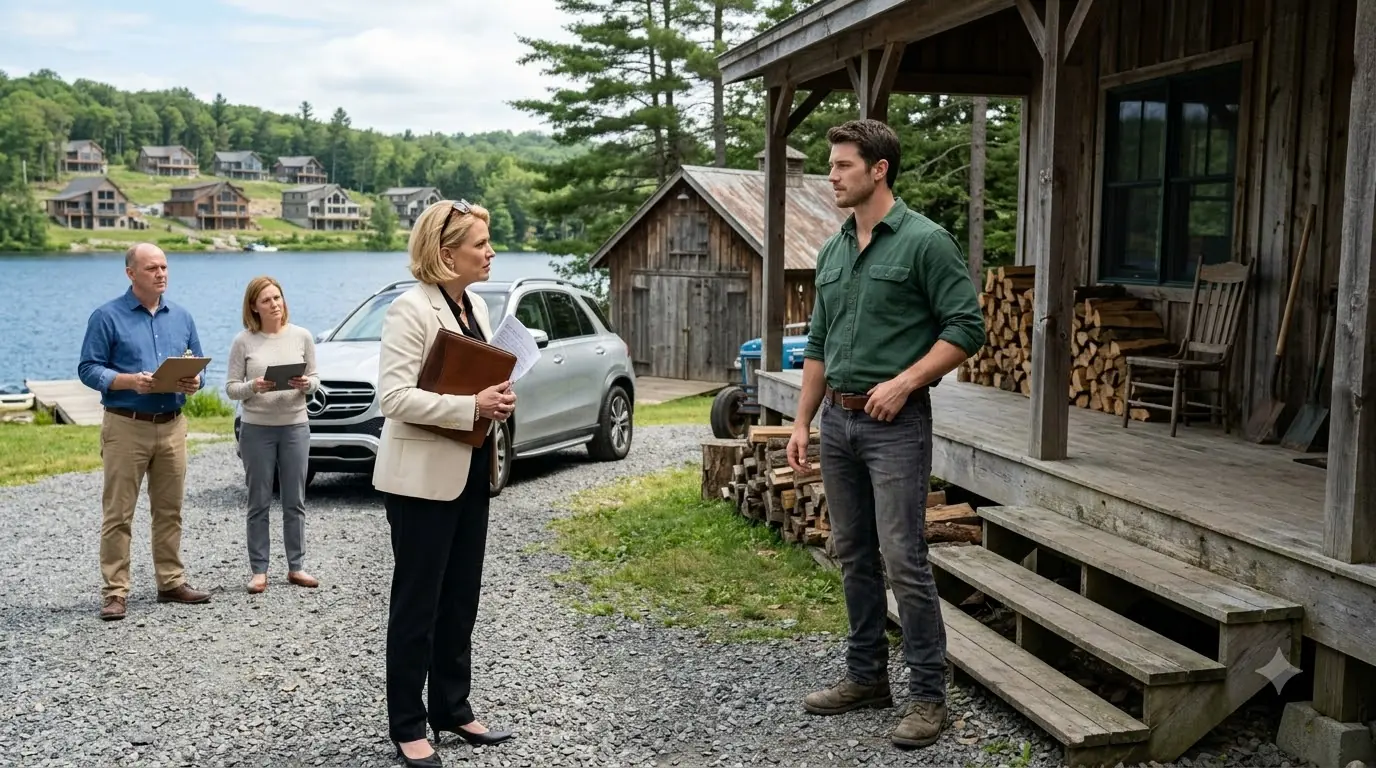
That was the life I thought I had inherited.
Instead, within eighteen months, I found myself fighting a multimillion-dollar developer, a wealthy homeowners association, a county zoning office, a sheriff who kept telling me to “be reasonable,” and a team of lawyers who seemed convinced that enough expensive paper could turn my private property into theirs.
They built 109 luxury cabins along my shoreline.
They cut my fence.
They drove jet skis across my lake.
They mailed me fines from an HOA I had never joined.
Then they went to court and convinced a judge to give them temporary recreational access to water my family had owned for generations.
For a while, it looked as though they were going to win.
What they did not understand was that Lawson Lake was not simply a lake.
It was a reservoir.
And the water did not exist because nature happened to put it there.
It existed because my great-grandfather built a dam.
When the legal fight finally forced me to open a century-old iron lockbox in my attic, I discovered something Arthur Pendleton should have found before pouring the first foundation.
The state still classified Lawson Lake as a regulated impoundment.
The dam still had inspection obligations.
And the owner of that dam still had authority, subject to state approval and engineering oversight, to lower the reservoir when maintenance required it.
Oakhaven Estates had sold people million-dollar “waterfront” homes beside water they did not own.
Worse, they had built the lowest row of cabins inside a flood-storage zone that appeared clearly on maps older than Arthur Pendleton’s company.
When the state eventually ordered the lake drawn down, the beautiful blue water vanished.
And what lay beneath it ended the war faster than anything I could have done myself.
But before that happened, there were months when I honestly thought I was going to lose everything my family had spent a century protecting.
My name is Jack Lawson.
I was twenty-eight when my grandfather died.
His name was Edward Lawson, although nobody in Millbrook County called him Edward.
To everyone except the bank and the Department of Motor Vehicles, he was Ed.
Grandpa Ed had lived at Lawson Lake nearly all his life.
His father, Robert, grew up there too.
The property began with my great-great-grandfather, Thomas Lawson, who bought approximately four hundred acres of rocky timberland in 1921.
Thomas had been a civil engineer with experience designing mill channels and small industrial dams.
A fast tributary of the West Branch crossed the property through a narrow valley.
Thomas saw potential.
He built a lumber mill first.
Then, between 1922 and 1924, he built the impoundment.
The original structure was part earth embankment, part concrete gravity section, with a controlled outlet and emergency spillway.
It backed water into the valley and created what became Lawson Reservoir.
Nobody in my family called it that.
It was Lawson Lake.
The water powered the mill through an engineered drop until electricity reached the area.
The lumber operation survived the Depression.
Barely.
Thomas died before World War II.
His son Robert kept the mill running.
The mill burned in 1956 after an electrical fire started in the drying shed.
By then, there was little reason to rebuild.
The lake remained.
The dam remained.
The property remained.
And through every generation, someone in the Lawson family stayed.
Grandpa Ed was that person for most of my life.
My parents preferred suburbs.
My father, Michael, loved his dad but had no interest in maintaining a dam, clearing stormfall from three miles of private road, or discovering at two in the morning that a beaver had blocked the drainage pipe behind the barn.
I loved all of it.
As a kid, I spent summers there.
Grandpa taught me to fish.
Then row.
Then split wood.
Then repair docks.
At fourteen, he made me help clear brush from the emergency spillway.
I complained for six hours.
That evening he said:
“One day you’ll understand that owning something beautiful mostly means maintaining the ugly parts nobody sees.”
I remembered that much later.
At eighteen, I left.
College.
Job.
City.
By twenty-seven, I worked for a logistics software company in Albany and spent most of my days staring at dashboards while people scheduled meetings to discuss the meetings they had already scheduled.
I earned good money.
I hated waking up.
Grandpa noticed.
He never told me to quit.
He simply asked more often whether I was coming north for the weekend.
Then he died.
A stroke.
Fast.
No long hospital decline.
No dramatic last speech.
The last thing he texted me was a photograph of a black bear investigating his compost bin.
Caption:
YOUR COUSIN IS BACK.
Three days later, he was gone.
The will gave me the Lawson property.
My father received investments.