“This entire project was approved months ago.”
Karen Whitmore stood beside the unfinished fire station with one hand pressed against a rolled set of construction plans.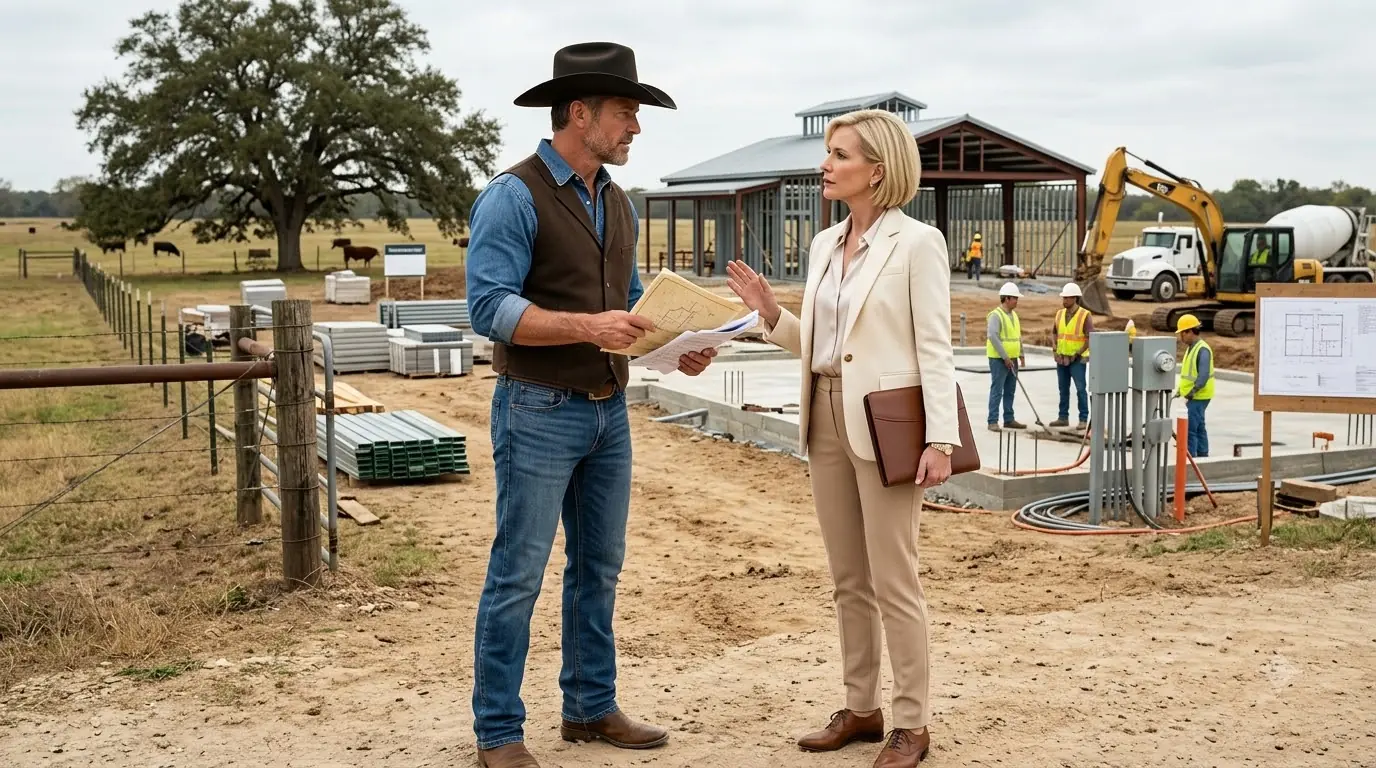
Behind her, an excavator idled beside a concrete foundation large enough to hold four engine bays.
Steel columns already rose twenty feet into the afternoon sky.
Electrical conduit ran through trenches.
Stacks of roofing material sat beneath plastic.
Nearly three million dollars’ worth of work had already gone into the site.
Karen looked at me as though all of that money made my argument impossible.
I looked past her toward the eastern pasture.
Then at the old oak tree standing behind the construction fence.
My grandfather had shown me that tree when I was seven years old.
He had tapped the bark with two knuckles and told me something I did not understand until forty-six years later.
“Maps change.”
He had said.
“Ground doesn’t.”
Now that oak stood inside Northridge Estates’ construction site.
So I looked at Karen and said:
“That fire station is sitting on my ranch.”
She laughed.
Not because anything was funny.
Because people sometimes laugh when certainty has become part of their identity.
“You have no idea what you’re talking about.”
“I know exactly what I’m talking about.”
“You think you can walk onto an active construction site and start giving orders?”
“I didn’t walk onto your construction site.”
“You built your construction site on my property.”
Her expression tightened.
“You have no authority to stop this project.”
I held up the worn leather folder in my hand.
Karen glanced at it.
Then smiled.
“You honestly think a cowboy hat and an old piece of paper are going to stop a twelve-million-dollar emergency-services project?”
I looked at the county surveyor standing twenty yards behind her.
Then at the sheriff.
Then at the contractor.
Then at the bright orange line David Mercer had marked across the gravel that morning.
The line ran beneath the future parking lot.
Through the equipment apron.
Across the station foundation.
And directly underneath two of the four engine bays.
I looked back at Karen.
“No.”
I said.
“The paper won’t.”
“The boundary will.”
Three months earlier, I had no idea any of this was coming.
My name is Thomas Hale.
I was fifty-three years old when Northridge Estates started building a fire station on land my family had owned for three generations.
The Hale Ranch sits outside Red Creek, Colorado, where the foothills flatten into open country before climbing again toward the mountains.
My grandfather bought the first eighty acres in 1959.
By the time I inherited the place from my father, the ranch covered a little more than one hundred forty acres.
Not a huge ranch by western standards.
But enough.
Pasture.
Creek bottom.
Ponderosa.
A barn.
A machine shed.
My house.
And a long eastern strip of rough ground my grandfather guarded with almost unreasonable seriousness.
At least, that was how it seemed when I was young.
The old boundary fence on that side was ugly.
Cedar posts.
Some replaced with steel T-posts.
Three strands of barbed wire.
Nothing straight.
Nothing photogenic.
But Grandpa Earl checked it every spring.
He kept notes.
He knew where every original monument sat.
He had a specific way of talking about property lines.
“You can lend a man a tractor.”
He once told me.
“You can lend him hay.”
“You can lend him money if you trust him.”
“But never lend him your boundary.”
I laughed when I was sixteen.
“What does that even mean?”
“It means the first time somebody treats your fence like a suggestion, you correct them.”
I thought he was being old-fashioned.
Grandpa had lived through neighbors arguing over irrigation ditches, grazing access, mineral leases, county-road alignments, and one ugly dispute involving twelve feet of creek frontage that divided two families for twenty years.
To him, a property line was not an abstract mark.
It was memory.
Responsibility.
Tax.
Liability.
Work.
He died when I was twenty-nine.
My father kept the ranch after him.
Dad was less dramatic about boundaries but just as careful.
Every deed.
Every tax statement.
Every survey.
Every water-right notice.
Everything went into a metal cabinet inside the old ranch office.
After Dad died, I continued paying the taxes and fixing fences, but I did not study those documents.
Why would I?
The property was mine.