Celeste Whitmore stood in front of my water tank like I had dragged a scrapyard into the middle of her beautiful neighborhood.
She looked me over from my work boots all the way up to my face, then placed a $3,000 homeowners association fine down on the hood of my truck.
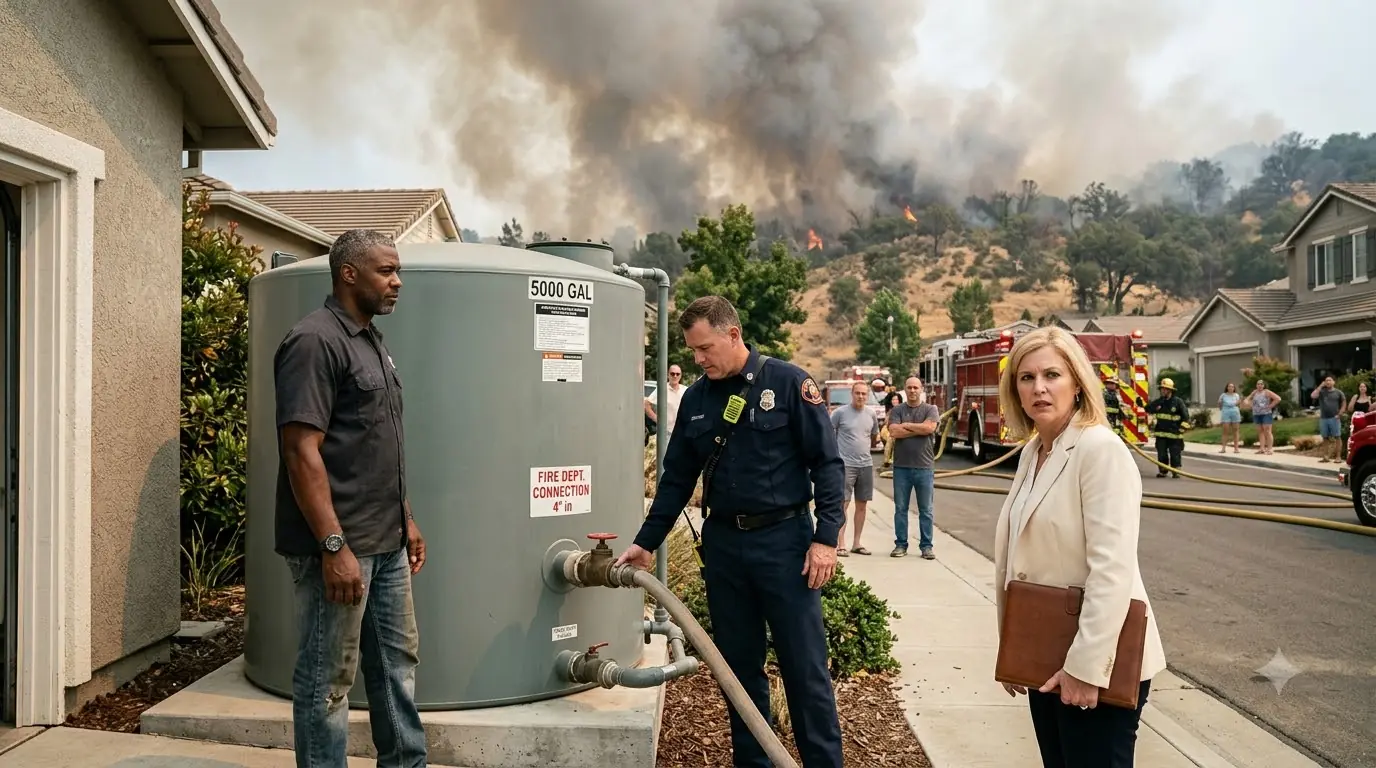
“This thing is an embarrassment, Darius. Take it down.”
Three weeks later, smoke covered the whole hillside behind Cedar Hollow.
A fire engine stopped right in front of my house.
Celeste came running, pointed at my tank, and told them it was already scheduled for removal.
The fire chief turned and looked at her.
“Nobody touches that tank.”
But he still did not know the worst thing the association had done.
Cedar Hollow Estates is not the kind of place people picture when they hear the word “estates.”
There are no gates made of imported stone, no security guard in a booth, no fountains lit up in colors at night.
It is a comfortable suburb of about 90 houses laid out along four curving streets, pressed up against a stretch of dry hills where the brush grows thick and gray-green.
The main road narrows to a single lane past the last cluster of mailboxes, and the service lane behind my property dead ends at a chain gate that county crews open maybe twice a year.
I bought my house six years ago because it was quiet, because the lot was deeper than most, and because from my back step I could see nothing but slope and sky.
I paid my dues on the first of every month.
I kept my grass cut.
I kept my gutters clean.
And in six years, I never once raised my hand at a meeting.
Then came a summer that did not behave.
We had almost no rain.
From March through August, the creek behind the service lane went to cracked mud, and the hills turned the color of old straw a full month earlier than usual.
I watched the fuel load build up along the fence line.
Every week, the way a man watches a bill grow when he already knows the amount.
In late August, I called a contractor I had worked with years before, and we installed a steel water storage tank behind my garage.
5,000 gallons.
Nine feet tall.
Gray-green paint.
Mounted on a poured concrete pad with a proper fill line and a valve assembly on the side facing my driveway.
It sat inside the legal rear setback, screened on two sides by the row of live oaks I had planted my second year in the house.
From the main road, you could not see it at all unless you stood in one particular spot at the end of the service lane and knew exactly where to look.
Celeste showed up on the last afternoon of the installation while the crew was still tightening fittings and washing concrete dust off the pad.
She came up the driveway in cream slacks and flat shoes that had never touched a job site, holding a leather folder against her chest the way other people hold a clipboard.
She was 52, always pressed, always pleasant on the surface, and she had a way of tilting her head that made every question sound like she was already disappointed in the answer.
She did not ask me what the tank was for.
She did not ask who installed it.
She did not ask whether I had pulled a permit or whether it was inside my property line.
She stood at the edge of the concrete, looked up at nine feet of painted steel, and let out a small breath through her nose.
“You were actually planning to leave that there,” she said.
I told her it was emergency water storage.
She laughed.
A short, polite sound with nothing behind it.
“Darius, this is Cedar Hollow. It is not a farm.”
I said I had checked the county requirements before I ordered anything, and that the pad location and setback were both cleared.
She looked at me then the way a substitute teacher looks at a student who has interrupted her lesson.
“The county does not live in our neighborhood,” she said.
Then she told me that people who worked with their hands often thought practical matters mattered more than presentable ones.
She said she did not blame me for it.
But a community like ours had to hold a line.
She said it as though she were doing me a kindness by explaining the world to me.
I did not argue.
I simply said, “Good afternoon.”
Then I walked her to the top of the driveway and watched her get in her car.
Before leaving, she backed out slowly enough to look at the tank one more time in her mirror.
Two days later, there was an envelope in my mailbox with the association letterhead on it.
It was not a request for information.
It was not a courtesy notice asking me to describe the structure or submit a plan.
It was a fine for $500 dated the same afternoon she had stood on my concrete pad.
The violation:
Unauthorized exterior structure visible from common property.
I read that citation four times.
Then I went inside and pulled the covenants out of the drawer where I keep the paperwork that matters.
The language in that section was as loose as anything I had ever seen.
Written by a lawyer who was paid by the hour.
It prohibited unapproved exterior structures visible from common property.
And it never once defined common property.
Never gave a sightline standard.
Never specified whether a rear utility installation counted as a structure at all.
The tank was behind my garage.
Common property in Cedar Hollow meant the entrance island, the mail kiosk, and a narrow strip of grass along the north curve.
From all three of those places, my tank did not exist.
The only angle from which anybody could see it was the service lane.
And the service lane belonged to the county, not the association.
So I did what I always do.
I put paper against paper.
I sent the association a full package by certified mail and kept copies of everything.