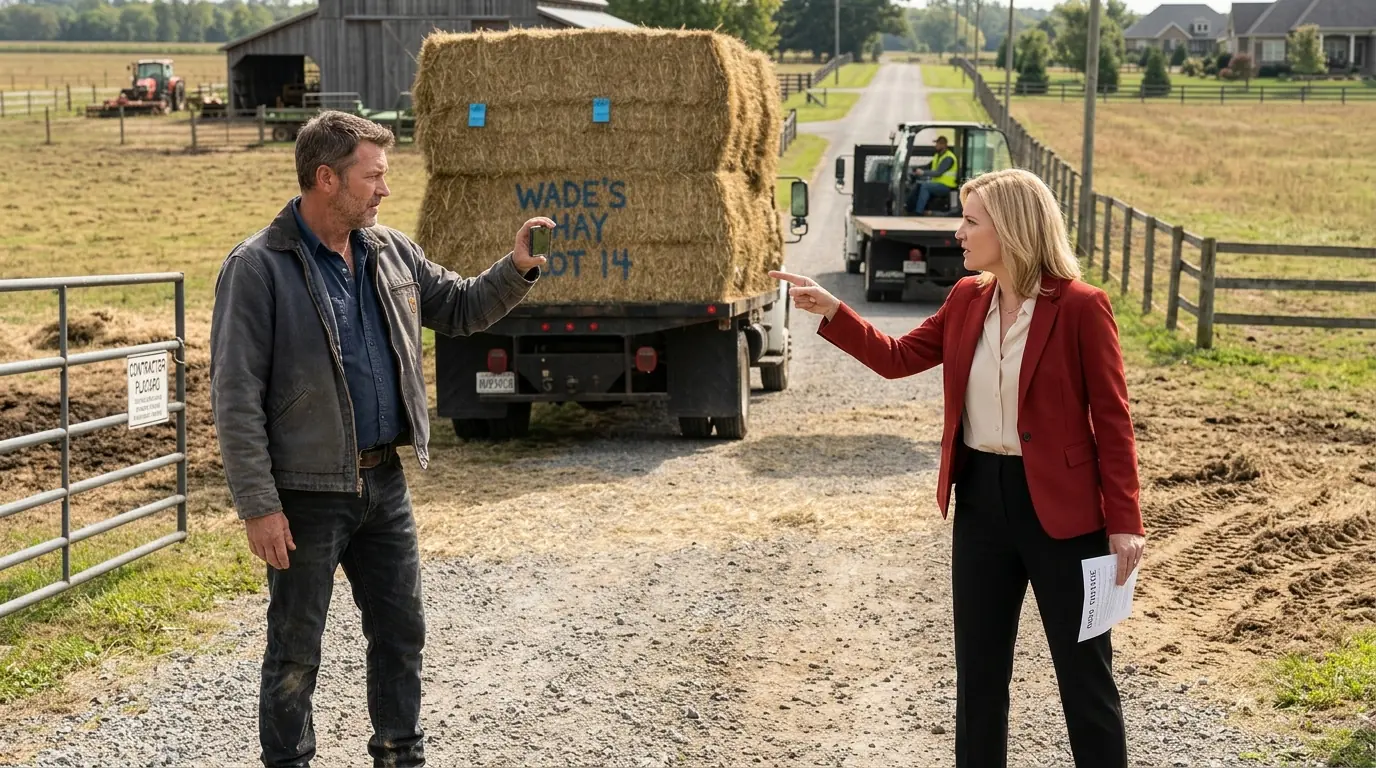
"Touch that truck and I'll have you cited for interference," Marissa Cole barked as another load of my hay rolled toward the highway.
She stood in the middle of my farm lane in a red blazer, gripping an HOA violation notice like a warrant.
I kept my hands at my sides.
"You hauled off 48 bales I already sold."
She didn't blink.
"We protected the neighborhood."
My phone rang behind her next sentence. The screen showed the county fire marshal's office.
I didn't answer right away.
I raised my phone instead and caught the second flatbed in frame as it passed the gate. The company name was printed across the cab door. I zoomed in on the plate, then on the white work order sheet clipped behind the driver's seat.
Marissa stepped closer.
"You were notified."
"I was notified that you considered the hay a hazard," I said. "That isn't the same thing as permission to remove it."
Behind her, the loader operator lowered his forks toward the last row.
Forty-eight large square bales had been stacked there before breakfast. By then, fewer than a dozen remained. They were winter feed inventory I had already contracted to sell, not brush piles or trash.
One bale still had the blue buyer tag tied beneath its twine, and another had my lot number sprayed across the end.
Nothing about that stack looked abandoned, temporary, or forgotten.
I had proof.
The notice in Marissa's hand carried the Silver Creek HOA letterhead and a bold line that read, "Fire Safety Correction."
I had received a copy two days earlier.
It told me to address combustible material near the community boundary, but it did not name a county inspector, list an inspection date, or attach any order from the fire office.
That was why I had written back instead of moving anything.
I walked toward the empty section of gravel without touching anyone or blocking the equipment.
Deep tire impressions crossed the pad where the first stacks had stood. Loose flakes of hay were caught in the ruts.
I photographed each track, the remaining bales, the loader, both trucks, and the orange contractor placard wired to the temporary gate.
The foreman glanced at Marissa before answering me.
"Who authorized the pickup?"
He pointed toward the paper in her hand.
"Work order came through the association."
"Do you have a job number?"
He read it off his tablet.
I wrote it down along with the time and the name stitched over his shirt pocket.
That changed the moment for me.
Up to then, Marissa could still frame the scene as an argument between a homeowners association and a stubborn farmer.
A numbered contractor order meant there was a record somewhere: who requested the work, what they claimed the emergency was, when they approved entry, and what they told the hauling company about my property.
Marissa must have understood that too, because her voice tightened.
"You can document whatever you want. The board acted for public safety."
My phone rang again.
Same number.