The first sound was metal on metal. Clang. Clang. Clang.
It was 6:42 a.m. on a Tuesday in late September, and someone was attacking the back gate of my property with what sounded like a hammer. I set my coffee on the nightstand, pulled on my robe, and walked to the back porch.
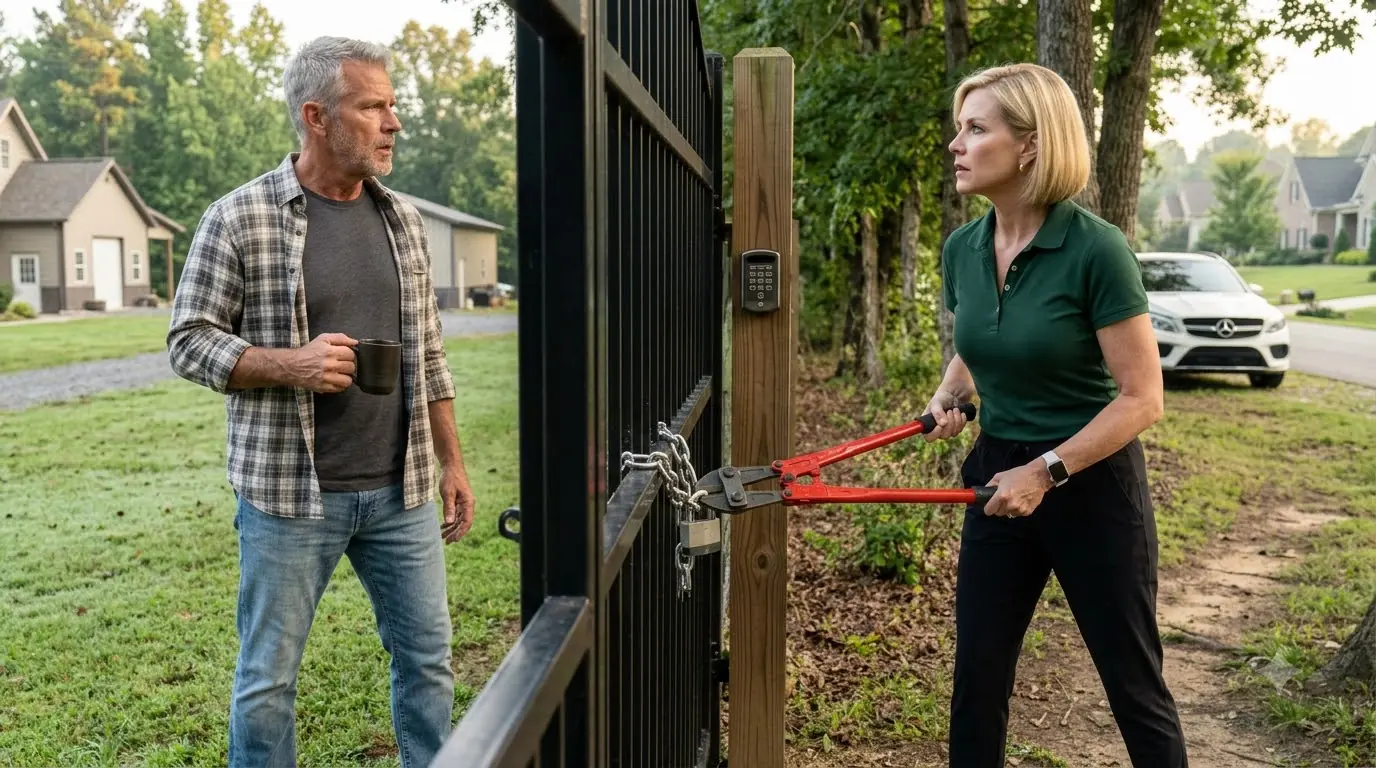
From the deck, I could see her clearly. A woman in a Maple Crest HOA polo and yoga pants was gripping a pair of bolt cutters in both hands, working the lock on my new steel gate like she was trying to cut a snake in half. She saw me. She did not stop.
“Open this gate,” she said. She said it like a manager talking to a staffer, no good morning, no question, just an order on my land, in my robe, before I had even had my second sip of the day. “This is our shortcut,” she shouted, jabbing one finger at the dirt trail behind the gate. “It has always been our shortcut. Open it or I’m calling 911 and the HOA, and you are going to lose this house. Do you understand me?”
Her name was Janine Whitmore. She lived four houses inside Maple Crest, the subdivision that bordered my parcel on the north side. I knew her name because I had typed it six months earlier into a court filing she had never bothered to read. I did not say anything yet. I just watched.
She switched modes the way people like her do, from rage to performance the second she realized I was filming her on my phone. “Sir, I am the president of the Maple Crest Homeowners Association,” she said, suddenly clear and slow, the way you talk to a jury. “You are obstructing community access to a recognized shortcut, and I am formally documenting this incident for the violation report.” She raised her own phone and panned it across my gate, slowly, from four angles, like a claims adjuster.
“What is your name, sir?” she asked.
I did not answer.
“Sir, I asked for your name.”
I sipped my coffee.
She took that as aggression. She took everything as aggression. “I see how it is. Squatter on HOA-protected land, won’t identify himself, refuses access. You are going to find out very quickly that this neighborhood does not tolerate people like you, squatter.”
She was saying that on a property whose deed was sitting in a manila envelope on the kitchen table fifteen feet behind me, a deed that had been recorded for eight months with my name on the front page and a county stamp on the back. I let her run. She held up three fingers like a teacher.
“Three things,” she said. “One, that gate is gone by Friday or you are looking at $250 a day in HOA fines, escalating. Two, I am calling the sheriff this week to report obstruction of a community easement. Three, when I am done with you, you will not be able to sell this house in this county. Do you understand me, sir?”
She did not wait for an answer. She bent down, dropped the bolt cutters on the dirt clean and deliberate, like she was leaving a calling card, and walked back to her white SUV with the kind of stride people use when they think they have just won something. The SUV door slammed. The engine started, the taillights cut a small red arc against the trees, and she was gone.
I stood on the porch for a long minute. The gate was untouched. The bolt cutters had not even scratched the lock. She had been swinging them like a drama instructor, not a locksmith.
The Ring camera above the gate post had caught every second of it, including the part where she identified herself by name and title, threatened a lien, and announced on tape that she planned to use the sheriff to coerce me off a recorded easement that did not legally exist. I walked down to the gate in my slippers. I picked up the bolt cutters. They were heavy, cheap, and almost new.
I carried them back up the porch steps and set them next to the manila envelope on the kitchen table. Inside that envelope were the recorded deed for my four-acre parcel, the county-stamped 1998 plat of Maple Crest, a quiet title judgment granted by default in March naming Janine Whitmore in her capacity as Maple Crest HOA president, and a green return-of-service card stapled to the back showing her signature in blue ballpoint pen.
I made another coffee. I thought about Ruth, the woman who had owned this land before me. I thought about the promise I had made her the day I signed the closing papers, when she held my hand with both of hers and asked me, almost whispering, “Please don’t let her win this time.”
I thought about how Janine Whitmore had just stood on my property in her HOA polo screaming about a shortcut that had always been hers. She did not know I had already settled that question in writing with the county three weeks before she ever saw the gate. She did not know she had signed the receipt for it herself.
After her SUV disappeared down the county road, I sat at the kitchen table for a while and watched the steam come off my second coffee. I am sixty-one years old. I retired three years ago after thirty years of land surveying in this county, the kind of job most people do not think about until they need a fence line settled or a property dispute closed. I have walked more property lines than I can count and signed my name in the corner of more recorded plats than I can remember.
After thirty years, I learned one thing about land that almost nobody outside the profession understands. The dirt does not care what people think they own. It only knows what is written down. Janine Whitmore had no idea she was screaming at the wrong man.
I bought this parcel eight months ago from a woman named Ruth Calloway. She was seventy-eight years old, a widow, and tired in a way that had nothing to do with her age. The first time I walked the property with her, she barely made it to the back fence before she had to sit down on a stump and rest. She apologized. I told her to take her time.
We sat on that stump for almost an hour. That was when she told me about the shortcut. The way Ruth told it, it had started innocently enough twelve or thirteen years earlier. A neighbor in Maple Crest had asked, politely, if her son could cut across Ruth’s land to get to the school bus stop on the county road. It saved him about five minutes.
Ruth said yes. He was a nice kid. Then his friends started cutting through. Then their parents, then strangers from three streets deeper in the subdivision, then joggers, dog walkers, and eventually SUVs.
By the time Ruth realized her quiet trail had become a shortcut for the entire north end of Maple Crest, she had been letting people cross for years. She tried to push back. She put up a small wooden sign. Someone tore it down within a week.