The excavator’s bucket came down on my dam at 7:14 on a Tuesday morning.
I was standing forty feet away in red Georgia clay, still wearing the boots I had pulled on without socks when the noise woke me.
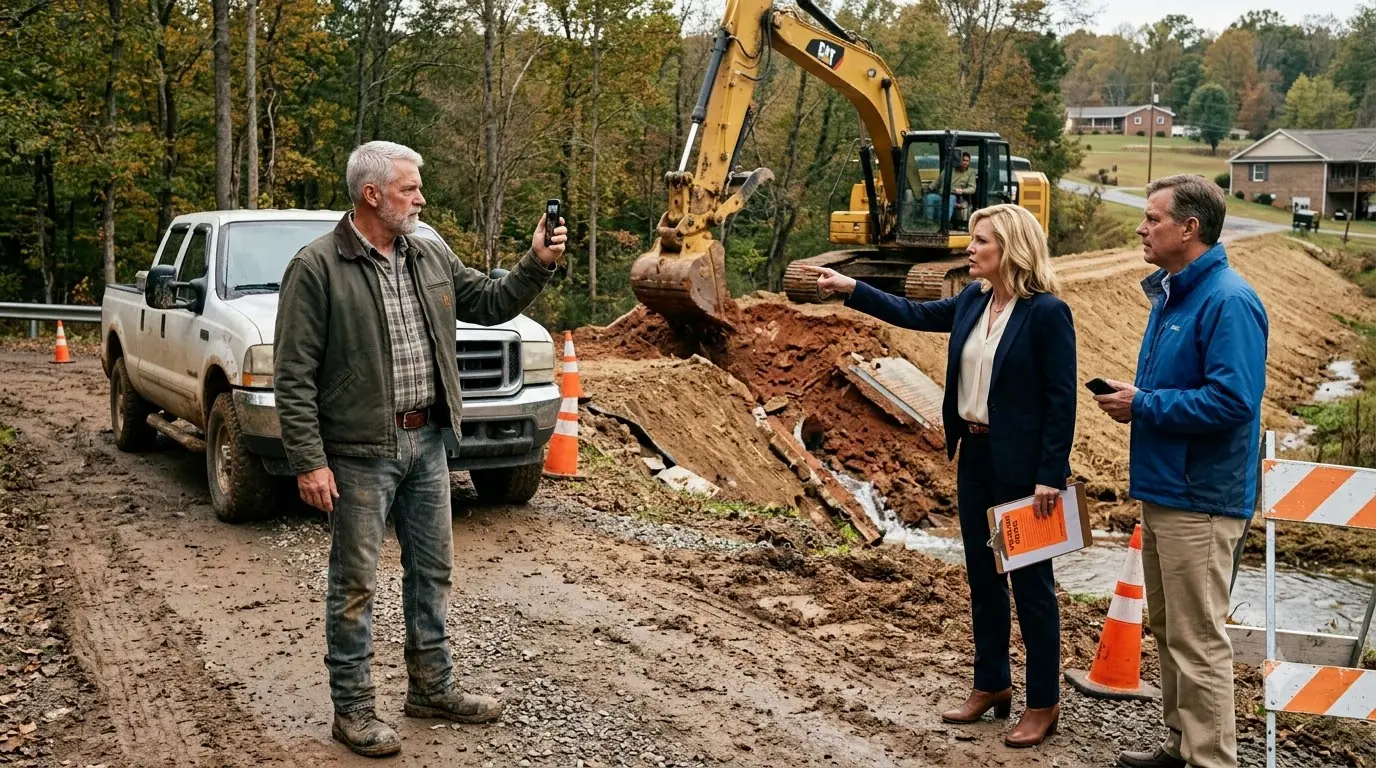
The first impact did not look catastrophic.
A steel tooth disappeared into the compacted face of the earthen berm, bit through reinforced soil, and tore away a section roughly the size of a kitchen table.
Wet dirt rolled down the slope.
A thin brown ribbon of water immediately appeared where no water should have been.
Karen Whitfield barely looked at it.
She stood beside the access road in a bright cream jacket, dark trousers, polished boots, oversized sunglasses, and the leather clipboard that seemed to accompany her everywhere.
She flicked two fingers toward me.
“You can stand over there.”
Her tone suggested I was a subcontractor she was allowing to observe.
“We’re almost finished.”
I looked past her at the yellow excavator.
Then at the Ridgeworks Demolition truck parked sideways across my gravel entrance.
Then at the orange notice nailed through the bark of an oak tree on my property.
“You’re tearing down a permitted flood-control structure.”
Karen pulled a second orange sheet from the clipboard.
“No.”
“We’re removing an unauthorized structure located inside the Cedar Ridge community service watershed.”
“My land isn’t in Cedar Ridge.”
She smiled.
“We’ve explained this to you repeatedly.”
Tom Briggs stood ten feet behind her.
Tom was the HOA vice president.
Sixty-one.
Broad shoulders.
Red face.
Retired regional sales manager who had apparently spent thirty years learning that volume could substitute for authority.
He raised his phone.
“One step toward that machine and I call 911.”
I looked at him.
“For trespassing?”
“Yes.”
“On my own property.”
“You’ve been notified.”
There are moments in life when anger becomes so complete it circles back into calm.
That was one of them.
I did not move.
My phone was clipped inside the breast pocket of my jacket, recording.
The small dash camera I had grabbed from my bedroom was mounted magnetically to the hood of my truck behind me.
It had been rolling since I came down the hill.
Karen had not noticed either one.
Or perhaps she had and simply did not care.
Confidence makes people careless.
She looked down at her paperwork.
“Outstanding balance.”
“Eleven thousand four hundred dollars.”
“Eighteen months of unpaid community assessments, late fees, enforcement costs, and structural violation penalties.”
I said nothing.
Karen continued.
“Section fourteen of the Cedar Ridge covenants authorizes the board to recover against assets connected to properties in default.”
I almost smiled.
That sentence was worth more to me than she understood.
She had just stated, on camera, that they were demolishing the dam as a collection action for HOA dues I did not owe.
My fourteen acres were not part of Cedar Ridge.
Never had been.
I had never signed a covenant.
Never paid dues.
Never accepted membership.
I had declined their so-called voluntary annexation offer in writing eighteen months earlier.
Karen knew that.
She simply believed a board vote had magically moved my property line.
Behind her, the excavator operator leaned from the cab.
“Mrs. Whitfield.”
Karen turned.
“What?”
“I need the permit release before I go farther.”
“You have our work authorization.”
“I’m asking about county or state.”
Karen lowered her sunglasses.
“The HOA has reviewed all applicable authority.”
The operator hesitated.
“I was told this is a water-control structure.”
“It is a dirt embankment.”
“It has a spillway.”
“It has weeds.”
The man looked toward me.
I called out:
“Your company should stop until you verify permit SWR-17-0418.”
Karen snapped:
“Do not take instructions from him.”
The operator looked between us.
“Ma’am, if this is state-regulated…”
“It isn’t.”
She lifted the clipboard.
“You were hired for demolition.”
“If you have concerns, submit them to the board in writing after completion.”
Tom laughed.
“Just finish it.”
The operator did not look comfortable.
But he climbed back inside.
The machine rotated.
The bucket rose.
I knew exactly where it was going to strike.
The center-left section of the primary berm.
The strongest part.
The section I had overbuilt because runoff from the northern ridge concentrated there during long-duration storms.
The bucket came down.
There was a deep tearing sound.
Not explosive.
Not spectacular.
Worse.
The compacted core opened along a diagonal seam.
Water appeared slowly.
First a trickle.
Then several trickles.