My wife stood on our back deck with a suitcase beside her and said, “I’m moving out tonight. Don’t call me again.”
For a few seconds, the only sound was fat dripping from the rib eyes onto the grill.
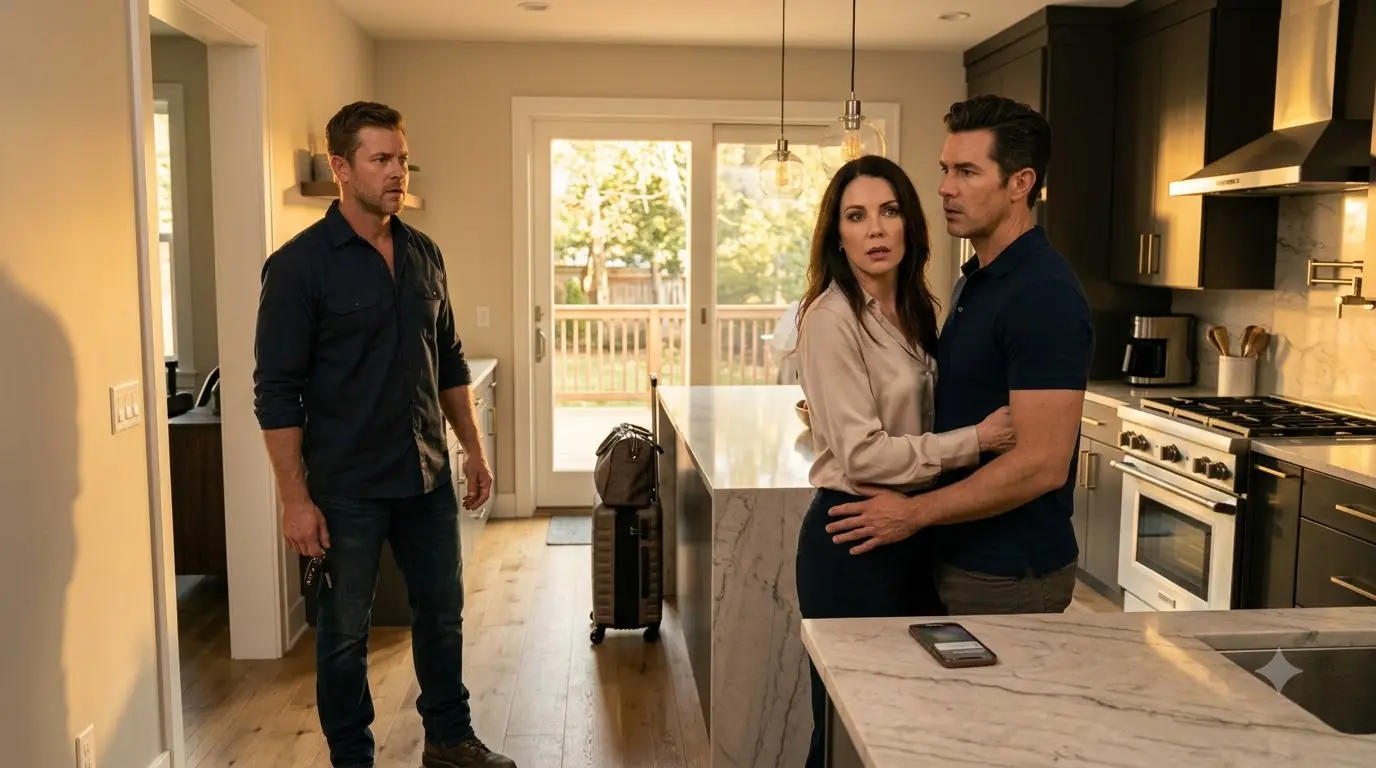
I looked at the steaks.
Then at Erica.
Then at the suitcase sitting beside the sliding door.
Seven years of marriage had apparently been reduced to one piece of luggage, a white linen outfit, and a sentence delivered with the same calm tone she used when canceling a lunch reservation.
“Fine,” I said.
That was not the answer she expected.
I saw it immediately.
A tiny pause.
A tightening around her mouth.
The expression of someone who had rehearsed a scene and suddenly discovered the other actor had changed the script.
Three days later, Erica was pounding on my front door because her credit card had been declined while she was having dinner with the man she left me for.
That was when I finally understood something I should have understood months earlier.
Erica wanted independence from our marriage.
She did not want independence from the life my income had built.
My name is Mark Callahan.
I was forty-two when my marriage ended.
I lived outside Wilmington, North Carolina, in a cedar-sided house with a small private dock behind it and too many tools in the garage.
I owned one-third of Harborline Marine, though most customers simply called it my business because I had become the public face of it.
Harborline did boat storage, engine service, dock repairs, trailer work, winterization, hull cleaning, electrical troubleshooting, storm recovery, and emergency calls from men who always began with the same sentence.
“It was running perfectly five minutes ago.”
Usually, whatever came next sounded like a blender full of bolts.
I liked that work.
Boats were expensive, temperamental machines operated by people who frequently believed money could negotiate with physics.
They taught patience.
They also taught warning signs.
A transmission rarely destroyed itself without saying something first.
A bilge pump did not fail silently forever.
A hull problem usually began as one crack, one bubble, one damp smell somebody explained away.
Expensive failures began small.
That was true of machines.
It turned out to be true of marriage too.
I did not come from money.
My mother, Claire Callahan, raised me by herself after my father disappeared before my eighth birthday.
She worked mornings at a dental office and evenings doing bookkeeping for a small construction company.
I learned early that unpaid bills did not care whether you were tired.
Electric companies did not accept grief as payment.
Grocery stores did not lower prices because a single mother had worked fourteen hours.
My two closest friends grew up under similar conditions.
Ray Porter lived two streets away.
Sam Whitaker lived above his parents’ hardware store.
We met at sixteen while washing boats at a marina for cash and whatever food the dock manager forgot to lock away.
Ray could fix an engine before he could legally drive.
Sam could organize a mess so naturally that by seventeen he was running the dock schedule better than the adult manager.
I had confidence.
Not justified confidence.
The kind broke young men develop because believing failure is possible feels too expensive.
At twenty-eight, we put everything together.
Ray had $18,000.
Sam had $22,000.
I had $31,000, mostly from years of overtime and one small inheritance from my grandfather.
We leased a corrugated metal building near the Cape Fear River.
The roof leaked.
The parking lot flooded.
Our office consisted of one desk, three folding chairs, and a coffee maker that eventually became a health-code concern.
We called the company Harborline Marine.
The first year nearly destroyed us.
Customers paid late.
Suppliers wanted deposits.
We underestimated labor constantly.
Ray could diagnose anything but hated paperwork.
Sam could calculate a job to the dollar but had the interpersonal warmth of a tax notice when customers tried to bargain.
I was the one who stood between them and the world.
Our first major legal problem came six months in.
A wealthy customer damaged his own engine after ignoring Ray’s written warning.
He blamed us.
Our service agreement was so badly written that his attorney stared at it for several minutes, then asked who had drafted it.
I said:
“Me.”
He laughed.
That attorney was Peter Nolan.
His father kept an old fishing boat at the marina.
We had repaired it after Hurricane Irene damage.
Peter looked over our paperwork as a favor.
He handed the contract back and said:
“Mark, if a sneeze had liability, this document would still lose.”
I remember looking at Ray.
Ray looked at Sam.
Sam looked at the contract.
Then Peter laughed.
“Relax. I can fix it.”
He did.
Then he fixed our corporate structure.
Insurance language.
Employee agreements.
Storage contracts.
Vendor terms.
Over the years, he became more friend than attorney.
That mattered later.
By the time I met Erica, Harborline had two storage yards, one full service bay, twenty employees, and seasonal agreements with three yacht clubs.
We were not rich.
We were stable.
For me, stable felt rich enough.
I met Erica at a coastal hospitality fundraiser.