At exactly 7:03 on a cold November morning, a yellow excavator rolled across my backyard and stopped beside Coho Creek.
The machine weighed enough to leave tracks six inches deep in the wet grass.
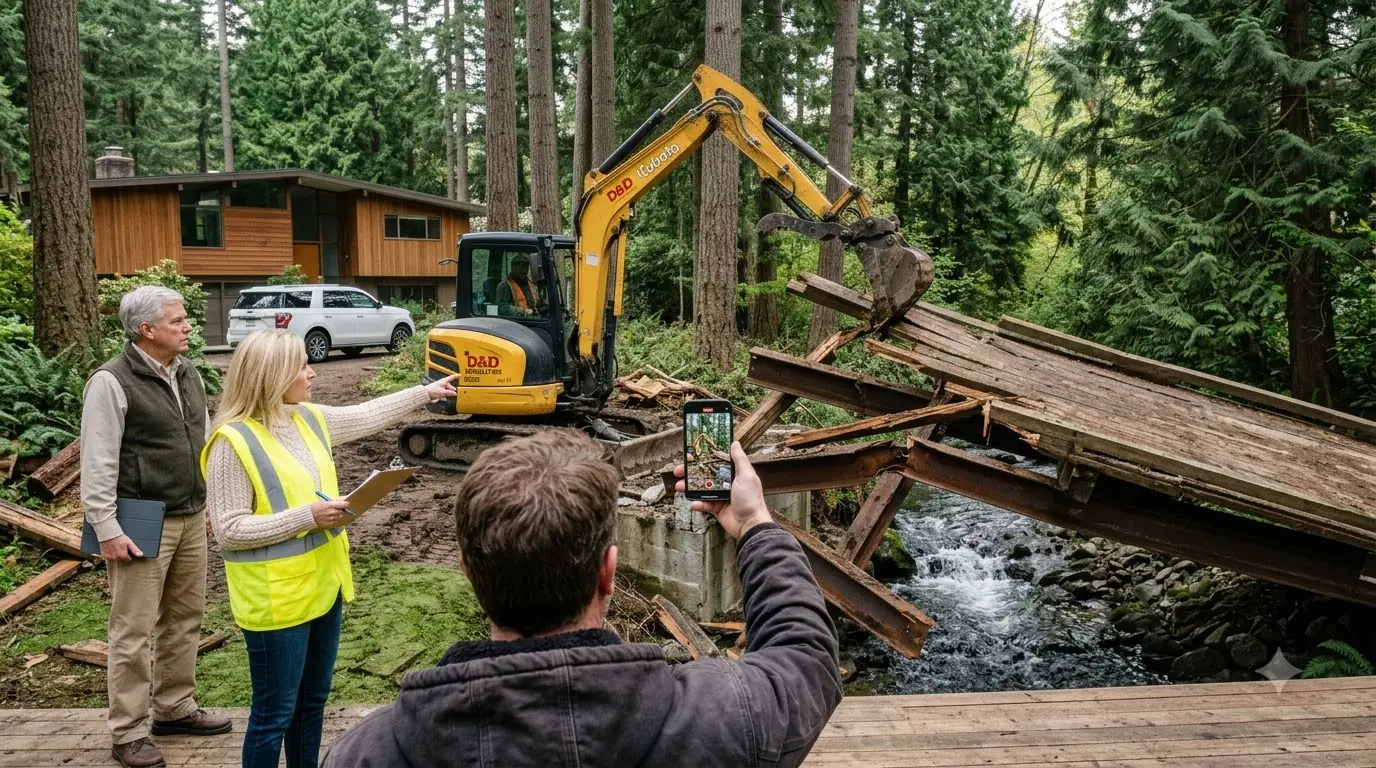
Behind it stood Susan Whitmore, president of the Pinehurst Enclave Homeowners Association, wearing a bright yellow safety vest over an expensive cream sweater and smiling as if she had personally won a war.
Her vice president, Greg Toland, stood beside her with a clipboard tucked beneath one arm.
Three members of the board had come to watch.
So had two neighbors.
Susan wanted an audience.
She wanted everyone in Pinehurst Enclave to see what happened when a homeowner refused to obey her.
I stood on my back deck holding a cup of coffee.
Three security cameras were recording.
My phone was recording.
And inside my kitchen, laid neatly across the island, was a folder containing the county plat, the recorded easement, thirty years of flood-control documents, certified-mail receipts, photographs, emails, and one particularly useful message from Susan herself.
THE BRIDGE COMES DOWN NEXT WEEK.
SEE YOU TUESDAY.
I had printed that one twice.
The excavator operator looked toward me.
His name was Jim Mercer.
He was maybe forty-five, thick through the shoulders, wearing a brown work jacket with APEX CONTRACTING SERVICES stitched over the chest.
I raised my voice.
“Jim.”
He killed the throttle but left the engine idling.
“You’re Dave Harding?”
“Yes.”
He glanced toward Susan.
“I was told you were expecting us.”
“I was expecting you.”
That was not the same thing.
I stepped down from the deck.
“I need you to understand something before you touch that bridge.”
Susan immediately moved toward us.
“Oh, for God’s sake.”
I ignored her.
“The bridge does not belong to me.”
Jim frowned.
“The work order says homeowner structure.”
“It isn’t.”
I pointed toward the creek.
“That bridge is part of a recorded flood-control access corridor.”
Jim looked at the heavy timber deck and rust-colored steel beams.
Then at me.
I continued.
“It was installed for county flood-control access before this neighborhood existed.”
Susan laughed.
Loudly.
Deliberately.
“You’ve been repeating this nonsense for months.”
Jim looked increasingly uncomfortable.
I took my phone from my pocket.
The recording indicator was visible.
“For the camera, Jim, I am the owner of this house.”
“Okay.”
“I am not authorizing you to demolish that bridge.”
He stared at me.
“I am also telling you that I believe you are about to damage public infrastructure and disturb a protected stream without the required authorization.”
Susan stepped between us.
“That is enough.”
She turned toward Jim.
“The association has already indemnified your company.”
Jim rubbed his jaw.
“Susan…”
“We signed everything.”
She pointed toward the creek.
“You were paid to remove an unauthorized eyesore.”
“It violates our architectural standards.”
I almost laughed.
The bridge looked exactly like what it was.
Industrial.
Heavy.
Functional.
Twelve feet wide.
Roughly twenty feet long.
Thick timber decking over steel beams anchored to concrete abutments.
Nobody would confuse it with landscaping.
Jim asked Susan:
“You sure the ownership’s clean?”
Her eyes narrowed.
“Absolutely.”
I said:
“It isn’t.”
Susan spun toward me.
“Dave, this performance is over.”
Then she looked at Jim.
“Start the machine.”
He hesitated.
Susan lowered her voice.
“Apex works for six associations I’ve referred you to.”
That was the moment.
Even from fifteen feet away, I saw Jim understand the threat.
Lose this job, perhaps lose future work.
He looked at me once more.
“I’m just following the contract.”
“I understand.”