For seventeen years, the machinery sheds on Leonard Bower’s farm had been filled with green paint.
To most people in Kingman County, Kansas, that did not seem remarkable.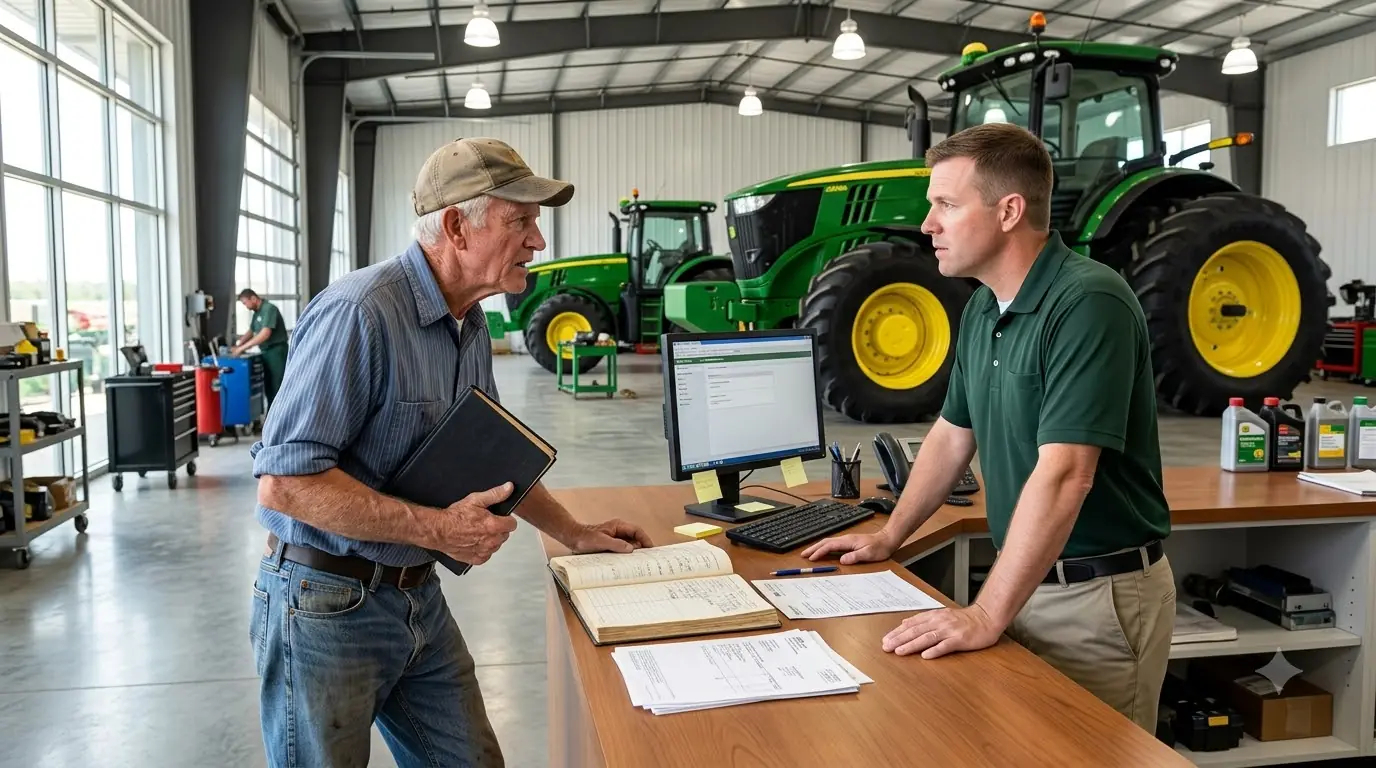
Brand loyalty in farm country could run almost as deep as family loyalty.
A farmer bought what his father had trusted, serviced it at the same dealership his neighbors used, learned every switch and grease fitting by feel, and stayed with that system until something gave him a reason not to.
For Leonard Bower, that reason eventually arrived in the form of a small steel coupling that cost less than a single rear tractor tire.
The coupling itself was ordinary.
What happened after it failed was not.
Leonard was seventy-two years old when the failure occurred, but he still worked his ground with the discipline of a man twenty years younger.
His farm covered roughly 3,100 acres of grain sorghum, wheat, rotational forage ground, and seasonal cover crops across several connected parcels in Kingman County.
Some of the land had belonged to his family for three generations.
Other sections had been purchased carefully over forty years, usually when neighboring families retired or when a small parcel fit naturally into his existing field layout.
Leonard did not consider himself wealthy.
The balance sheets told him the farm had substantial value, but farmers understood the difference between owning valuable land and having money available on Monday morning.
Land could make a man look rich while diesel, fertilizer, seed, insurance, repairs, taxes, and interest quietly emptied his checking account.
Leonard therefore thought in margins.
He knew what one extra gallon of diesel per acre meant across 3,100 acres.
He knew what a two-bushel yield difference meant when multiplied across an entire sorghum contract.
He knew how many productive field hours disappeared when a tractor went down at 2:00 in the afternoon instead of 7:00 in the evening.
Most importantly, he knew something his father had taught him before he was old enough to understand bookkeeping.
Time was a cost.
Farmers who ignored it usually discovered the bill after harvest.
The second week of April was therefore not simply another date on Leonard’s calendar.
It was a working window.
Winter had finally released its grip on southern Kansas.
The topsoil had warmed enough that Leonard could begin moving through fields without fighting cold, sticky ground.
Daytime temperatures were becoming reliable.
The spring winds had not yet dried the upper soil profile into powder.
The planting sequence Leonard had planned during January finally had a narrow path to begin.
His first priority was approximately 3,100 acres that had to be worked in a carefully staged order.
Some ground needed only a light preparation pass.
Other sections required heavier tillage because of residue conditions left after the previous season.
Leonard had already mapped the sequence on a large laminated field chart hanging beside the shop office.
Every field had a number.
Every field had a target date.
Every tractor had a job.
At the center of that plan was his John Deere 7R 330.
The tractor had become his primary high-horsepower workhorse.
Leonard had purchased it because he needed a machine capable of long days pulling heavy implements without constantly operating at the edge of its power range.
He knew its controls without looking.
He knew which vibration in the seat came from the implement and which meant something in the tractor itself needed attention.
He knew the pitch of the engine under load.
He could usually tell whether the machine was working comfortably simply by listening.
That Monday morning began exactly as he wanted.
The sky was clear.
Wind was moderate.
The previous night’s temperature had remained above freezing.
By midmorning, Leonard had already covered a respectable amount of ground.
He had a thermos beside the seat and his old black pocket notebook tucked into the chest pocket of his work shirt.
The 7R 330 pulled steadily.
Then, without warning, the hydraulic pressure dropped.
There was no explosion.
No grinding noise.
No cloud of smoke.
Nothing dramatic enough to match the size of the consequences that followed.
One second, the implement responded normally.
The next, the hydraulic reading collapsed toward zero.
Leonard immediately lifted his hand from the controls.
The implement stopped responding.
He throttled down.
Set the parking brake.
Then sat for several seconds listening.
The engine still sounded healthy.
No obvious metal failure.
No major fluid spray visible from the cab.
That narrowed the possibilities.
Leonard climbed down.
At seventy-two, getting in and out of tractors was no longer something he did carelessly.
One knee had begun reminding him every morning that it had survived seven decades.
Still, he moved with the practiced economy of someone who had climbed those steps thousands of times.
He opened the relevant access panel and began tracing the hydraulic drive area.
His hands were already dirty within two minutes.
A few minutes later, he found the problem.
The hydraulic pump drive coupling had sheared.
Leonard stared at it.
A small part.
A sacrificial part by design.
Something intended to fail before a more expensive component destroyed itself downstream.
He had seen similar couplings before.
Mechanical parts wore out.
That did not offend him.
He did not expect machinery to be immortal.
What mattered was what happened after failure.
Leonard walked back to his pickup, removed his notebook, and wrote:
MONDAY, APRIL 8
7R 330
ENGINE HOURS: 2,846.7
10:38 A.M.
HYDRAULIC PRESSURE LOSS
PUMP DRIVE COUPLING FAILED
He underlined the final line once.
Then he called the John Deere dealership in Kingman.
Leonard had been doing business there for seventeen years.
Seventeen years was enough time to know the voices on the phone.
Enough time to know which service technician liked strong coffee and which parts clerk had a grandson playing football at the local high school.
Enough time to remember when the service department had been smaller and mechanics sometimes drove directly to the farm after supper if a combine went down during harvest.
The service manager answered.
“Kingman service, this is Dale.”
“Dale, Leonard Bower.”
“Morning, Leonard.”
“I’ve got the 7R down.”
The tone changed immediately.
“What happened?”
“Hydraulic pressure disappeared clean.”
Leonard gave him the symptoms.
Then the coupling diagnosis.