The county fair smelled like sugar, grease, and wet dust, the kind of smell that clings to a person long after the lights come down and the rides go still. By nine-thirty on a humid August night, the main crush had thinned into drifting clusters: teenagers sharing funnel cake under strings of bulbs, exhausted parents steering sticky children toward the parking field, high-school workers slumping against game booths while carnival music leaked tinny and persistent into the dark. The Ferris wheel turned above everything with its slow jeweled glow, red and blue and gold reflected in puddles left by the afternoon sprinkler truck that had tried and failed to settle the dust. From the livestock barn came the faint stubborn smell of hay, manure, and warm animal breath. From the midway came fried dough, sausage smoke, and the mechanical whine of motors still spinning for the few people not ready to go home.
David Harper had always loved county fairs for reasons he would have struggled to explain without sounding sentimental. He was forty-eight, broad-shouldered, thickening at the waist in the ordinary manner of men who still thought of themselves as athletic because they once were, and he wore the same battered baseball cap to every fair, football game, and hardware-store run as if the cap itself proved continuity. He liked the informality of a place where nobody needed reservations, where dinner could be corn dogs and lemon shake-ups, where adults turned forgivingly silly and children believed the giant rides in the dark were a kind of magic. He had been coming to this fair for almost twenty-five years, first with college friends, then with the woman who became his wife, and later with nieces, nephews, and borrowed children from the neighborhood once it became clear that he and his wife were never going to have kids of their own.
His wife, Linda, still said he walked through a fairground like a man moving through a memory. Linda Harper was forty-seven, compact and strong in the way women become after years of carrying more practical responsibility than anybody ever counts. She wore a denim jacket over a striped T-shirt despite the heat because the evenings always cooled around the shoulders, and she held a pink cloud of cotton candy in one hand with the absent confidence of someone who could eat two bites of sugar and spend the next hour claiming she didn’t want any more. Her hair, once bright blond and now the softer dark gold of middle age, was pulled into a loose ponytail through the back of a baseball cap she had stolen from David years ago and never returned. On most nights in most places, they looked exactly like what they had spent two and a half decades becoming: an ordinary married couple drifting comfortably inside the small rituals that accumulate into a shared life.
That was the lie the Ferris wheel lit for them.
They had been bickering lightly over whether to stay long enough for fried Oreos when David saw the stuffed bear first. It was clamped under the arm of a little boy standing in the path ahead, a cartoonishly oversized blue thing with a red ribbon bow and one bent ear. The boy’s free hand was tucked into the fingers of a woman David recognized one fraction of a second before his body registered fear.
He did not stop gracefully. His whole movement hit a wall inside him. One step, then a second that went nowhere, his cotton candy tilting dangerously in his hand as if even the sugar had lost direction.
Linda took two more strides before she noticed David was no longer beside her.
When she turned, she saw first the woman. Black, maybe early thirties, tired around the mouth but standing very straight. Then the boy, five years old or near enough, with close-cropped curls, fine brown skin, and a serious little face tipped upward in the bright ride lights as if trying to determine whether this was finally the moment he had been promised.
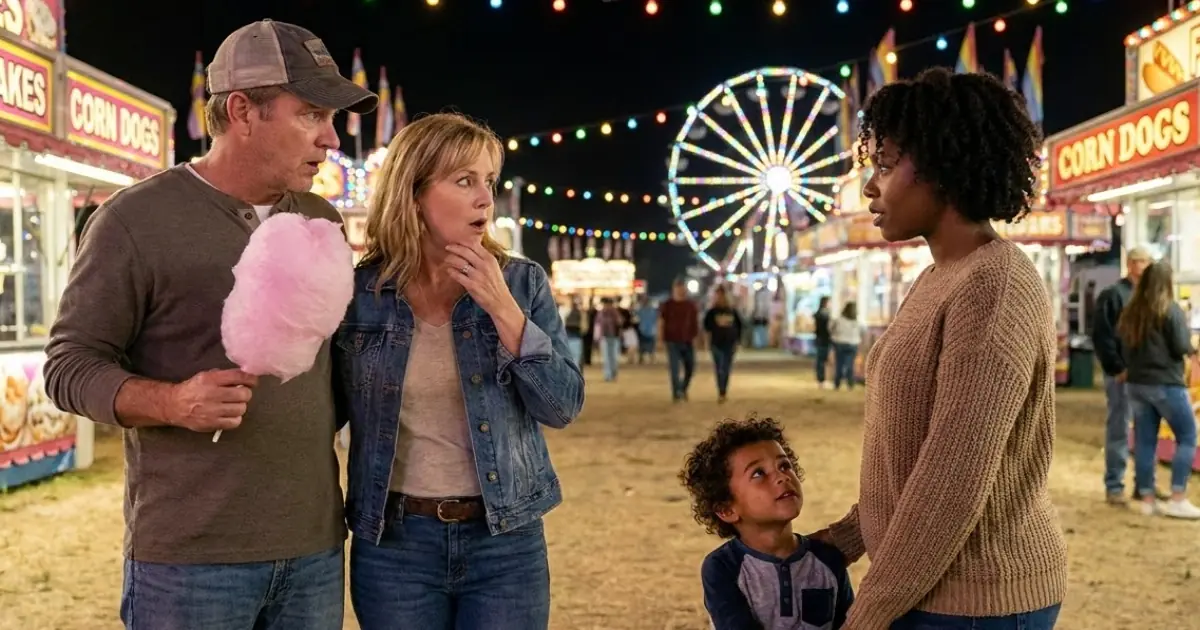
Then she looked at David. In all the years she had been married to him, she had seen him startled, angry, embarrassed, amused, and once sick enough to gray out after a roofing accident. She had never seen him look emptied out so quickly, as if somebody had reached in and yanked all the structure from behind his face.