250 of the toughest bikers in America sat frozen in their chairs, tears streaming down their faces because a 7-year-old girl held up a faded pink ribbon and said eight words that shattered every wall they had ever built.
Three days earlier, Nathan Caldwell, a road captain who hadn’t cried since he was 12, watched this same girl silently tie that ribbon to his motorcycle mirror in an empty parking lot.
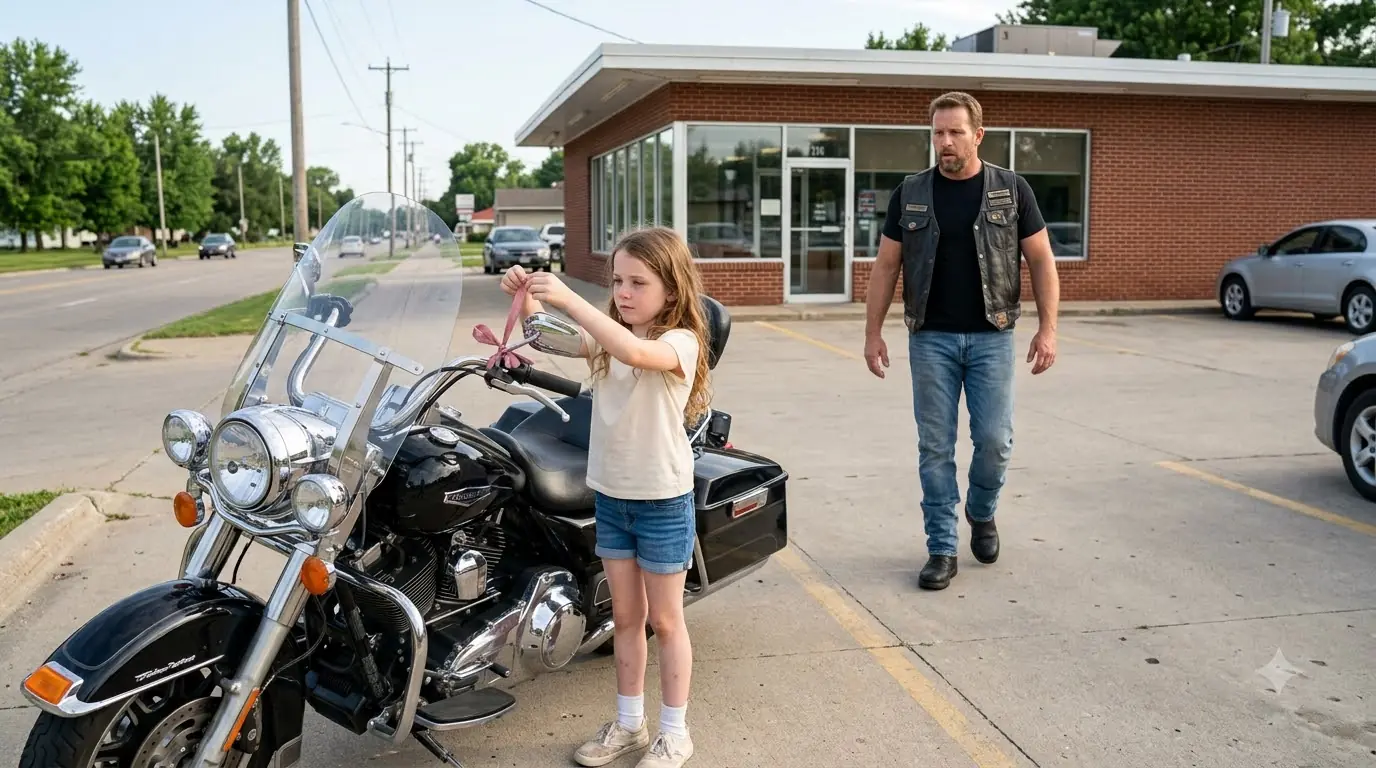
She whispered five words, “My daddy had one just like yours.”
What Nathan uncovered next sent him on a desperate mission across Iowa to expose a buried truth that would bring an entire brotherhood to its knees.
The afternoon sun hung low over Cedar Falls, Iowa, painting the sky in shades of copper and amber that bled into the flat horizon like watercolors left in the rain. Nathan Caldwell killed the engine of his Harley-Davidson Road King and sat for a moment in the sudden silence, letting the ticking of the cooling engine fill the space where thunder had been.
The parking lot of Millie’s Diner sat mostly empty. A rusted pickup truck, a minivan with a cracked taillight, and now his motorcycle gleamed black and chrome under the fading light.
He had been riding since dawn, 312 miles from his apartment in Sioux City, heading east toward nothing in particular, which was exactly where he wanted to be.
At 47, Nathan had learned that the road didn’t ask questions. It didn’t want to know why he hadn’t called his daughter in six weeks, or why the divorce papers from Sharon still sat unsigned on his kitchen counter, or why the nightmares had come back.
The ones where he heard the screech of tires and the sickening crunch of metal that had taken two of his brothers three summers ago on Highway 20.
He swung his leg over the seat and stood, stretching the stiffness from his lower back. His leather cut hung heavy on his shoulders, the patches worn smooth from years of wind and weather.
Road captain. The title meant he led the formation, planned the routes, made sure every rider behind him got where they were going safely.
It was a responsibility he took seriously. More seriously, Sharon would have said, than he ever took his marriage.
The bell above the diner door chimed as he pushed through. Inside, the air smelled like coffee that had been sitting too long and hamburger grease that had been there even longer.
A woman behind the counter, mid-50s, kind face, name tag reading Doris, looked up and offered the kind of smile reserved for strangers who looked like they needed one.
“Sit anywhere, hon. Menus on the table.”
Nathan chose the booth in the far corner, back to the wall, facing the door. Old habit.
He ordered coffee, black, and a turkey club he didn’t particularly want. Through the window, he could see his bike in the parking lot and, beyond it, the edge of the road stretching into the distance like a promise he wasn’t sure he believed anymore.
He noticed them when Doris brought his sandwich. A woman, older, maybe mid-60s, sitting in a booth near the front with a little girl.
The woman had white hair pulled back tight and the kind of posture that suggested she had spent a lifetime holding things together. The girl was small, maybe six or seven, with light brown hair that fell in loose waves past her shoulders.
She had freckles across her nose and large green eyes that seemed too old for her face, the way children’s eyes sometimes do when they have seen things that children shouldn’t have to see.
The girl was watching him. Not staring, watching the way a bird watches from a branch, curious but ready to fly.
Nathan looked away, focused on his sandwich, but every time he glanced up, those green eyes were still there, studying him with a quiet intensity that made him oddly uncomfortable.
He finished his meal, left a ten on the table, and headed for the door. The evening air had cooled, carrying the smell of cut grass and distant rain.
He walked across the parking lot, fishing his keys from his pocket, and that was when he saw her. The little girl was standing beside his motorcycle.
She had moved so quietly that he hadn’t heard the diner door open or close. In her small hands, she held a ribbon, pink, faded almost to white, frayed at the edges as if it had been held and folded and unfolded a thousand times.