The barn door was red, faded, peeling, but red.
It was the kind of red that looked less like paint and more like a warning left behind by somebody who knew what had happened there. Years of Tennessee summers had blistered its surface.
Rain had darkened the wood beneath it. Long strips of paint curled away from the boards like old skin.
Behind that door, somewhere inside a forgotten barn at the edge of eighty-seven acres of abandoned farmland, a ten-year-old girl had been missing for four days.
Seven hundred fourteen bikers lined every back road in the county.
Their engines rumbled in the dark.
Some waited beneath oak trees. Others sat at intersections where narrow county roads disappeared into the hills. Groups of riders occupied logging trails, gravel turnoffs, bridges, abandoned service stations, and crossroads most people in Ridgewood had forgotten existed.
They were waiting for a single word through their radios.
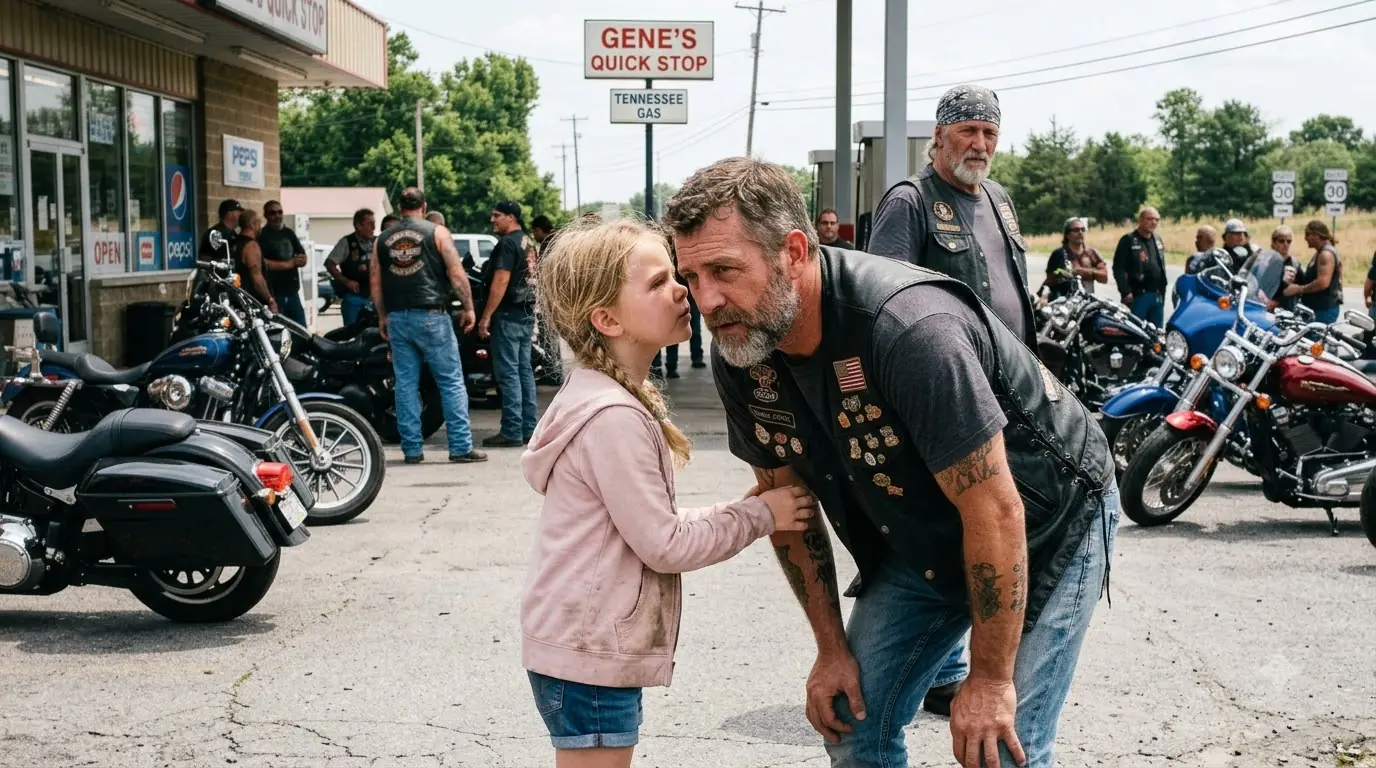
But none of it would have happened if a seven-year-old girl had not walked up to a complete stranger at a gas station.
A man covered in tattoos and leather.
A man most parents would have pulled their children away from.
A man whose face looked hard because life had spent years making it that way.
She had gripped the edge of his leather vest, risen onto the tips of her worn sneakers, and whispered six words into his ear.
"I know where they hid her."
Those six words would send hundreds of motorcycles into the Tennessee night.
The August heat in Ridgewood pressed down on the cracked asphalt of Route 42 like a hand holding the entire town underwater.
The air smelled of hot tar, gasoline, dry weeds, and cut grass. Cicadas screamed from the tree line with such intensity that the brief pauses between their calls somehow felt even louder.
Ridgewood was small enough that almost everyone recognized everyone else's truck, dog, children, and family history.
It was the kind of place where people still left keys beneath flowerpots, where the same barber had been cutting hair for thirty years, and where the cashier at Franklin's Market could usually tell who was buying groceries before the customer reached the register.
The town lived according to seasons.
Winter meant dark streets by six in the evening, smoke curling from chimneys, and basketball games at the high school gym.
Spring brought mud, thunderstorms, and swollen creeks.
Autumn smelled of leaves and wood smoke.
Summer belonged to humidity.
By August, the air became so thick that dogs stretched beneath porches and refused to move. Farmers began work before sunrise because after noon every movement felt twice as difficult.
That Thursday afternoon was one of the hottest days of the summer.
At the Crossroads Fuel Stop, three miles south of the town square, Cole Harrington swung one leg off his black Harley-Davidson and planted a heavy boot on the pavement.
The motorcycle ticked softly as the engine cooled.
Cole removed the black bandana from around his neck and wiped the sweat from his forehead.
He was forty-four years old, and the road had written its autobiography across his face.
Deep lines framed his mouth. Smaller ones spread from the corners of his gray-blue eyes. His salt-and-pepper beard was trimmed close, although uneven in places where he had stopped caring enough to inspect it carefully.
His leather vest carried the patches of the Iron Ridge Motorcycle Club.
A roaring engine stitched in silver thread.
A mountain ridge behind it.
Underneath, the words Ridgewood, TN.
His forearms were covered in tattoos. None of them were random. One marked the year his father died. Another carried his daughter's initials. A smaller one near his wrist showed a pair of wings surrounding the name Emma.
His hands were rough from years repairing engines.
Scars crossed several knuckles.
Grease had settled permanently into the lines of his fingers despite countless washings.
To anyone watching from across the parking lot, Cole Harrington looked exactly like the kind of man they expected to see on a motorcycle.
And exactly like the kind of man they expected to avoid.
Cole was used to that.
He inserted his card into the pump, removed the nozzle, and began filling the Harley's tank.
The pump clicked and hummed.
At the next island, a woman in a white SUV looked toward him.
For half a second their eyes met.
Then she looked away and pulled her purse closer against her hip.
Cole noticed.
He always noticed.
There had been a time when it bothered him.
Years earlier, he might have wanted to explain himself. He might have wanted to tell people that he owned a motorcycle repair shop, paid his taxes, helped organize charity rides every Christmas, and once spent three freezing nights fixing an elderly stranger's generator because she could not afford a new one.
He might have explained that the men and women in Iron Ridge had raised money for children's hospitals, delivered food after tornadoes, and escorted grieving families to funerals.
Eventually Cole stopped explaining.
Somewhere around his thirty-eighth birthday, he realized people were going to see the leather before they saw the man wearing it.
There was nothing he could do about that.
The fuel pump clicked off.
Cole returned the nozzle, replaced the cap, and walked toward the convenience store.
The moment the glass door opened, air conditioning struck him like another season.
He stood beneath the vent for half a second longer than necessary.
Behind the counter, a teenage boy named Mason was staring at his phone.
Cole had repaired Mason's mother's car the previous winter for half the normal labor cost, but the teenager still treated him with the careful awkwardness most teenagers reserved for adults they did not know how to categorize.
Cole walked toward the refrigerated section and took a bottle of water.
He added a pack of beef jerky.
A television hung in the corner above the lottery display.
The volume was turned low.
Cole was not paying attention until a photograph appeared on the screen.
A school portrait.
Brown hair.
Blue shirt.
A shy smile.
Lily Ashford.
Ten years old.
Missing since Monday afternoon.
Cole stopped moving.
He had seen the photograph everywhere.
It was taped to telephone poles.
Pinned to grocery store doors.
Posted in the window of the pharmacy.
Someone had attached one to the bulletin board outside First Baptist Church.
SEARCHING FOR LILY ASHFORD.
AGE 10.
BROWN HAIR.
HAZEL EYES.
LAST SEEN MONDAY.
Every person in Ridgewood knew her face by then.
The television showed footage from the previous evening.
Volunteers walking through woods.
Police vehicles parked along Birch Lane.