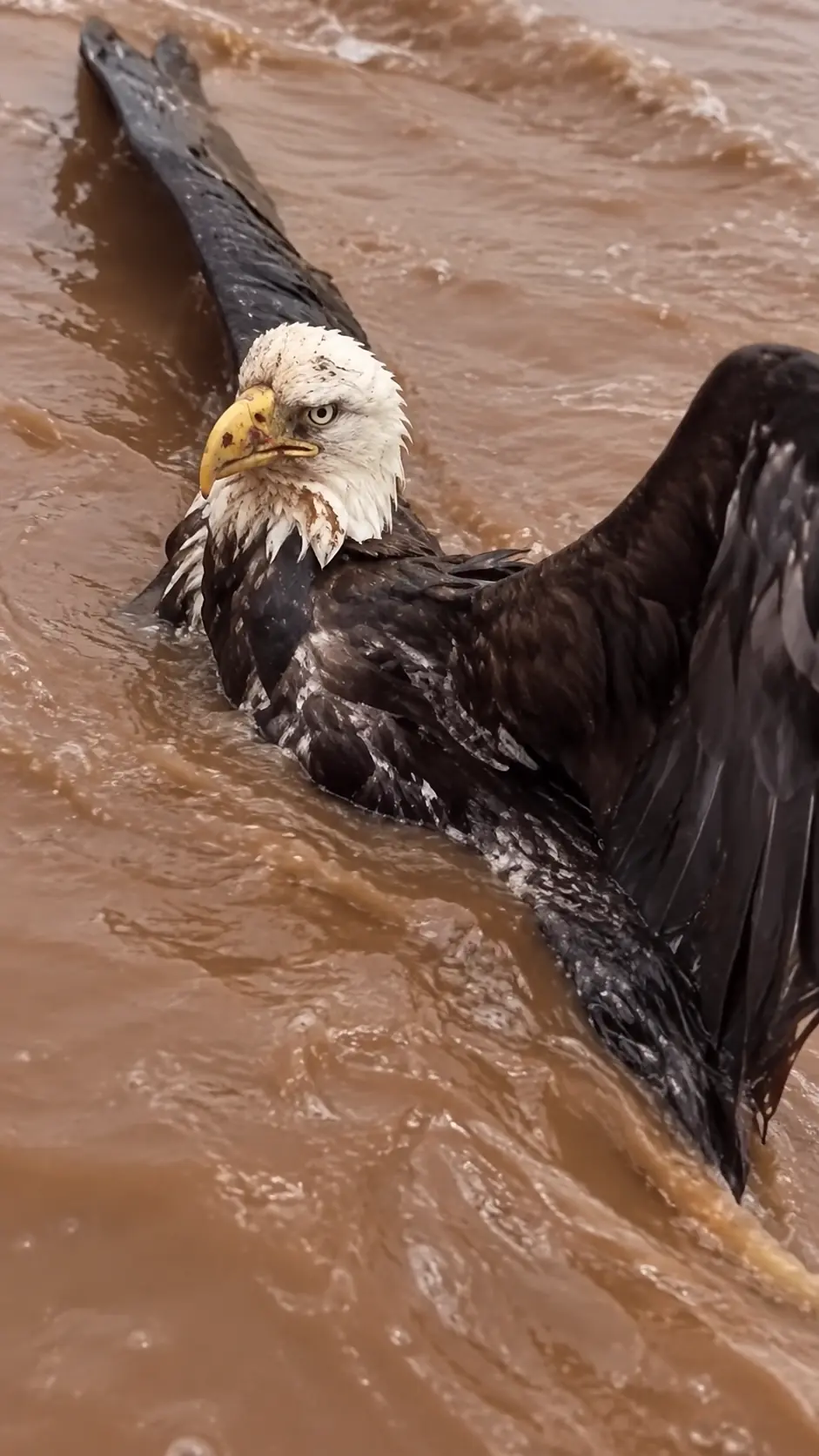
For a moment he thought the bird was swimming. Eagles sometimes cross water that way, using their wings to pull themselves toward land. But this eagle was not making progress. The same submerged log appeared beside it twice as the river carried it downstream. Daniel watched the bird lift its head clear of a wave and understood that waiting could cost it its life. This is a reconstructed rescue narrative inspired by the reported scenario and the accompanying image, not a verified account of a specific incident. Daniel Mercer, a forty-two-year-old fisherman, and the stretch of the West Branch Susquehanna River near Lock Haven, Pennsylvania, are proposed story details. No original rescue log, veterinary record, witness interview, or documented release has been supplied. In the narrative that follows, the eagle survives and ultimately returns to flight, as the approved storyline specifies. That hopeful ending is part of the story, not a result established by the photograph. The river had been running brown that morning. Recent rain upstream had clouded the water with sediment, making the faster channels difficult to distinguish from the calmer edges. Daniel had come to a familiar fishing spot expecting a quiet morning. A few trees leaned over the bank, their exposed roots gripping dark soil above the waterline. Across the river, branches hung low enough to touch the current. Under ordinary circumstances, an eagle would have been a welcome sight. This one made him put down his fishing rod without thinking. Its right wing rose awkwardly above the surface while the other stretched behind it. Neither movement brought it closer to shore. He remained still for several seconds, trying to understand what he was seeing. A healthy eagle can appear ungainly in water while still controlling its direction. Daniel looked for the deliberate rhythm of a bird pulling itself forward, then for a clear path toward shallow water. Neither was evident. Instead, the eagle moved sideways and then backward, the current doing most of the work.
Its head stayed above the water, but only just. When a small wave reached its chest, it lifted its beak, held that position, and made another weak stroke. Daniel could not know how long it had been there. He could see that it needed help now. The appearance of the riverbank made the situation particularly difficult. There was no gentle, sandy landing immediately ahead. Water met a steep patch of mud below roots and fallen branches. The closest shallow area lay downstream, around a bend that Daniel could not see from where he stood. If the eagle passed that point, it might be carried into an even faster channel. At the same time, Daniel understood that a bald eagle was not a harmless bird to pick up. Its feet could injure a person seriously, especially when frightened. He had to weigh the danger of intervening against the visible risk of the bird disappearing around the bend. He called for wildlife assistance and described the location as clearly as he could: the river, the access point, the current, the bird's position, and the fact that it could not reach shore. While seeking guidance, he watched for a way to help without entering dangerous water. The precise method of reaching the eagle is not documented in the source material; in this reconstruction he uses a secure position at the bank and assistance from a nearby fishing platform to get close enough for a careful recovery. The scene is not a recommendation that bystanders enter fast water or attempt to capture an eagle. Both hazards require trained judgment. Daniel's opportunity came when the current carried the bird toward a partially submerged branch near the edge. For one brief moment the branch slowed its drift. The eagle tried to push away with one wing, but the movement failed. Daniel reached the safer side of the bank, kept his footing, and managed to support the bird as it came within reach. The eagle gave a short, startled struggle. He felt the sudden power still present in its body and kept clear of its feet. Within moments, he had helped move it out of the water and onto sheltered ground, where the immediate danger from the current was gone. On shore, the bird seemed unexpectedly small beneath its wet plumage. Water darkened the brown feathers, pressing them against its body and making their overlapping structure difficult to see. Its white head was streaked with mud. One wing lay partly extended while the other remained folded closer to its side. The eagle held its beak slightly open and watched Daniel, but it did not attempt to launch. His relief at getting it out was interrupted by a new concern. Had the current exhausted a healthy animal, or had an earlier injury brought the bird into the water in the first place? Neither question could be answered beside the river. Daniel did not treat its lack of resistance as trust. He knew that a wild animal might remain quiet because it was frightened, exhausted, injured, or severely unwell. He covered the eagle loosely with a clean blanket, taking care not to press on its chest, and stayed nearby while he followed the instructions of the responding wildlife personnel. The blanket helped reduce visual stimulation and kept the bird from making uncontrolled movements. It also made the moment look surprisingly intimate. Daniel sat on the ground with one of America's most recognizable wild birds close beside him, yet his responsibility was not to enjoy that proximity. It was to keep the animal safe until qualified help could take over. The eagle lifted its head whenever Daniel moved. Otherwise it rested with its eyes open, making small adjustments to its position. Water drained from the flight feathers and collected in the low places of the blanket. As the minutes passed, Daniel became aware of how hard he was listening for every breath and rustle. The bird was breathing; that alone did not mean it was well. There might be a problem with its muscles, with its wings, with coordination, or with something the river had concealed. Nothing about its posture could tell him whether it had inhaled water. He resisted the temptation to offer food or pour water into its beak. The image associated with this account shows a bald eagle floating low in opaque brown water, its white head above the surface and one dark wing raised dramatically. Mud marks the head and beak, and the water ripples around its body. The photograph demonstrates the bird's difficult position in the river at that instant. It does not show Daniel, the recovery, the length of time spent swimming, medical treatment, or a later release. Those elements belong to the supplied motif and this proposed narrative. Recognizing that limit is essential when telling wildlife stories intended to sound like responsible reporting rather than turning an image into proof of events it cannot show. Bald eagles are closely connected to water. Rivers and lakes provide fish, waterfowl, carrion, and places to perch while searching for food. They are strong fliers and accomplished opportunists, but they are not built to swim like ducks. When an eagle ends up in water, it may use both wings in a rowing action often compared to a breaststroke. Air spaces associated with its respiratory system and the structure of its feathers can contribute to buoyancy. Even so, floating is not the same as having enough control to overcome moving water. A bird can stay on the surface while failing to reach safety. Sometimes an eagle enters the water after grasping a fish too large to lift immediately. At other times it may be wet after an unsuccessful hunting attempt, displaced by weather, or affected by injury or illness. Observers cannot reliably identify those causes from a single photograph. In this narrative, Daniel has no evidence that the eagle captured an oversized fish.
He sees no fishing line or visible entanglement, and he cannot confirm a collision. The bird's struggle is real within the story, but the reason for that struggle remains a medical question. A careful account avoids choosing the most dramatic explanation simply because it creates suspense. The prolonged effort also matters. Flight requires energy, but so does keeping an eagle's head above water while battling a current. Repeated wing strokes recruit large muscle groups, and an exhausted bird may lose coordination before it loses consciousness. Water temperature, body condition, and earlier illness can influence that decline. The bird's wet feathers do not by themselves establish hypothermia, and muddy water does not prove the animal inhaled it. Still, exposure and exhaustion are concerns that qualified responders must evaluate. When Daniel first saw the eagle, every unsuccessful stroke suggested that its physical reserves were being depleted. The responders arrived with a secure transport carrier and the protective equipment needed for a large raptor. Their first goal was to move the eagle without adding stress or worsening any hidden injury. They observed its posture and breathing, then carefully controlled its talons and wings. A large bird can appear passive and then react with remarkable speed. The team did not interpret the lack of vigorous resistance as permission to handle it casually. They transferred the eagle to the carrier, kept the surroundings quiet, and arranged an examination at a wildlife rehabilitation facility equipped to care for birds of prey. Daniel stood back as the carrier door closed. His part in the rescue had been urgent and personal; the next part would be deliberate and clinical. It was difficult not to imagine an immediate happy ending. He wanted to see the eagle shake its feathers dry, stretch both wings, and disappear into the trees. But that would have been the wrong measure of success at that moment. The bird had just spent an unknown period in moving water and had displayed substantial weakness. The appropriate next step was not a test of courage or an attempt to provoke flight. It was a medical assessment to determine whether the eagle was capable of recovering safely. At a rehabilitation hospital, a bird recovered from a river would be evaluated first for problems that threaten stability. Clinicians would observe its breathing pattern, circulation, body temperature, awareness, and posture. They would inspect the eyes and beak, the feet and talons, and the shoulders and wings. They would check whether the bird could grip normally and maintain its balance. A wet bird may be difficult to examine without repeated handling, so minimizing unnecessary restraint is part of sound care. The team must distinguish the normal stress response of a frightened animal from signs that something is medically wrong. One concern is respiratory function. A bird struggling in water might keep its head above the surface throughout, or it might briefly submerge and inhale water. There is no direct evidence of aspiration in this account. Clinicians would nevertheless consider respiratory signs if the history suggested that possibility. A veterinarian might watch for abnormal effort, altered sounds, unusual posture, or changing tolerance of activity. The absence of visible coughing would not automatically rule out a problem, while a wet face alone would not confirm one. Monitoring must be based on examination and the animal's changing condition rather than assumptions from a muddy photograph. Temperature is another concern, but not every soaked bird is dangerously cold. Bald eagles spend time outdoors through difficult weather and possess insulation adapted to their lives. Prolonged immersion and fatigue can compromise those defenses. A clinical team can assess temperature rather than assume it. If warming is needed, it should be controlled and appropriate for the patient's condition. Overly aggressive interventions are not automatically beneficial. The goal is to return the bird toward physiological stability while avoiding additional stress. That work is less dramatic than a river rescue, but it can make the difference between a patient that stabilizes and one that deteriorates. The wings demand close attention because they were the most visible part of the struggle. When Daniel saw the raised wing, he could not know whether it was injured or being used normally for swimming. At the hospital, clinicians might check for unequal extension, swelling, painful responses, abnormal joint movement, and damage to the feathers. Radiographs could be appropriate if physical findings suggested skeletal trauma. No X-ray result is supplied in the scenario, so the story does not claim a fracture or a normal scan. The fact that a bird eventually flies in the approved ending should not be retroactively treated as proof that it never had an injury. The same caution applies to the nervous system. Weakness and difficulty coordinating movements can have many causes. Exhaustion can make an otherwise healthy bird appear unsteady, but toxins, collisions, infection, and other illnesses may produce related signs. A veterinarian would observe head control, awareness, balance, grip, and coordinated movement, while considering tests guided by the examination. There is no evidence here for lead poisoning, seizures, or permanent neurological injury.
Introducing any of those as a confirmed diagnosis would shift the story away from its source. The narrative's central uncertainty is why the eagle failed to leave the river, and the clinical work must respect that uncertainty. Nutrition and hydration present further questions. The eagle may have spent enough time struggling that it needs carefully managed supportive care, but Daniel does not know when it last ate. A wildlife team would judge its body condition rather than assume starvation. It would decide whether the bird can swallow safely, whether it is ready for food, and whether fluids are clinically indicated. Feeding a debilitated animal without understanding its condition can create additional problems. The image of a rescuer holding an eagle can make care seem as simple as warmth and reassurance. In practice, effective rehabilitation often depends on timing, restraint, and information that the public cannot see. For the purposes of this story, the initial examination reveals no immediately apparent catastrophic injury, but the team remains cautious because the eagle is weak and its history is incomplete. This is an invented clinical development, not a verified finding. The bird is placed in a secure, quiet setting, where staff can observe without repeatedly approaching it. Its posture improves gradually. It begins to hold its head more steadily and shifts its feet beneath its body. Those small changes matter, yet none alone is enough to support release. Stability during rest and capability during flight are different standards, and the rehabilitation process must bridge the distance between them. Daniel receives a carefully worded update that the eagle is alive and being evaluated. He does not hear that it is cured. He does not hear that it was poisoned or hit by a boat. The uncertainty leaves him replaying the scene by the water: the wing caught in the current, the white head lifted toward another wave, the brief pause when the branch slowed its drift. He remembers the strength he felt when the eagle moved in his hands, a reminder that a bird can be simultaneously powerful and vulnerable. He also remembers the moment of silence afterward, when it seemed too tired to make another effort. The days that follow are presented here as the fictional continuation approved for this account. The rehabilitation team monitors the eagle's eating behavior, posture, responsiveness, and ability to perch. Its feathers dry and settle into their familiar overlapping layers. It begins spending more time upright. A bird may look impressive while standing still, but that appearance does not show whether it can sustain flight. The staff wait for consistent evidence that its balance and coordination have returned. No one handles it simply to make an appealing photograph. Wild patients benefit when people remain necessary caregivers rather than familiar companions. A healthy bald eagle has no need for human affection in the ordinary sense. Daniel's instinct to cradle the exhausted bird came from concern, not a belief that it wished to be held. He would never want the eagle to associate people with comfort or food. The long-term objective is for the bird to remain wary, self-reliant, and able to respond normally to its environment. That principle becomes more important as the patient grows stronger. The better the eagle does, the less direct human interaction it should need. Daniel finds that idea reassuring: recovery would mean the bird no longer needed him. When clinicians consider the next stage, they look beyond the original water exposure. The eagle must demonstrate strength in its feet and legs, normal vision, coordinated movement, and proper use of both wings. It should be able to take food independently and maintain adequate condition. If movement remains abnormal, additional evaluation is needed. A single strong wing flap does not establish sustained endurance. A short jump is not a safe flight trial. Rehabilitation is organized around the actual demands the bird will face after release, not around the most hopeful interpretation of an isolated movement. A spacious flight enclosure offers a controlled place to evaluate those demands when veterinary staff consider it appropriate. The eagle has room to move between perches and demonstrate controlled takeoffs and landings. Observers watch symmetry, wingbeat strength, maneuvering, and whether the bird can stop without losing balance. They avoid turning every motion into a dramatic milestone. Some patients fly well briefly but fatigue; others need more time before movement becomes smooth and repeatable. In this proposed story, the eagle gradually shows the coordinated flight needed to progress. That advancement is intentionally fictional because no rehabilitation record accompanies the image. The river still matters as the team evaluates the bird. If it had been exhausted by an ordinary encounter with strong water, a return to baseline function might be possible after appropriate care. If some underlying problem had contributed, that problem would need to be understood well enough to support release. The narrative does not pretend the mystery has been solved. Daniel never witnesses the moment the eagle entered the river. Neither the photograph nor the fictional update identifies a fish, a collision, or a toxin. Sometimes a wildlife case can have a successful outcome without the exact precipitating event being documented. Honest uncertainty can remain part of a complete story. That uncertainty is also a reason not to romanticize the final flight. The image of a large bird lifting away from a rescuer is powerful, but a premature release can be harmful. A patient must be able to survive more than a few seconds in the air. It needs the endurance to reach food, the coordination to land safely, and the awareness to navigate hazards. Qualified rehabilitators are responsible for evaluating those capacities. In this fictional account, they make a release decision only after suitable medical and functional checks. Daniel's hopes do not override that judgment, even though the rescue has become deeply personal to him. When he is invited to witness the final step, Daniel returns to a quiet natural area rather than the crowded part of town. The weather is calm. Trees rise beyond an open stretch of ground, and the release team has selected a setting with room for an unobstructed departure. There is no audience surrounding the carrier, no attempt to make the eagle perform, and no promise that it will circle back. Daniel stands where staff direct him and waits. The man who once moved toward danger because a bird could not reach shore now has a different responsibility: to stay still and allow the eagle to leave on its own terms. The carrier is positioned and opened by experienced personnel. For a brief moment the eagle remains inside. Then its white head appears at the opening. It looks toward the trees and shifts forward. Daniel feels the familiar urge to help, but this time help would be interference. He watches the bird step clear, lift its wings, and gather itself. The first powerful wingbeats raise it above the ground. It climbs, corrects its angle, and moves beyond the nearest branches. Daniel follows it with his eyes until the white head becomes a small bright mark against the distant treeline. The release is the resolution chosen for this story, not an event independently authenticated by the original image. Its emotional force comes from the contrast between the eagle's two positions: first low in muddy water, unable to make headway, then high enough in the air to cross the space ahead without human assistance. The same wings that appeared to be fighting the river now hold the bird aloft. Daniel does not claim the eagle recognizes him or understands what he did. He is grateful for something simpler. A wild animal has regained the ability to move beyond his reach.
Afterward, he talks about the experience without calling himself a hero. He remembers fear more clearly than bravery. He remembers asking whether the bird was moving toward shore and seeing that it was not. He remembers how quickly a simple fishing trip became a situation where he had to make choices. His story could easily be reduced to a single dramatic photograph and an uplifting ending. He prefers to remember the larger chain of effort: the first call, the careful transfer, the clinical assessment, the quiet days of observation, and the decision to release only when the bird was ready. The role of the rescuer is important, but no one person can substitute for professional care. Daniel could interrupt the immediate drowning risk in the fictional scenario. He could not diagnose internal injuries, evaluate respiratory complications, or test safe flight. The wildlife team could provide those assessments. The eagle itself had to recover the physical capacity that no caretaker could supply on its behalf. Each part mattered. A rescue becomes sustainable when compassion is followed by competent care, and when the goal remains the animal's return to independent life rather than a prolonged bond with the people who assisted it. Bald eagles are federally protected in the United States and occupy a distinctive place in American cultural life. Their image appears on familiar national symbols, yet the living birds remain wild animals with biological needs that are independent of human meaning. They feed, nest, migrate or remain within territories, defend themselves, and encounter environmental hazards. A dramatic rescue may bring one individual's vulnerability into focus, but protection also includes ordinary actions: preserving habitat, reducing harmful exposure, reporting injured birds appropriately, and respecting nesting and feeding areas without unnecessary disturbance. The water itself is not inherently the enemy. Rivers support the fish and other life that make eagle habitat productive. The same landscape that gives an eagle food can create difficulties when current, weather, or an unexpected event leaves it unable to maneuver. For that reason, seeing a bald eagle in water does not always indicate crisis. People should observe behavior and contact wildlife authorities if the animal appears trapped, injured, or unable to reach safety. Trying to enter a dangerous current can put another life at risk. The unusual circumstances of Daniel's proposed rescue should never be mistaken for routine advice to handle raptors or attempt river recoveries without trained assistance. The photograph's most important information is modest but compelling. It shows an adult bald eagle in muddy moving water, head above the surface, with one wing lifted and another stretched behind. It reveals the visible struggle of that instant. It does not tell viewers whether the eagle was swimming successfully, why it entered the river, whether someone arrived, or what happened later. The rest of this article builds an explicitly reconstructed rescue around the user's selected motif. That distinction allows the story to carry emotion without presenting unverified medical details or a fictional release as documented fact. The choice to leave the original cause unresolved is not a missing twist. It reflects the limits of observation in wildlife cases. An eagle does not offer a history of symptoms, and a witness may see only the final minutes of a developing problem. Veterinarians can examine, test, monitor, and sometimes infer likely mechanisms, but certainty depends on evidence. In this account, the river's force, the bird's exhaustion, and its failure to reach shore establish an immediate emergency. They do not establish a particular disease. The bird's eventual flight within the narrative supports recovery of function, not proof that every earlier concern was imaginary. Daniel's hour with the bird also does not make it a pet. The eagle's stillness as he held the blanket was compatible with fatigue or stress. As it grew stronger, its return to normal wild behavior was something to welcome, even if that meant it could no longer be approached. Human tenderness is most useful here when it does not demand affection in return. Daniel found meaning in holding the bird briefly because the situation required help. He found more meaning in watching it fly away because it no longer did. That difference is the heart of the rescue rather than any claim of a special bond. For many people, a bald eagle flying across a river appears effortlessly strong. A close view of one struggling in water disrupts that image. It reminds observers that wings, talons, feathers, and sharp eyesight do not make an animal invulnerable. Strength depends on circumstances. Against a powerful current, even a capable bird may need a chance to recover. The same is true of its medical care: diagnosis and patient monitoring can matter more than bold gestures. A good outcome, when it occurs, is made possible by many measured decisions that may never appear in a photograph. If Daniel had arrived a little later, the eagle might have passed beyond the visible bend. That possibility remains part of what makes the discovery memorable. Yet the story does not need to claim he knew death was seconds away. He knew enough: the bird had stopped making progress, the current was moving it, and its attempts to escape appeared weaker. His response was to seek assistance and use the opportunity available without deliberately courting additional danger. That judgment is more credible than a flawless action scene. It shows an ordinary person trying to solve an urgent problem under uncertain conditions. The final image Daniel keeps is not the bird against his chest or the muddy feathers spread on a blanket. It is the moment after release, when the eagle shifts from climbing to steady flight and the distance between them grows. The bird does not turn toward him. It simply continues into the landscape. For Daniel, that is enough. The rescue began because the eagle could not get where it needed to go. It ends when the animal can choose its own direction again. The river keeps flowing below, indifferent to what happened, while the eagle becomes part of the sky above it. There is another lesson in the space between the rescue and the release. A bird's improvement is rarely a single dramatic change. At first, merely resting comfortably may be progress. Later, standing for longer periods, gripping securely, and accepting appropriate food can matter more than any spectacular movement. The rehabilitation team must observe patterns across time. A bird that manages one strong effort may still tire too quickly afterward. Each evaluation is an opportunity to ask whether the next step is safe. Daniel's eagerness to hear that the eagle was flying again could not shorten the animal's recovery schedule, and he accepted that. Nor should the waterlogged appearance of a bird lead observers to assume it is beyond saving. At the opposite extreme, bright eyes and sudden resistance may tempt people to conclude that everything is fine. Both impressions can mislead. Wildlife professionals combine behavior with physical examination and, where appropriate, diagnostic testing. It is whether its body can perform the demanding work of survival without assistance. Daniel also thinks about the people who never appear in the most dramatic version of the story.
Someone answers the rescue call and collects the essential location details. Someone prepares the carrier and arranges transport. Veterinary staff assess the bird, review observations, and protect it from needless handling. Rehabilitation specialists watch flight behavior carefully enough to recognize a limitation that an excited bystander might overlook. Every one of those steps helps explain why a rescue should lead to professional evaluation rather than an improvised release on the nearest riverbank. The eagle's welfare depends on that continuity of care. The experience changes the way Daniel looks at the river. He still sees the fishing spots, the branches above the bank, and the shifting channels after rainfall. Now he also watches for animals behaving in ways that do not fit their surroundings. He knows an eagle using its wings on water is not necessarily drowning, and that distance alone may obscure whether it is moving purposefully. He knows that contacting qualified responders can be more useful than charging into danger. Most of all, he understands that helping a wild creature sometimes means recognizing the limit of one's own role and allowing trained people to finish the work. That ending belongs to a dramatized reconstruction rather than a verified wildlife report. It is nevertheless grounded in a meaningful principle of rehabilitation: removing an animal from danger is the beginning, not the measure, of recovery. Responsible care requires determining why assistance was needed, addressing medical concerns, and confirming that the patient can survive independently before release. In the approved story, a fisherman interrupts a possible drowning, professionals oversee the bird's recovery, and the eagle ultimately returns to flight. What makes the event worth telling is not that a person briefly held a national symbol, but that the symbol was once again a living, self-sufficient bird.