The bell above the mercantile door gave a thin metallic ring when Nellie Thornton stepped inside.
Cold air followed her through the doorway.
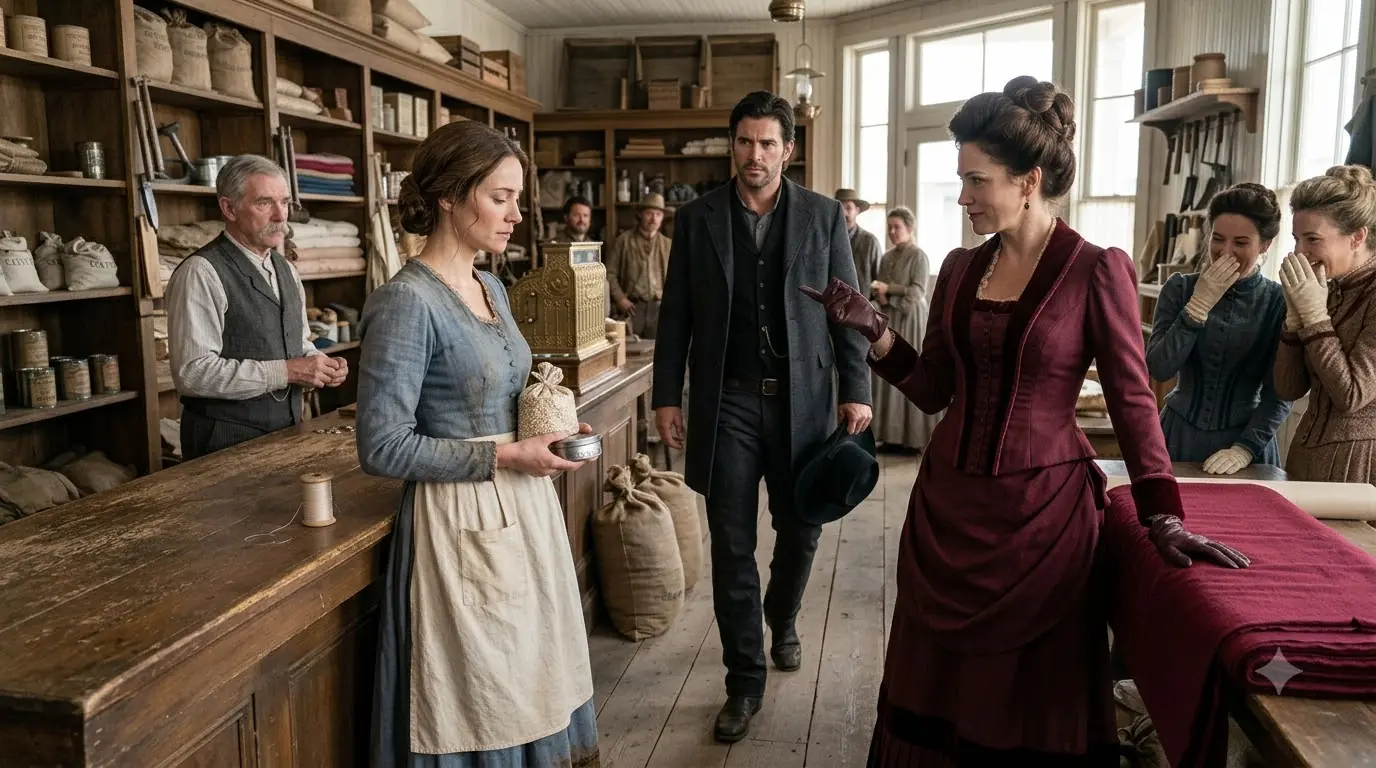
Clearwater had woken under a hard November sky, pale and windless, the kind of morning when every sound seemed sharper than usual. Wagon wheels cracked over frozen ruts on Main Street.
Horses stamped clouds of breath beside hitching rails. Smoke from iron stovepipes hung low between the buildings before the wind finally carried it east toward the hills.
Nellie closed the door behind her and rubbed one gloved hand over the other.
Her gloves were worn at the fingertips.
So was almost everything else she owned.
She had spent the previous evening patching the right sleeve of her brown wool coat by lamplight, using thread she had pulled from an old hem because she had none left in her sewing box.
That was one reason she had come into town.
The other reasons were oats and lard.
Neither could wait much longer.
Mr. Higgins stood behind the counter adding figures in a small ledger.
He looked up.
“Morning, Mrs. Thornton.”
“Morning.”
Nellie gave him the polite smile she reserved for people who had never been unkind to her, even if they lacked the courage to be particularly kind.
“I need half a sack of oats, please. A tin of lard.”
She paused.
“And a spool of black thread, if there’s enough.”
Mr. Higgins glanced toward the shelf behind him.
“How much have you got?”
Nellie opened the small leather purse she carried inside her coat and counted the coins again even though she already knew exactly what was there.
She had counted them three times before leaving home.
Two quarters.
Three dimes.
Four nickels.
Seven pennies.
Every cent had a destination.
The hens needed feed.
The old mare needed oats.
The lard would stretch meals for another week.
The thread was not essential.
That was the trouble with thread.
Nothing that held a life together ever looked essential until it ran out.
Mr. Higgins weighed the oats.
Then the lard.
Then he counted the coins Nellie placed on the counter.
His expression shifted.
“That’ll cover the oats and the lard.”
Nellie waited.
“The thread?”
Higgins looked apologetic.
“You’re two cents short.”
Nellie looked at the spool.
Black cotton.
Nothing special.
Two cents might as well have been two dollars.
For a moment, she considered asking him to put it on her account.
She had never liked doing that.
The Thornton name had once been worth trust in three counties.
Her grandfather had owned cattle, wheat fields, and one of the first stone barns in the valley.
Her husband had borrowed carefully.
Her father had taught her that a person who could not pay today should not make another person responsible for tomorrow.
Pride was expensive.
Nellie knew that better than anyone.
She closed her purse.
“The oats and lard, then.”
Higgins nodded.
“I can hold the thread for you.”
“No need.”
“Mrs. Thornton—”
“I said no need.”
Not sharply.
Just firmly.
He wrapped the lard.
Nellie lifted the sack of oats.
That was when Harriet Gable noticed her.
Harriet was standing near the fabric counter with Eunice Palmer.
Both women belonged to the church committee that organized summer socials, winter relief collections, and nearly every other public event in Clearwater that allowed women with comfortable houses to congratulate themselves on their virtue.
Harriet’s husband, Arthur Gable, owned the Clearwater Commercial Bank.
That made her wealthy enough to confuse social position with moral authority.
“My word, Eunice.”
Harriet did not lower her voice.
“Is that Nellie Thornton?”
Eunice turned.
Nellie heard the pause before the answer.
“It is.”
“Two years widowed and still wearing herself out like a hired hand.”
Nellie adjusted the oats against her hip.
She could leave.
She should leave.
But Harriet had already moved closer to the fabric counter.
A bolt of deep red flannel sat open on the polished wood.
The color caught Nellie’s eye despite herself.
It was beautiful.
Rich.
Warm.
The kind of cloth she had not touched in years except when mending someone else’s coat.
Harriet ran her fingers over it.
“This came from back east, didn’t it?”
Mr. Higgins nodded.
“Imported through St. Louis. Four dollars a yard.”
Harriet smiled.
“Fine weave.”
Nellie looked away.
Four dollars a yard.
Five yards would be twenty dollars.
More than she had spent on herself in months.
Harriet noticed the glance.
“Oh.”
She looked at Nellie as though discovering something amusing.
“You like it?”
Nellie shifted the oats.
“It’s beautiful fabric.”
“I’m sure it seems so.”
The pause was deliberate.