I stood in the barn doorway that Thursday morning, watching Grandpa Gus freeze like somebody had unplugged him from the world.
Thirty seconds passed, maybe longer.
His weathered hands hung at his sides, tools forgotten, while his eyes traced the lines of our John Deere Model B like he was seeing it for the first time.
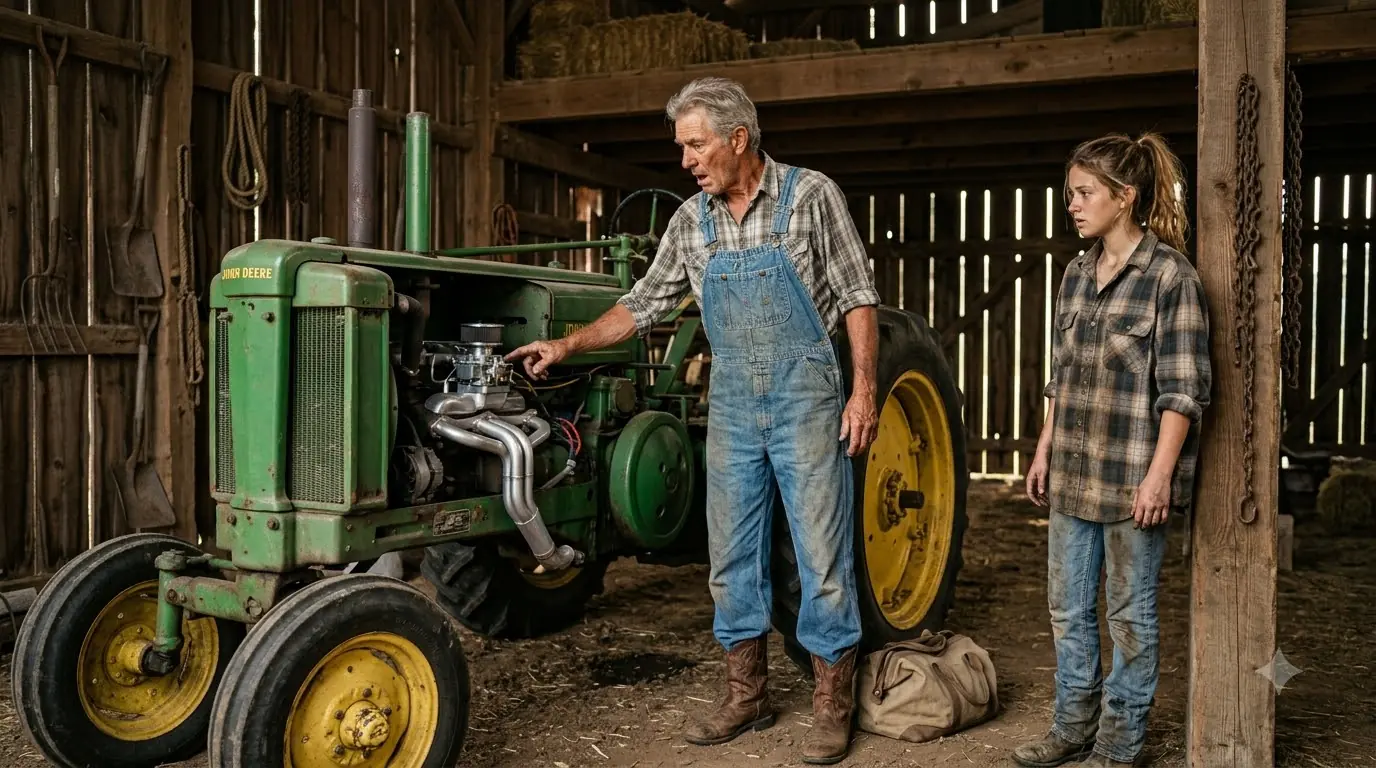
Or maybe seeing a ghost.
The machine looked different. It was different. I’d made sure of that.
Three weeks earlier, I was nobody. Just Marigold Hartwell, fifteen years old, too tall and too clumsy, the girl who wore her dead father’s work shirts because they had pockets deep enough for wrenches. The girl whose hands always carried the smell of machine oil no matter how hard Grandma Lorelei made me scrub before supper. The girl the other kids at Oak Ridge High whispered about when they thought I couldn’t hear.
But I’m getting ahead of myself.
To understand why Grandpa stood there like the ground had opened beneath him, you need to know about that Sunday in late July when everything started to crack.
The Hartwell farm sat on sixty acres of Kansas flatland, where the horizon stretched so far you could watch tomorrow coming at you across the wheat fields. Our house wore white paint that had given up fighting the sun years ago, turning gray and peeling in long strips that curled like wood shavings. The barn still held its red color better, though rust ate at the tin roof in one corner where Grandpa kept meaning to patch it.
We’d lived through worse than peeling paint. The drought of ’66 had killed forty percent of our crop and left the soil cracked and mean. We owed $3,800 to First National Bank of Oak Ridge, due September 15th. Six weeks away.
Grandma kept a ledger in the kitchen drawer, her careful handwriting tracking every penny we had left.
$127.50.
Not nearly enough.
But the real heart of everything, the piece that kept us alive or would kill us trying, was the John Deere Model B sitting in the barn. Green and yellow paint faded to ghosts of their original colors. Grandpa had bought it used in 1946 when he came back from the war.
Twenty-one years of plowing, planting, harvesting. Twenty-one years of keeping us fed.
Grandpa Augustus Hartwell didn’t talk much about the war. Didn’t talk much about anything, really. Sixty-eight years old, tall and lean as a fence post, skin dark from decades under the Kansas sun, he had a way of moving through the world like he was trying not to disturb it, like if he stayed quiet enough, the bad things might not notice him.
The only thing he ever said about fighting in Europe was this.
“Equipment you can trust saves lives. Learned that at Normandy.”
Then his jaw would set, and the conversation was over.
Every evening at 6:00, he’d walk out to the barn and spend an hour with that tractor. Checking oil, greasing fittings, running his hands over belts and hoses. It was like watching someone perform a religious ritual.
Maybe it was one.
Maybe that machine was the only God he still believed in after whatever he’d seen in France.
The tractor meant even more after 1960, after we lost my father.
Jasper Hartwell was twenty-five when he died. I was eight. The details lived in the spaces between what people would tell me, in the way adults edited their sentences when I walked into rooms.
“An accident,” they said.
“The tractor,” they said.
“Quick,” they said, like that made it better.
Grandpa never talked about it at all. He just got quieter, spent longer hours in the barn, held his tools like they might slip away if he loosened his grip.
Grandma Lorelei was the spine that held our crooked house upright. Sixty-six years old, silver hair always pinned in a neat bun, wearing aprons with tiny flower prints that she’d sewn herself. She managed every dollar like a general deploying troops, her ledger thick as a Bible and twice as sacred.
She knew exactly where we stood.
$3,847.23 in debt.
$127.50 in the bank.
$43 a month for insulin.
The diabetes had caught up with her five years back. Type 2, the doctor said, handing over prescriptions we could barely afford. Sometimes she’d skip meals to save money and thought I didn’t notice.
But I saw everything.
I saw how she’d portion out smaller servings for herself, claiming she wasn’t hungry while Grandpa and I ate.
She was the one who taught me to think before acting, to measure twice and cut once, all those old sayings that sound simple until you’re standing in the middle of a decision that could wreck everything.
“Goldie,” she’d say, sitting across from me at the kitchen table while I did homework, “being smart isn’t knowing what to do. It’s knowing when not to do something.”
I should have listened better.
My full name was Marigold Hartwell, after the flowers my mother loved. Most people called me Goldie.
I was fifteen years old that summer, five-foot-four, skinny in a way that made me look breakable even though I could carry feed sacks that made grown men grunt. My hair was brown with blonde streaks from the sun, cut short because long hair got caught in machinery.
Grandma hated it. Said I looked like a boy.
Maybe I did.
I didn’t care much about looking like the other girls at Oak Ridge High School anyway. They wore dresses with patterns and shoes with little heels, talked about Beatles albums and which boys had the nicest cars.
I wore jeans with oil stains and work boots that used to be my father’s. I read Popular Mechanics like other girls read romance novels.
The other girls thought I was strange.
They weren’t wrong.
While they were learning to curl their hair, I was taking apart alarm clocks to see how the gears meshed. While they practiced walking in heels, I was learning to read engine compression by sound alone.
I didn’t have friends at school, just Iris, my sister, and she was barely around anymore.
Iris Hartwell was everything I wasn’t. Twenty years old, beautiful in that effortless way some people have, blonde hair that actually stayed where she put it. She’d graduated nursing school two years ago and worked at Mercy Hospital forty miles away in Junction City.
She made $80 a week and sent home whatever she could spare after rent and gas.
We were opposites, Iris and me. She was organized, graceful, knew how to talk to people without making them uncomfortable.