My mother screamed at me in front of almost our entire extended family that I owed my sister my savings because family was supposed to save family.
I set my fork down beside a plate of brisket, looked directly into her eyes, and said, “Maybe Chloe shouldn’t have cheated on Ethan.”
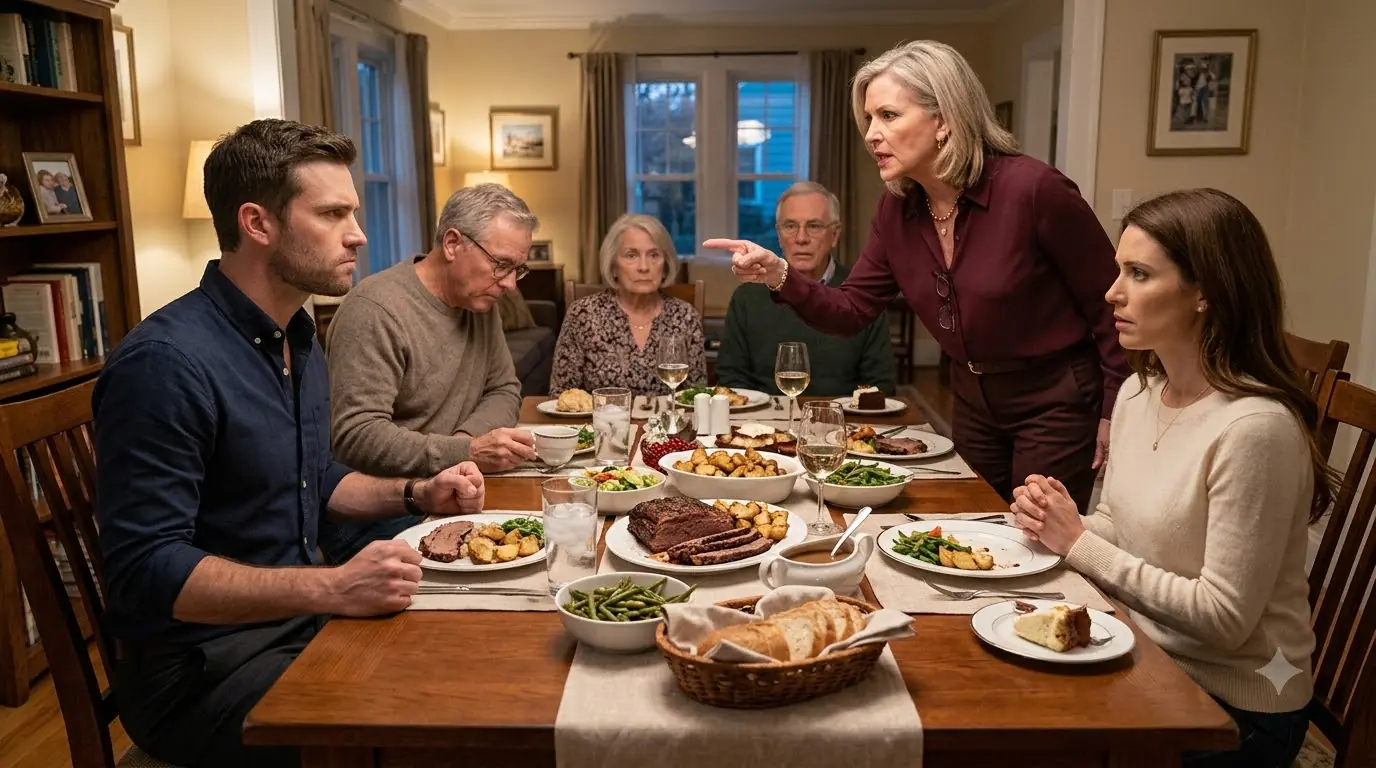
The room went so silent that I could hear ice shifting inside Aunt Martha’s water glass.
My mother’s face lost every trace of color.
My father stopped moving.
My sister Chloe looked at me as if I had just pointed a loaded gun across the dinner table.
That was the moment I committed what my family would later describe as the greatest betrayal in our bloodline’s history.
My name is Leo Brooks.
I’m thirty-two years old, and until about a month before that dinner, I had been living a quiet and mostly peaceful life in Charlotte, North Carolina.
I worked as a data analyst for a healthcare technology company.
The job was stable, occasionally boring, and paid well enough that I had finally reached the stage of adulthood where an unexpected car repair did not feel like a personal catastrophe.
I rented a comfortable one-bedroom apartment about fifteen minutes from downtown.
I had a decent group of friends.
I played hockey badly on Wednesday nights.
I went running three mornings a week.
I had spent almost two years saving for a trip to Japan.
Nothing about my life was particularly glamorous.
That was exactly how I liked it.
Then my sister’s marriage collapsed, and somehow my bank account became part of the emergency response.
To understand why my parents thought that was reasonable, you have to understand how my family had always worked.
From the outside, we were perfectly ordinary.
My father, Arthur, spent thirty-five years working in corporate insurance.
My mother, Helen, sold residential real estate part-time and treated every neighborhood association, charity committee, and church fundraiser like she had been elected governor of it.
We lived in a comfortable suburban house with beige siding, a two-car garage, and enough framed family photographs to create the illusion that every childhood moment had been equally treasured.
Inside the house, however, there had always been a hierarchy.
My older sister Chloe was the sun.
The rest of us adjusted our orbit accordingly.
It was never the kind of favoritism that would make an outsider immediately uncomfortable.
Nobody locked me in a closet.
Nobody forgot my birthday.
Nobody denied me food while Chloe ate steak.
It was subtler than that.
It was the difference between being loved and being prioritized.
Chloe was always prioritized.
When she was twelve, she announced she wanted to play competitive tennis.
My parents immediately purchased lessons, tournament fees, a new racket, and enough athletic clothing to outfit a small private school.
When I was twelve, I wanted to join a robotics camp.
My father looked at the fee and told me, “That’s a lot of money for one week, Leo. Maybe next summer.”
Next summer never came.
When Chloe received a B in high school chemistry, my mother reacted as if Harvard had personally called to revoke a scholarship that did not exist yet.
Within forty-eight hours, Chloe had a private tutor charging sixty dollars an hour.
When I struggled in calculus two years later, Dad said, “You’re smart. Stay after school and ask the teacher for help. You need to learn how to solve your own problems.”
I did.
That became the family explanation for almost everything.
Leo can handle it.
Leo is independent.
Leo will figure it out.
Those sounded like compliments.
Sometimes they were.
But eventually I realized they were also convenient excuses for giving me less.
Chloe needed help.
I did not.
Chloe deserved investment because she had potential.
I was expected to manufacture my own potential from whatever was left.
When she turned sixteen, my parents helped finance a brand-new Toyota Corolla.
My mother said a young woman needed something safe and reliable.
When I got my license, my uncle Bob gave me his 1999 Ford Taurus.
The driver’s side window did not close completely.
The air conditioning worked only when the car was moving faster than forty miles an hour.
And for reasons nobody could explain, the back seat smelled permanently like wet dog.
Dad slapped the roof and said, “Character builder.”
I drove that car until the transmission died.
College was worse.
Chloe was accepted to a private university in Virginia.
My parents were ecstatic.
They paid tuition, housing, meal plans, and spending money.
My mother cried when they dropped her off.
She later told anyone who would listen that investing in education was the greatest gift a parent could give.
Two years later, when it was my turn, the philosophy had changed.
Dad sat me down at the kitchen table.
He folded his hands.
“Leo, your mother and I have spent more on college than we anticipated.”
I already knew where the conversation was going.
“We can help some,” he continued, “but you’re going to have to take ownership.”
“How much is some?”
His eyes moved toward Mom.
She answered.
“Books, maybe part of the first semester.”
That was it.
I remember staring at the wood grain in the kitchen table because looking at either of them felt dangerous.
Dad put a hand on my shoulder.
“You’re a smart kid.”
Then came the sentence.
“You’ll figure it out.”
So I did.
I attended a public university.
I applied for scholarships.
I worked overnight shifts at a hotel front desk where drunk wedding guests routinely lost room keys at two in the morning and businessmen complained about Wi-Fi as though I personally controlled the internet.
I took loans.
I ate more instant noodles than any human digestive system should tolerate.
I graduated with a degree in data analytics.
Then I got a job.
Then a better one.
Then another.
I paid my loans.
Built an emergency fund.
Started investing.
Every achievement quietly reinforced the family mythology.
See?
Leo is fine.
He never needed anything.
I told myself I did not care.
For a long time, I almost believed it.