The first time Cooper blocked our eight-year-old daughter from going upstairs, I laughed.
The second time, I thought he was being stubborn.
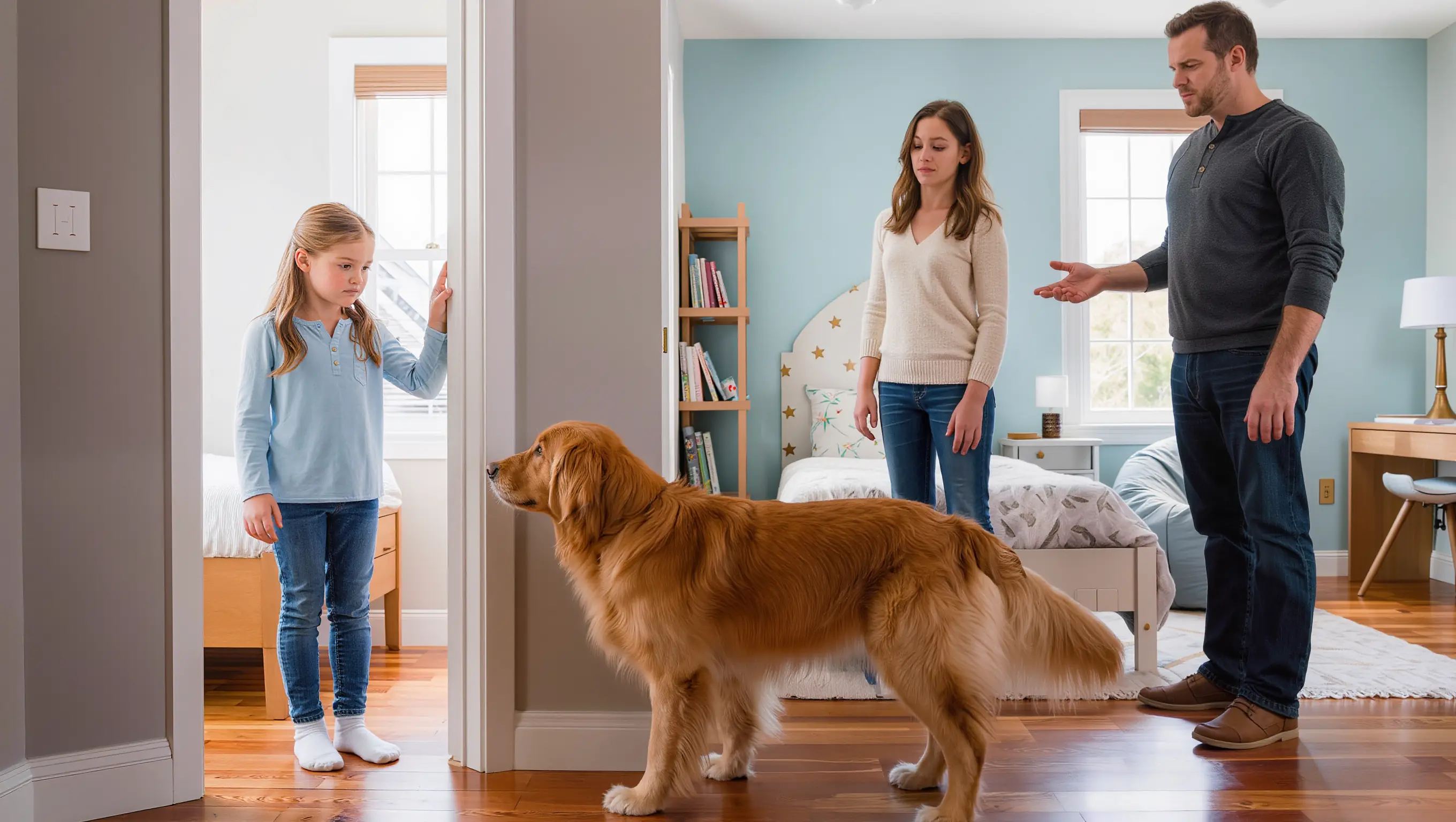
By the fifth time, my husband and I were discussing whether something had gone wrong with the dog we had trusted around our child for almost four years.
Cooper was a seventy-five-pound Golden Retriever with a honey-colored coat, a broad head, and the kind of permanently gentle expression that made strangers crouch in grocery-store parking lots just to pet him.
He loved everybody.
Delivery drivers.
Toddlers.
Our elderly neighbor.
The veterinarian who gave him injections.
Once, a plumber accidentally stepped on his tail, and Cooper responded by licking the man’s hand.
That was Cooper.
Gentle to the point of absurdity.
But suddenly, whenever our daughter Emma tried to enter her bedroom, Cooper became a different dog.
He would stand in front of the stairs.
If she went around him, he followed.
If she reached her bedroom door, he pushed his entire body between her and the doorway.
At night, he scratched at the wood.
He barked at one particular section of wall beside her bed.
Sometimes he planted himself on top of her blanket and refused to move.
And twice, he took Emma’s pillow in his mouth and carried it downstairs.
The behavior made no sense.
What made it worse was that Cooper never behaved aggressively toward Emma.
Quite the opposite.
He seemed terrified for her.
At first, we thought he was protecting her from something imaginary.
By the end, we understood that Cooper had known there was something wrong with that room long before any human being in our house did.
And if our Golden Retriever had not refused to give up on making us understand, our family might have lost far more than a bedroom.
My name is Claire Bennett.
My husband, Mark, and I live outside Columbus, Ohio, in a two-story house on a quiet residential street lined with maple trees.
Emma is our only child.
She was eight when this happened.
Cooper entered our lives when Emma was four.
We had not planned to get a dog.
Mark definitely had not planned to get a dog.
He was the sort of person who researched vacuum cleaners for three weeks before buying one.
An animal was a commitment.
Food.
Veterinary bills.
Training.
Travel problems.
Hair on furniture.
He had spreadsheets.
I wanted a dog.
Emma wanted every animal she had ever seen.
Then one Saturday, we went to a local adoption event because I told Mark we were “just looking.”
Everybody knows how that sentence ends.
Cooper was sitting at the far end of the enclosure.
He was about a year old.
Big paws.
Too much fur.
Ridiculously long tail.
His foster volunteer told us he had been surrendered by a family moving overseas.
While every other dog pushed toward the gate, Cooper sat quietly.
Emma crouched several feet away.
“Hi.”
She whispered.
Cooper stood.
Walked directly toward her.
Then sat.
Emma reached through the barrier.
Cooper pressed his forehead against her fingers.
Mark looked at me.
“No.”
Twenty minutes later, he was filling out paperwork.
Cooper and Emma became inseparable almost immediately.
He slept beside her bed.
Waited outside the bathroom.
Followed her into the backyard.
Sat under the kitchen table while she did homework.
When Emma cried, Cooper appeared.
Nobody taught him.
He simply knew.
When she had the flu at six, he barely left her room for three days.
When she started second grade and was nervous about taking the school bus, Cooper walked with us to the corner every morning and sat beside Emma until the bus arrived.
The bus driver eventually began waving at him.
Emma called him her “golden shadow.”
That was accurate.
He followed her everywhere.
But he was never possessive.
Emma had friends over constantly.
Cooper adored them.
He did not mind sleepovers.
Did not guard toys.
Did not become jealous when Emma hugged other people.
He was simply there.
Steady.
Warm.
Reliable.
That was why his behavior in October frightened us.
The trouble started after we renovated the upstairs.
Our house had been built in the late 1970s.
It was structurally sound but outdated.
The second floor originally had three small bedrooms.
Emma had used the one closest to ours since she was a baby.
The back bedroom served as my home office.
The third became storage.
That summer, we decided to reorganize.
I had started working remotely more often.
We wanted a proper office downstairs.
Emma wanted the larger back bedroom because it had two windows overlooking the yard.
Mark agreed to convert the old office into her room.
Nothing dramatic.
New drywall on one section.
Built-in shelves.