"Hands on the vehicle. You thought you could talk to me like that in front of everyone and nothing would happen?"
"I didn't do anything."
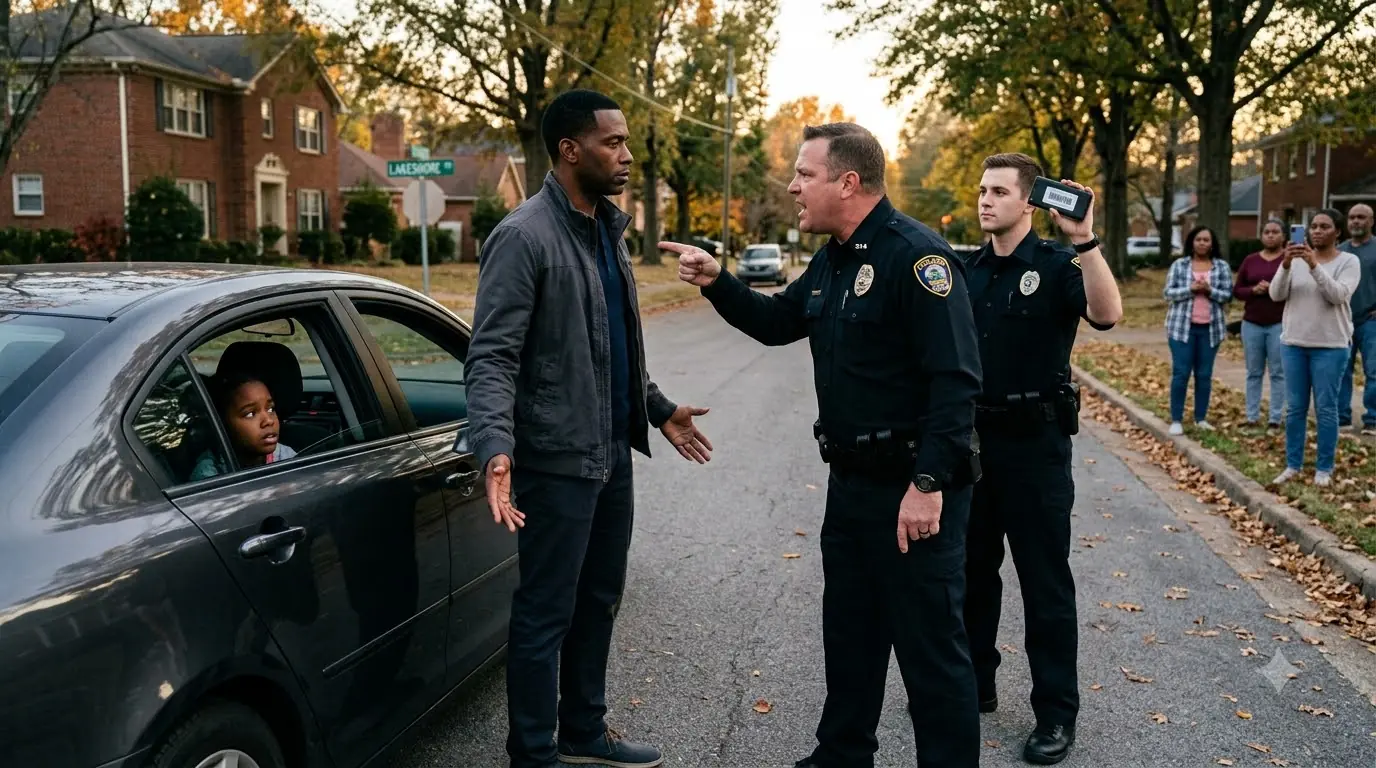
"Wrong. Found it. Serial number matches. $9,800 in stolen property. That's a long time in a cell. Nobody's coming for you."
Travis Mercer had built a career on knowing when a man was broken. He could read the moment someone gave up, the slump, the silence, the slow collapse behind the eyes.
Standing on that curb, watching Daniel Reeves get loaded into the back of the patrol car, Travis saw every sign he expected to see. What he missed was the difference between a man who had nothing left to fight with and a man who had already decided the fight was over on his own terms.
The question was what Daniel had been quietly doing in Lakeshore for 14 months, and who exactly had been watching whom.
Daniel Reeves woke every morning at 5:15 without an alarm. It was a habit he had carried for years through the academy, through 14-hour surveillance shifts, through nights spent in unmarked cars parked outside buildings where dangerous men held quiet meetings.
His body had learned long ago that sleep was a resource, not a comfort, and it rationed accordingly.
By 5:45, coffee was made. By 6:00, he was at the kitchen table with his laptop open and his daughter still asleep down the hall.
The window above the sink framed a pale strip of Tennessee sky, and the neighborhood of Lakeshore was still quiet, the kind of quiet that belonged only to working people in the hour before the day demanded something of them.
He used that hour carefully.
To anyone passing by, Daniel Reeves was a straightforward figure, a Black man in his early 40s, single father, owner of a small phone repair shop called Reeves Tech on the corner of Alderman and Fifth.
He was the kind of man people trusted instinctively, unhurried, capable, the sort who would hold a door open and mean it.
Neighbors brought him cracked screens and dead batteries, and sometimes more than that.
Mrs. Patterson from across the street had once brought him a box of her late husband's old tools because she thought someone should use them. He kept them in the back of the shop and actually did.
Nobody in Lakeshore knew what Daniel had spent 15 years doing before he arrived.
Nobody knew about the federal credentials folded inside a hidden compartment of his laptop bag.
Nobody knew about the encrypted drive backed up every 48 hours and transmitted to a secured server in Washington.
And nobody, not one person in this town, knew that for the past 14 months, Daniel Reeves had been operating as a senior field agent for the Office of Federal Law Enforcement Integrity, a division of the Department of Justice that specialized in investigating police misconduct from the inside out.
The assignment had come through quietly.
Lakeshore PD had developed a pattern that the federal office had been tracking for years.
A pattern of evidence manipulation, coerced confessions, and selective prosecution that disproportionately targeted Black residents in the city's lower-income districts.
The complaints had piled up.
The internal investigations had gone nowhere.
Three previous attempts to place an undercover agent in the city had failed before the subjects could get close enough to anything that mattered.
Daniel had volunteered.
He had his reasons.
Some of them were professional.
Some of them were the kind that a man keeps to himself and examines only in the early morning, when the coffee is hot and the house is still and no one is watching.
His daughter Maya was 10 years old and knew nothing about any of it.
She knew her father fixed phones.
She knew he made good pancakes on Saturday mornings and that he always showed up to her school events even when she told him he didn't have to.
She knew that he had a way of being calm in situations where other adults got loud, and that this quality, whatever it was, made her feel safe in a way she couldn't fully articulate, but also didn't need to.
What she didn't know was that her mother, Clare, had died in a car accident when Maya was four.
Not because Daniel had kept it from her, but because Maya knew it simply as a fact of her life rather than a wound.
Clare's absence was a shape in the house, not a ghost.
Daniel had made sure of that.
It was, in his estimation, the most important work he had ever done.
He was in the middle of that ordinary life, holding it together with both hands, when the first crack appeared.
It was a Monday afternoon in late October when Daniel stopped at Oakridge Market on his way home from the shop.
He needed eggs and two cans of soup.