The old man’s debit card declined at 10:17 on a cold Saturday morning, and the cashier reacted as though Walter Hayes had personally inconvenienced the entire store.
The register gave two short electronic beeps.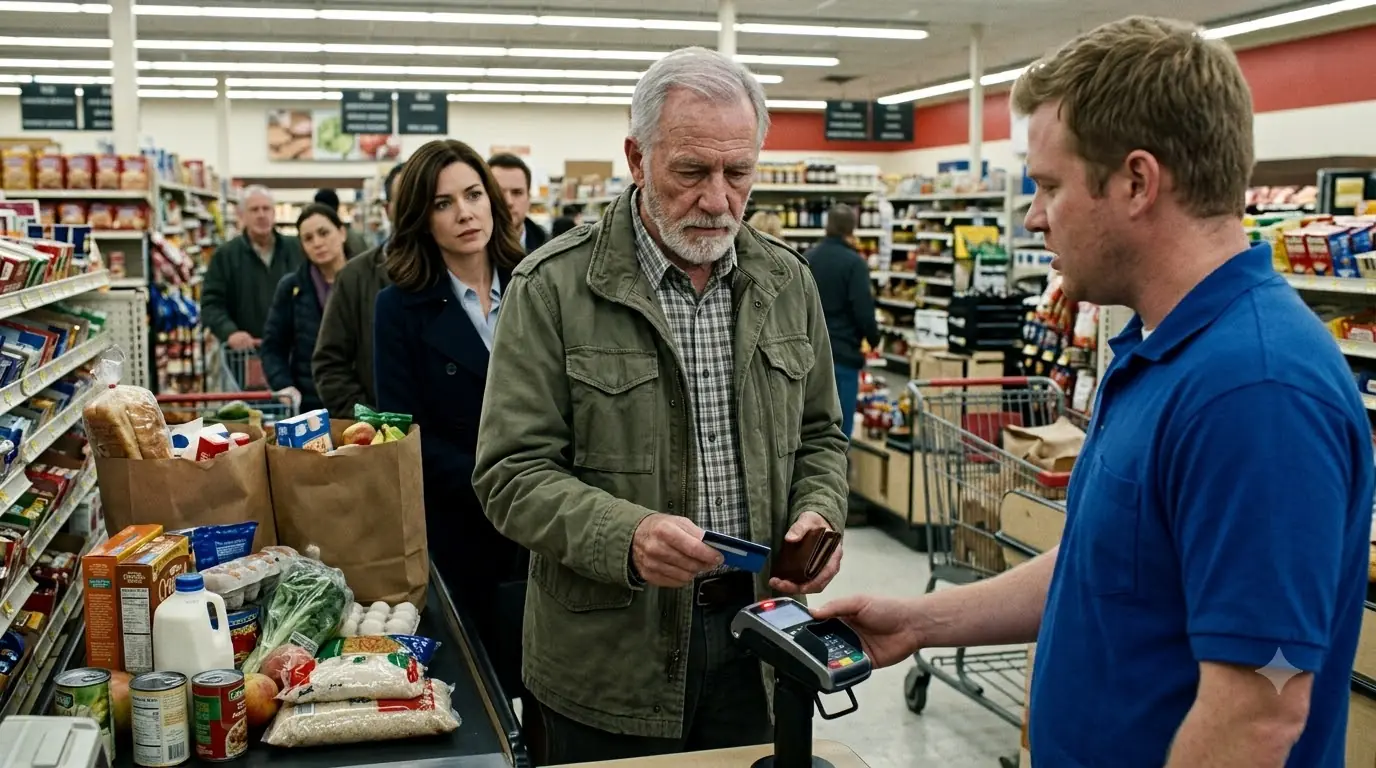
DECLINED.
The word appeared on the small screen between them.
Walter looked at it without changing expression.
“Run it again.”
The cashier sighed.
His name tag said BRENT.
He looked twenty-three or twenty-four, with carefully shaped hair and the permanently irritated expression of someone who believed every customer existed mainly to make his shift longer.
“I already did.”
“Try once more.”
“It’s not going to become less declined because we keep pressing the button.”
Walter looked at him.
“Run it again.”
Brent rolled his eyes.
There were four people waiting behind Walter.
One woman shifted her basket from one hip to the other.
A man checked his phone.
Someone farther back sighed loudly.
Walter ignored them.
The groceries filled almost the entire belt.
Milk.
Bread.
Eggs.
Ground beef.
Chicken thighs.
Rice.
Beans.
Pasta.
Breakfast cereal.
Apples.
Bananas.
Frozen vegetables.
Peanut butter.
Laundry detergent.
Toilet paper.
Three boxes of macaroni and cheese.
Two cartons of orange juice.
A package of inexpensive sandwich meat.
Nothing luxurious.
Nothing unnecessary.
It was the kind of cart somebody filled when feeding children for more than one day mattered more than making the bags look impressive.
Brent tapped the machine again with one finger.
“Card declined.”
Walter reached for his wallet.
“Give me a second.”
“That’s enough.”
Brent began pulling the first bag back toward himself.
Walter’s hand stopped.
“What are you doing?”
“If the card won’t go through, the groceries stay.”
“I can pay.”
“Then maybe buy less if you’re broke.”
The woman behind Walter looked up sharply.
Walter did not.
He opened his wallet.
Inside were two credit cards he almost never used, a veterans identification card, an expired photograph of his late wife Helen, and a folded envelope held together with a rubber band.
He did not touch the envelope.
Instead, he pulled out another card.
“Try this.”
Brent took it.
The machine processed for several seconds.
DECLINED.
Brent laughed once under his breath.
Not loudly.
Loud enough.
“Sir.”
He said.
“If you don’t have the money, there’s no shame in putting some things back.”
The tone made the sentence crueler than the words.
Walter’s eyes lifted.
“I said I can pay.”
“Then do it.”
Brent gestured toward the growing line.
“People have places to be.”
Walter glanced behind himself.
Several customers immediately looked away.
He was seventy-six years old.
Tall once.
Still broad across the shoulders, though age had thinned him.
His gray hair was cut close.
He wore a brown canvas jacket polished smooth at the cuffs from years of use.
Nothing about Walter Hayes suggested helplessness.
But humiliation does not need helplessness.
It only needs an audience.
Walter looked down at the groceries.
Then at the envelope inside his wallet.
His thumb touched it.
Stopped.
That money was not his.
Not anymore.
It had not been his from the moment he withdrew it.
Eight hundred dollars.
Electric bill.
Two months of overdue rent.
A pair of children’s winter boots if enough remained.
Walter would eat canned soup for two weeks before touching it.
Brent reached for the cereal.
“Maybe leave the shopping to people who can actually pay.”
“That’s enough.”
The voice came from behind Walter.
A man stepped forward from third place in line.
He was around forty, wearing jeans, work boots, and a green jacket with a small embroidered high-school logo on the chest.
His name was Evan Cole.
Walter did not know that yet.
Brent stared.
“I’m just doing my job.”
“No.”
Evan said.
“You’re enjoying it.”
The line became very quiet.
Walter turned.
“I don’t need help.”
Evan looked at him.
“I didn’t say you did.”
“Then stay out of it.”
Evan took out his card.
Walter’s jaw tightened.
“No.”