Harland County, Kentucky. Early spring.
The hills are still gray, the fields still cold, and a loader arm is swinging over a dumpster behind Route 7 Farm Market, lifting, tilting, dropping 400 sacks of rotting potatoes into the steel container like they never mattered.
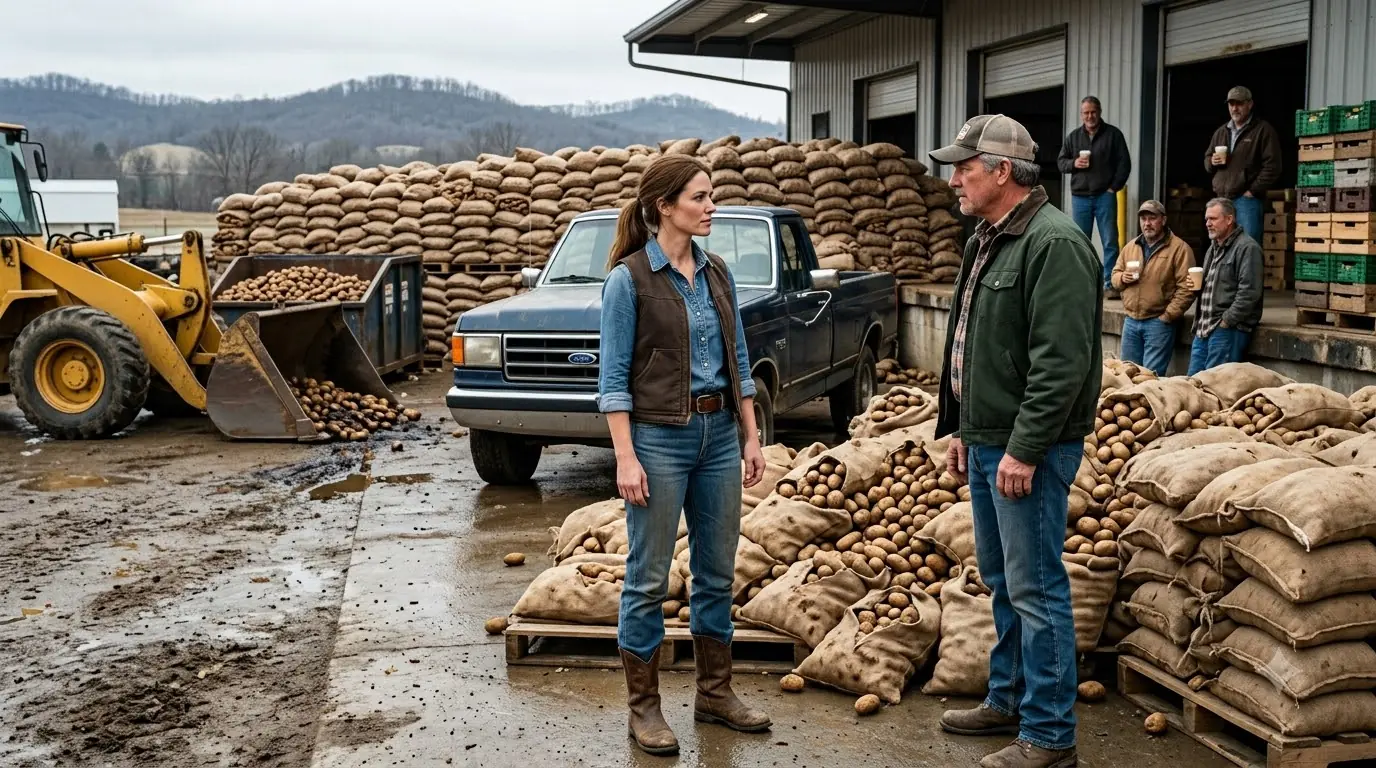
A truck pulls into the back lot, slows, stops. A woman gets out, 34 years old, hands already rough from a winter of keeping a farm alive alone.
She stands in the cold and watches the loader swing back for another load. The dock hands watch her. Nobody moves.
Then she walks straight toward the machine.
Behind her, two miles down a gravel lane, sits 40 acres of clay ground that swallowed her father's best years and gave nothing back. Everyone in this county knows that field. Everyone has already decided what it is.
She hasn't.
She raises her hand.
The loader stops.
"I'll take all of them."
The loader was already moving when Ren Callaway pulled off Route 7 into the back lot of Route 7 Farm Market. She saw it from the road, the yellow arm lifting the bucket, burlap sacks tumbling against each other as the machine rolled toward the dumpster at the far end of the loading dock.
She pulled in anyway. She cut the engine.
She sat for a moment, watching the arm lift again, watching more sacks disappear over the lip of the steel container, watching a thin, dark liquid run down the outside of the dumpster where the worst ones had already gone over.
She got out of the truck.
The dock smelled the way early spring always smelled in Harland County. Cold mud, diesel exhaust, the faint sweetness of last year's hay still clinging to everything.
But underneath all of that was something else now. The specific, cloying rot of a vegetable that had gone too far past useful.
It wasn't overwhelming in the open air. It was just present, the kind of smell that registered in the back of the throat before the nose fully caught it.
The loader operator was a young man named Lyall who worked the market's back dock most mornings. He had his cab window down, his elbow out, and he was watching the sacks go over the lip with the mild disinterest of a man doing a job he'd done before.
When Ren stepped in front of the machine with her hand raised, he stopped.
He looked at her. He looked at the dumpster. He looked back at her.
Ren kept her voice level.
"Stop. I'll take all of them."
Lyall's face moved through several expressions in quick succession before settling on something between confusion and amusement. He cut the engine on the loader.
The dock went quiet except for the wind off the ridge behind the market.
Ray Burton came out of the loading bay 40 seconds later, wiping his hands on the canvas apron he wore every day regardless of what he was doing.
Ray was a compact, practical man in his mid-50s who had managed the market for 11 years and had seen enough strange things in that time to keep his face neutral under most circumstances.
He looked at Ren. He looked at the sacks staged behind the building, the ones that hadn't gone over yet.
He did a rough count in his head.
"Ren."
He said her name the way men say a name when they're using it to replace a longer sentence.
"There are close to 400 sacks back here. They're done. Sprouted, soft. Some of them are past soft."
"I know what they are."
"You want 400 sacks of reject potatoes."
"I want 400 sacks of potatoes. What they are is my business once they're on my truck."
Ray looked at her for another moment.
He was not a man who wasted energy on other people's decisions once those decisions were clearly made. He nodded once, the way he nodded when he'd received information he'd file away without comment, then turned back toward the bay to get the paperwork.
By then, two of the dock hands had wandered over the way men do when something unusual is happening within walking distance.