Three days before Christmas, Caleb Mercer walked out of Northstar Executive Aviation carrying a cardboard box against his chest and trying desperately not to let anyone see that he was crying.
Inside the box were nine years of his working life reduced to four objects.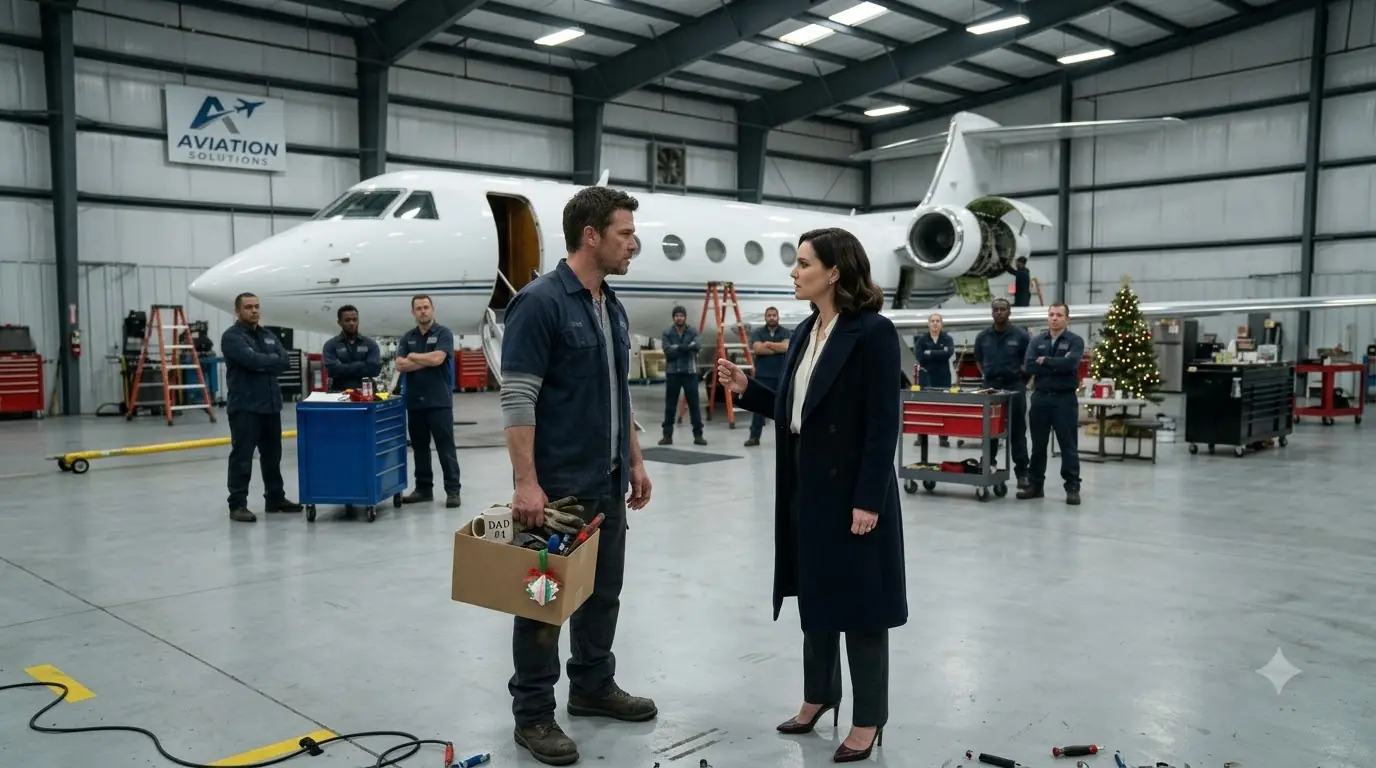
A faded blue coffee mug with a chipped handle.
A pair of leather work gloves softened by years of hydraulic fluid, solvent, cold mornings, and heat from aircraft brakes.
A framed photograph of his eight-year-old daughter, Nora, grinning through the gap where she had lost her two front teeth.
And a crooked little Christmas ornament made from green craft foam, glitter, and a school picture of Nora taped into the center.
She had written on the back in purple marker:
FOR DAD’S WORK TREE.
Caleb had not owned a work tree.
So every December, he hung the ornament from the metal shelf above his toolbox.
He had done it four years in a row.
Now it lay on top of everything else in a cardboard box because Graham Voss, Northstar’s new operations director, had decided Caleb’s position was being eliminated.
That was the official explanation.
Caleb knew better.
Everybody in Hangar Two knew better.
Two weeks earlier, Caleb had refused to close a maintenance task on an executive jet because he believed a structural component in the left main landing gear assembly required further inspection.
The aircraft had been scheduled to depart that afternoon.
The passengers were important.
The delay was expensive.
And Graham Voss had made it very clear that Caleb’s refusal was inconvenient.
Caleb had signed his name to aircraft maintenance records for almost fifteen years.
He had one rule.
If he was not willing to put his daughter on the airplane, he would not put his name on the work.
That rule cost him his job three days before Christmas.
What Caleb did not know as he walked toward the exit was that thirty-seven people were about to decide his job was not the only thing at stake.
And before Christmas morning, Northstar Executive Aviation would be forced to choose between the man who protected its schedule and the people who protected its airplanes.
Caleb Mercer had never planned to become an aircraft mechanic.
As a boy, he liked taking things apart.
Radios.
Lawn mowers.
A broken washing machine his father dragged home from the curb when Caleb was thirteen.
His mother hated that habit because Caleb was much better at disassembly than reassembly.
For almost a year, one side of their garage held labeled coffee cans filled with screws from household objects Caleb had promised he would eventually repair.
His father, Thomas Mercer, never complained.
He worked as a city bus mechanic and believed curiosity was only destructive when nobody taught it discipline.
So on Saturday mornings, he brought Caleb into the garage.
Not to fix buses.
Caleb was too young for that.
Thomas taught him smaller things.
How to clean a thread before forcing a bolt.
How to feel resistance instead of overpowering it.
How to mark components before removing them.
How to stop when something did not make sense.
Most importantly, he taught Caleb never to sign work he had not personally verified.
“A signature means you’re volunteering your name to stand beside the result.”
Thomas told him.
“Make sure you like the company.”
Caleb remembered that sentence years later when he enrolled in an aviation-maintenance program.
Cars were interesting.
Airplanes were different.
Every system interacted with another.
Every shortcut could travel much farther than the person taking it.
An improperly secured panel did not simply rattle on a highway.
A missed hydraulic leak did not leave someone stranded beside a road.
Aircraft rewarded discipline.
Caleb liked that.
By twenty-six, he held his mechanic certificates and had already spent several years working line maintenance at a regional airport.
At twenty-nine, he joined Northstar Executive Aviation.
Back then, Northstar operated from two hangars outside Charlotte.
The company maintained privately owned and chartered business aircraft for corporate clients, medical-flight operators, and wealthy individuals who rarely saw the people working beneath the wings.
Caleb liked the place almost immediately.
Not because it paid more.
It did not, at first.
He liked the culture.
The old Northstar believed maintenance delays were frustrating but explainable.
A safety compromise was neither.
The former maintenance director, Frank Bell, had a sentence he repeated so often that new apprentices could imitate him.
“An airplane can wait on us.”
“We never ask gravity to wait on an airplane.”
Caleb respected Frank.
Frank respected technicians who spoke up.
That was how Caleb met Ronan Pierce.
Ronan was fifty-three when Caleb arrived.
He had already spent twenty-four years working on turbine aircraft and possessed a frightening ability to look at a component for five seconds and tell whether somebody had installed it while tired, rushed, or angry.
Ronan was not warm.
He did not believe workplaces were families.
He called that phrase “corporate hostage language.”
But he took care of people.
When Caleb joined the night shift, Ronan quietly corrected his mistakes before supervisors noticed.
He never mocked a question.
He never allowed apprentices to guess when a manual existed.
If somebody worked through lunch, Ronan placed food beside them without announcing that he had noticed.
For the first year, Caleb was slightly afraid of him.
Then Caleb met Emily.
She was a respiratory therapist at a hospital near the airport.
They met because her car battery died outside a grocery store and Caleb happened to have jumper cables.
Emily later joked that she married him because any man who carried jumper cables, electrical tape, a multimeter, granola bars, two flashlights, and spare socks in his trunk was prepared for marriage.
They were married three years later.
Nora was born the following spring.
Caleb discovered fatherhood frightened him more than airplanes ever had.
Aircraft came with manuals.
Babies arrived with opinions.
Emily seemed to understand Nora instinctively.
Caleb approached newborn care the way he approached troubleshooting.
He made lists.
Feeding times.
Diapers.
Sleep.
Temperature.
Emily laughed when she found a notebook titled NORA OPERATING TRENDS.