“You forgot the salt again?”
Clarissa Vale stood over the stainless-steel soup kettle with a tasting spoon in one hand and an expression of disgust already fixed across her face.
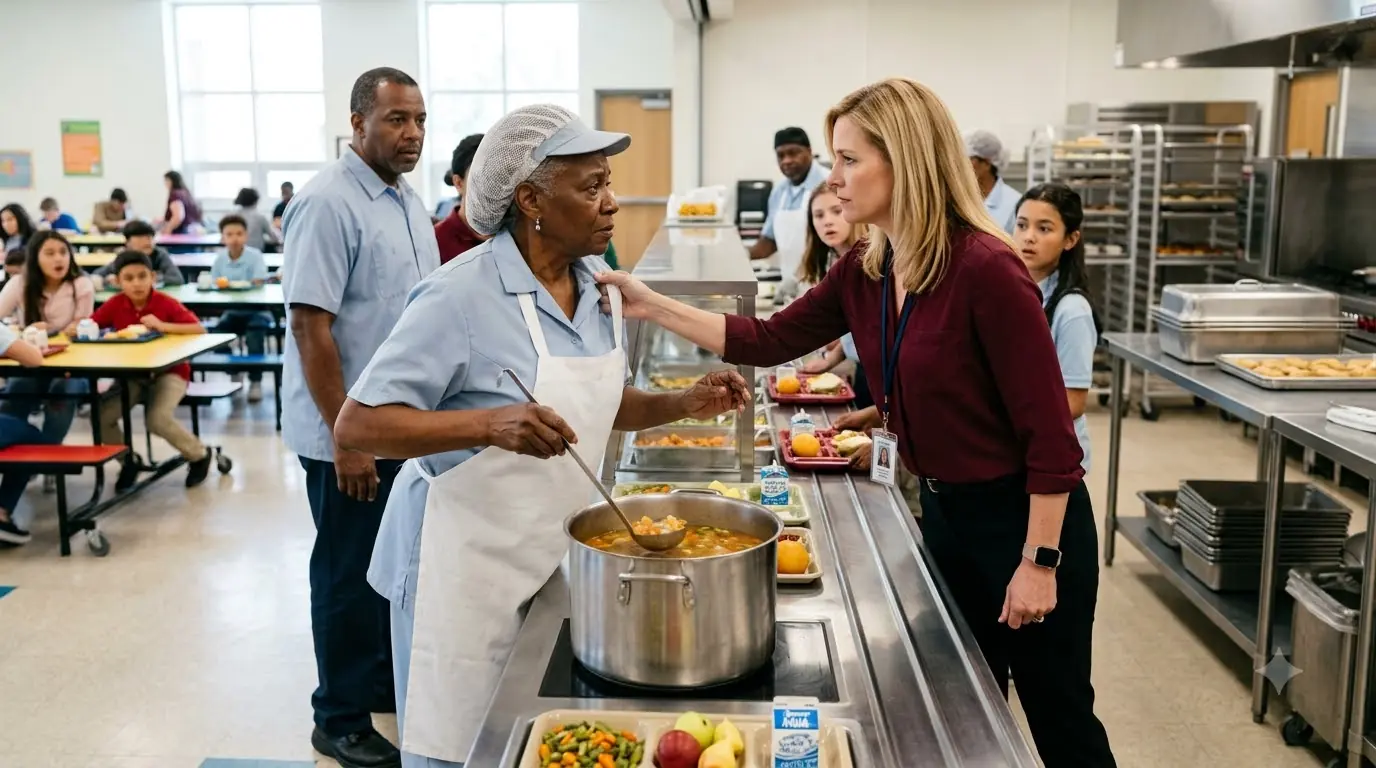
“Bernice, this tastes like hot water.”
The cafeteria had been noisy only seconds earlier.
Now half the serving line seemed to hold its breath.
Bernice Carter turned slowly from the tray rack.
“I seasoned that pot myself.”
Her voice was quiet.
“I know I did.”
Clarissa tasted the soup again.
Then she set the spoon down harder than necessary.
“Then maybe you don’t remember what you do anymore.”
Bernice stared at her.
That sentence hurt more than the criticism.
Not because Bernice had never made a mistake.
She had.
Anyone who worked in a school kitchen for two decades eventually burned something, dropped something, ordered the wrong quantity, or misread a label on a morning when three other problems were happening at once.
Bernice understood mistakes.
What she did not understand was why Clarissa had chosen to turn one pot of soup into a public judgment of her mind.
Clarissa folded her arms.
“I’m not letting another child eat something you can’t even prepare correctly.”
Around them, trays rattled.
Children moved through the line more slowly now.
Several were openly watching.
Bernice glanced toward them.
“Please, Clarissa.”
Her voice lowered.
“Don’t talk about me like that in front of the children.”
Clarissa did not lower hers.
“Then stop giving me reasons to question whether you should still be on this line.”
A boy standing near the milk cooler froze with his carton halfway to his tray.
A girl beside him looked at Bernice.
The girl knew her.
Most of them did.
Bernice had worked in the cafeteria at Jefferson Grove Elementary for twenty years.
Long enough to feed children whose older brothers and sisters she had also fed.
Long enough to recognize food allergies by faces before checking the printed list.
Long enough to know which first graders were frightened on their first day, which fifth graders pretended they were not hungry because money was tight at home, and which children needed someone to quietly add an extra apple without asking questions.
She had never thought of those things as special.
They were simply part of feeding children.
Clarissa pointed toward Bernice’s apron.
“Take it off.”
Bernice’s face changed.
“What?”
“I’m not letting you serve another tray until I can trust your work.”
A few children stopped moving entirely.
Bernice looked toward the soup.
Then toward Clarissa.
“I didn’t guess at anything.”
“I followed that recipe exactly.”
Clarissa gave a short, humorless laugh.
“Then that makes this even worse.”
She stepped closer.
“You should know better by now.”
Bernice Carter was sixty-seven years old.
For eighteen years, she had worked directly in the kitchen at Jefferson Grove.
For two years before that, she had worked in another school in the same district.
Twenty years altogether.
She had arrived at 5:45 every morning through snow, rain, summer heat, staffing shortages, broken ovens, freezer failures, budget cuts, menu changes, health inspections, and three different principals.
She had missed six workdays in twenty years.
Four because her husband died.
Two because she had pneumonia.
Her work shoes had changed.
The ovens had changed.
The children had changed.
Bernice had not changed much.
She still carried a tiny spiral notebook in the front pocket of her apron.
She still sharpened one yellow pencil every morning.
She still believed soup should taste better after sitting for twenty minutes.
She still believed no child should feel ashamed for needing a free lunch.
And she still tasted everything before it went onto the line.
That Tuesday morning had begun normally.
By 6:15, Bernice was chopping carrots.
At 6:40, she had onions sweating gently in two large kettles.
At 7:05, the stock went in.
Then beans.
Tomatoes.
Vegetables.
Pasta.
Seasoning.
The recipe was one Bernice could practically make in her sleep.
She still never trusted memory alone.
The laminated district recipe sheet remained clipped above her station.
She followed it.
Every measurement.
Every required temperature.
Every portion calculation.
Clarissa had approved the production quantity herself.
Three hundred eighty servings.
Bernice had made three hundred eighty servings.
At 10:42, she tasted the soup.
It was right.
At 10:47, she wrote the temperature in the food-safety log.
At 10:49, she added one final measured portion of seasoning.
At 10:51, she tasted it again.