By the second week of October, everyone in Bell County knew pepper season was over.
The nights had turned sharp, frost whitened fence posts before sunrise, and farmers were clearing their packing sheds before winter arrived.
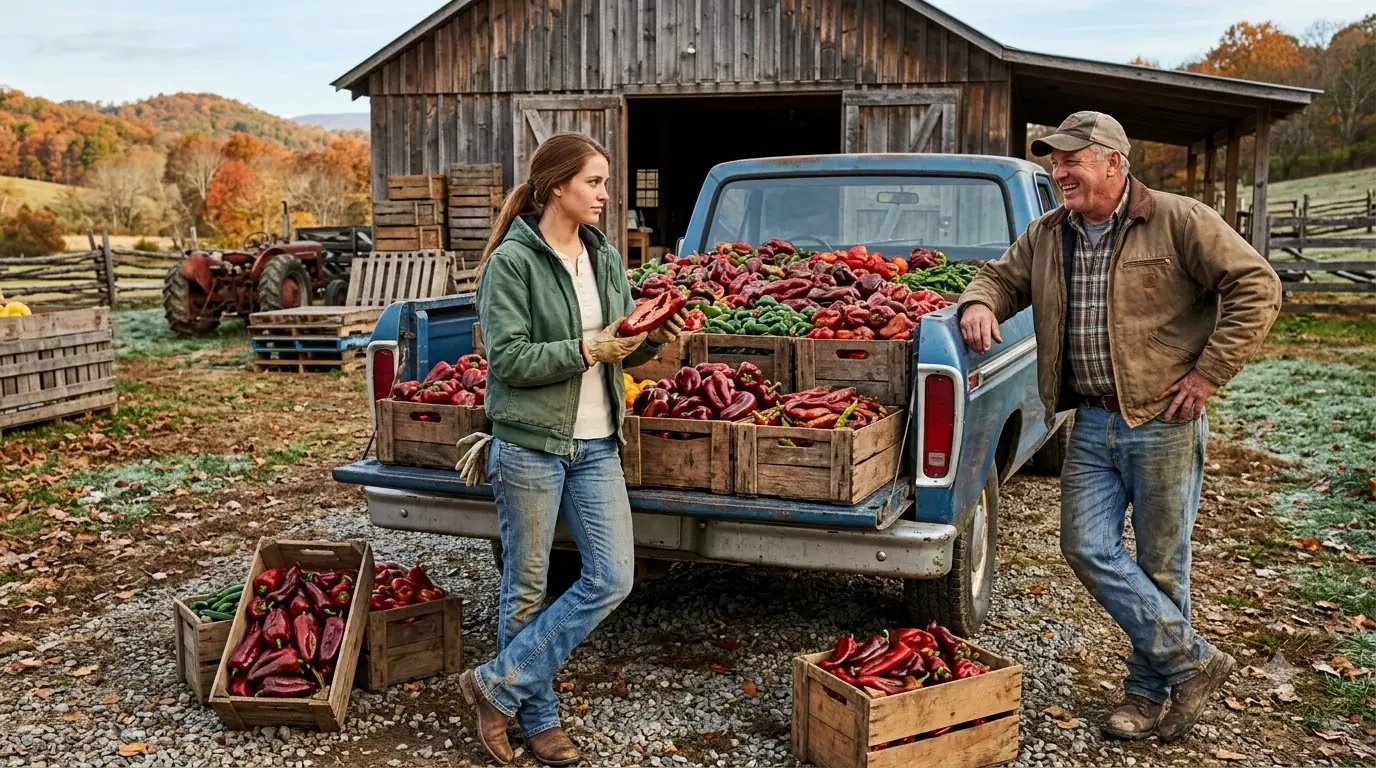
That was how Clara Bennett found herself behind Walter Hayes’s produce barn, staring at nearly 300 pounds of peppers nobody wanted.
They filled battered crates in an old farm truck. Red jalapeños, thick-walled bells, long peppers curled like fingers.
A month earlier, they would have gone straight to market. Now they were too ripe.
Their skins had softened and wrinkled. Some were scarlet, others nearly burgundy, and a few had already collapsed and would have to be discarded.
Walter had called two produce buyers. Both refused them.
Distributors wanted firm peppers that could survive another week on a shelf. Restaurants wanted clean, uniform produce.
By afternoon, Walter had decided the load was going to the compost pile.
Clara reached into a crate and picked up a dark red pepper, soft but not rotten. She broke it open.
The flesh beneath the wrinkled skin was still bright.
“Never seen you look at one quite like that,” Walter said. “You planning on cooking 300 pounds of peppers?”
Clara smelled the broken fruit.
Sweetness came first, then heat.
“Maybe.”
Walter laughed.
“Tomorrow those things are going in the pile.”
Clara looked across the truck.
“How much?”
“For what?”
“All of them.”
Walter stared at her.
“You heard me say they’re finished, right?”
“I heard you.”
He shrugged.
“Five dollars.”
Clara pulled a folded bill from her coat. Walter took it and shook his head.
“You just bought yourself a truckload of trouble.”
By sunset, Clara had hauled the peppers back to the small property she rented outside town.
Under a hanging barn light, she sorted them one by one.
Anything moldy, leaking, rotten, or suspicious went into the discard bucket. But crate after crate, she found peppers that were simply overripe, ugly by market standards, yet still usable.
Soon, the table was covered.
She didn’t have enough freezer space. She couldn’t sell them fresh, and there were far too many to use at once.
Outside, the temperature kept falling.
Clara carried a crate toward the shed.
Then she stopped.
Beside the barn sat an old steel smoker left by the previous tenant.
She looked at it, then at the peppers.
Minutes later, dry wood cracked beneath a match. Smoke curled into the cold October air.
Clara placed the first red peppers over the heat.
Their skins slowly blistered.
Then the smell changed.
The sharpness softened beneath the wood smoke, replaced by something darker and sweeter.
Clara leaned closer.
It didn’t smell like fresh peppers anymore. It smelled deeper, warmer, like something unfinished had suddenly found a direction.
She turned toward the mountain of rejected peppers beneath the barn light.
For the first time that evening, she smiled.
Everyone else had seen peppers one day away from being worthless.
Clara was beginning to wonder if they were one step away from becoming something else.
Clara stayed beside the smoker long after darkness settled over the property.
Every few minutes, she lifted the lid.
The peppers were changing.
Their bright red skins had darkened and blistered. Some collapsed against the metal rack as their flesh softened.
Smoke moved slowly around them, carrying a sweetness Clara hadn’t expected.
She pulled one pepper out with a pair of tongs.
It looked worse than before, blackened in places, wrinkled almost beyond recognition.
She waited for it to cool, peeled away a strip of skin, and tasted the flesh.
The heat was still there, but something had happened underneath it.
The pepper tasted sweeter, deeper, almost earthy. The smoke remained after the heat faded.
Clara took another bite, then another.
She had started the fire because she needed a way to deal with too many peppers.
Now she was thinking about flavor.
She carried several smoked peppers into the kitchen and dropped them into an old blender with salt and a little vinegar.
The machine rattled across the counter.
What came out wasn’t pretty.
The sauce was dark red, thick, and uneven.
Clara dipped a spoon into it.
Too smoky.