Cynthia Harrow stood in the back corner of my yard with one hand resting on a leather folder, staring at the gray-green shed as if I had hauled a dumpster into the middle of Brier Glenn.
“Tear it down, Andre.”
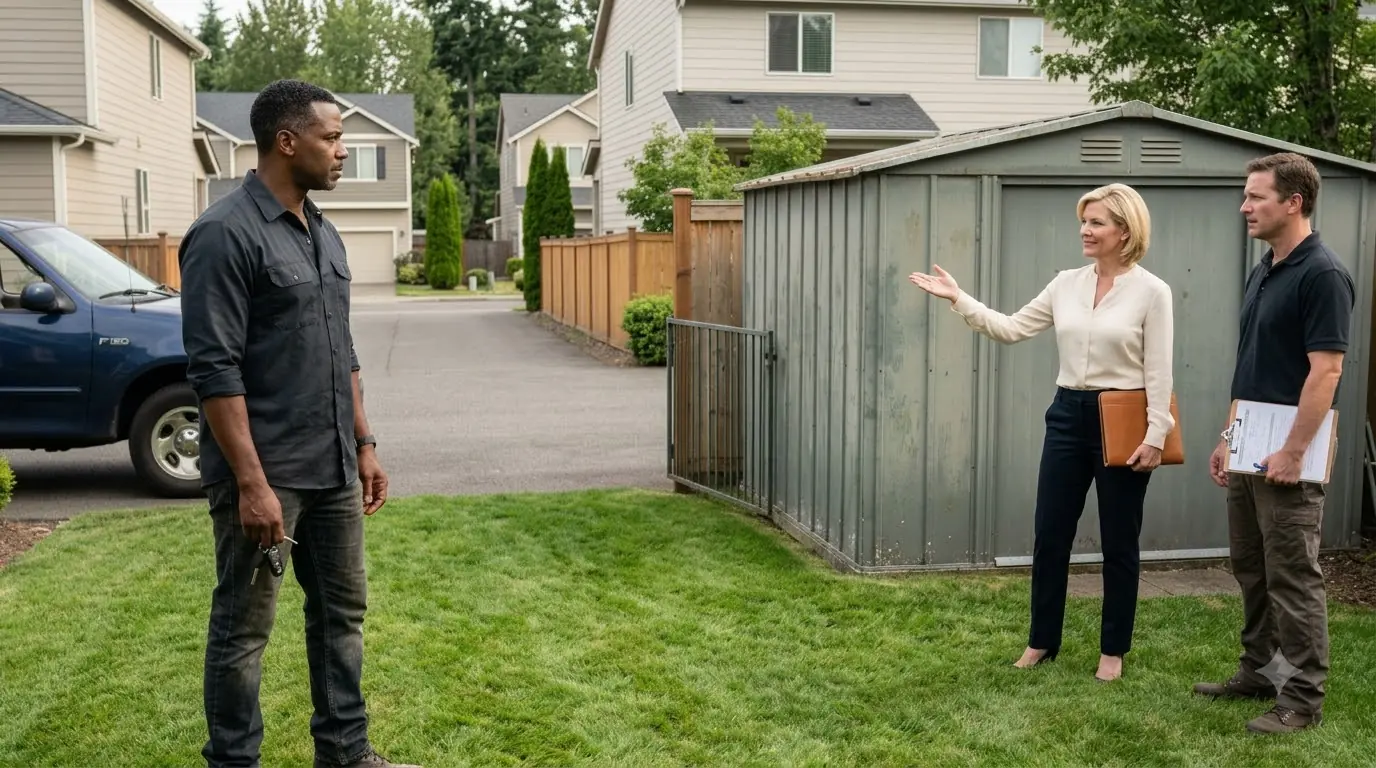
I was still holding the coffee cup I had carried outside.
“What?”
“It is ugly. It is deteriorating. And it does not belong in this neighborhood.”
Three weeks later, after nearly a thousand dollars in fines, two denial letters, a public meeting where she mocked me in front of forty neighbors, and a final threat to place a lien against my house, the shed was gone.
The next morning, two white trucks from Asheford Regional Utilities rolled directly into Brier Glenn.
A field manager walked behind my house, stopped in front of the exposed concrete slab, stared at the equipment standing naked in the morning sun, and asked one question.
“Who removed our utility enclosure?”
The entire street seemed to go quiet.
But by then, the answer had been six weeks in the making.
Six weeks earlier, I was just a man who liked his coffee on the back step and preferred his name to stay out of other people’s mouths.
My name is Andre Whitaker.
I was forty-seven years old and had lived in Brier Glenn for three years.
I lived alone.
I drove a fourteen-year-old Ford pickup with 190,000 miles on it.
I owned exactly one suit that still fit properly.
Most days, I wore work boots, jeans, and whatever shirt I could stain without regretting it.
For nineteen years, I worked as an electrical and controls technician for a utility contractor before leaving to work independently.
That job taught me two lessons that eventually became the most important things I brought into the fight with Cynthia Harrow.
First, buried infrastructure does not care whether the lawn above it is pretty.
Second, paper outlives opinions.
So I kept everything.
Permits.
Surveys.
Closing papers.
Old inspection reports.
Warranty information.
County notices.
Every document connected to my house lived in a plastic storage bin inside the hall closet.
Most people thought that was excessive.
I thought it was easier than arguing with someone five years later about something I could prove in thirty seconds.
Brier Glenn sat on the eastern edge of Asheford County.
It was the kind of subdivision where the grass looked vacuumed rather than mowed.
Trash cans had to disappear from the curb before eight in the morning.
Mailboxes came in one approved shade of black.
Visible basketball goals required written approval.
Roof shingles were supposed to stay within three variations of weathered gray.
The entrance had brick columns, flowering shrubs, and a carved stone sign that was washed twice a year.
People who lived there liked to say the rules protected property values.
Mostly they did.
I had no objection to that.
I bought into the neighborhood knowing there was a homeowners association.
I did not expect complete freedom.
I expected reasonable administration.
The reason I bought the house was the lot.
The original section of Brier Glenn had been built before the expansion, and those first forty-one parcels were deeper than the newer lots.
Mine stretched farther back than most.
Behind the rear fence was a gravel service lane bordered by woods and utility right-of-way.
No future developer was going to put a two-story house twelve feet from my kitchen window.
That mattered more to me than a clubhouse or community pool.
The house itself was nothing extravagant.
Three bedrooms.
Brick front.
Single-story.
Detached garage.
A kitchen somebody remodeled in 2008 and apparently believed beige would remain fashionable forever.
I liked it.
At the rear edge of the property stood the shed.
If someone had asked me to describe it before Cynthia Harrow became interested in it, I probably would have needed a moment.
It blended into the yard because it had always been there.
About ten feet wide.
Maybe twelve deep.
Low sloped roof.
Faded gray-green metal siding.
No windows.
One heavy door.
The south face had faded more than the others.
It was not pretty.
I will give Cynthia that.
It looked more like something beside a water-treatment plant than something sold in the gardening department of a home-improvement store.
The construction had always struck me as strange.
The wall framing was heavier than necessary.
The hinges looked industrial.
Ventilation louvers were built into two sides.
A steel gate behind it opened directly onto the gravel lane.
Inside, I kept a wheelbarrow, some driveway salt, two shovels, and a few bags of grass seed.
Most of the interior was occupied by something else.
A locked beige metal cabinet stood against the rear wall.
It was taller than I was comfortable pretending not to notice forever.
Conduit rose through the concrete slab and entered the cabinet from beneath.
There were warning stickers, although years of dirt had faded them.
A seal hung from one latch.
I never had a key.
I never tried to get one.
Two or three times a year, a utility truck would park on the gravel lane.
A technician came through the steel gate.
He would disappear into the shed for ten minutes.
Then leave.
The man who sold me the house, Harold Weaver, had been seventy-six and tired of maintaining a yard.
During the final walkthrough, he pointed toward the rear corner and said:
“Don’t block the way back there.”
I asked why.
“Utility company has access.”
That was it.
At the time, I had three other things on my mind.
The closing costs were higher than I expected.
The inspector had found a leaking exterior faucet.
And the mortgage company had decided at the last minute that one missing signature required six emails.