The Mercer house was rarely truly quiet.
Even on calm nights, there was always some domestic soundtrack running beneath everything else: the low hum of the refrigerator, the occasional settling creak in the hardwood floors, the distant rush of cars from the boulevard at the edge of the subdivision, the intermittent buzz of Claire Mercer’s phone when another school email slipped in after hours, the soft electronic chirps from whatever game her son Evan had convinced himself could not survive thirty unattended seconds. The house itself sat halfway down a gently curving street in Brookfield Estates, one of those middle-class suburban neighborhoods outside Indianapolis where every driveway held at least one crossover SUV, every mailbox looked almost identical, and every front porch had some variation of a wreath or potted fern depending on the season. It was not large enough to impress anyone and not small enough to create excuses. It was, in the language Claire used when she was feeling grateful and Daniel used when he was feeling practical, a good house for a family.
The open-plan living room and kitchen formed the heart of it.
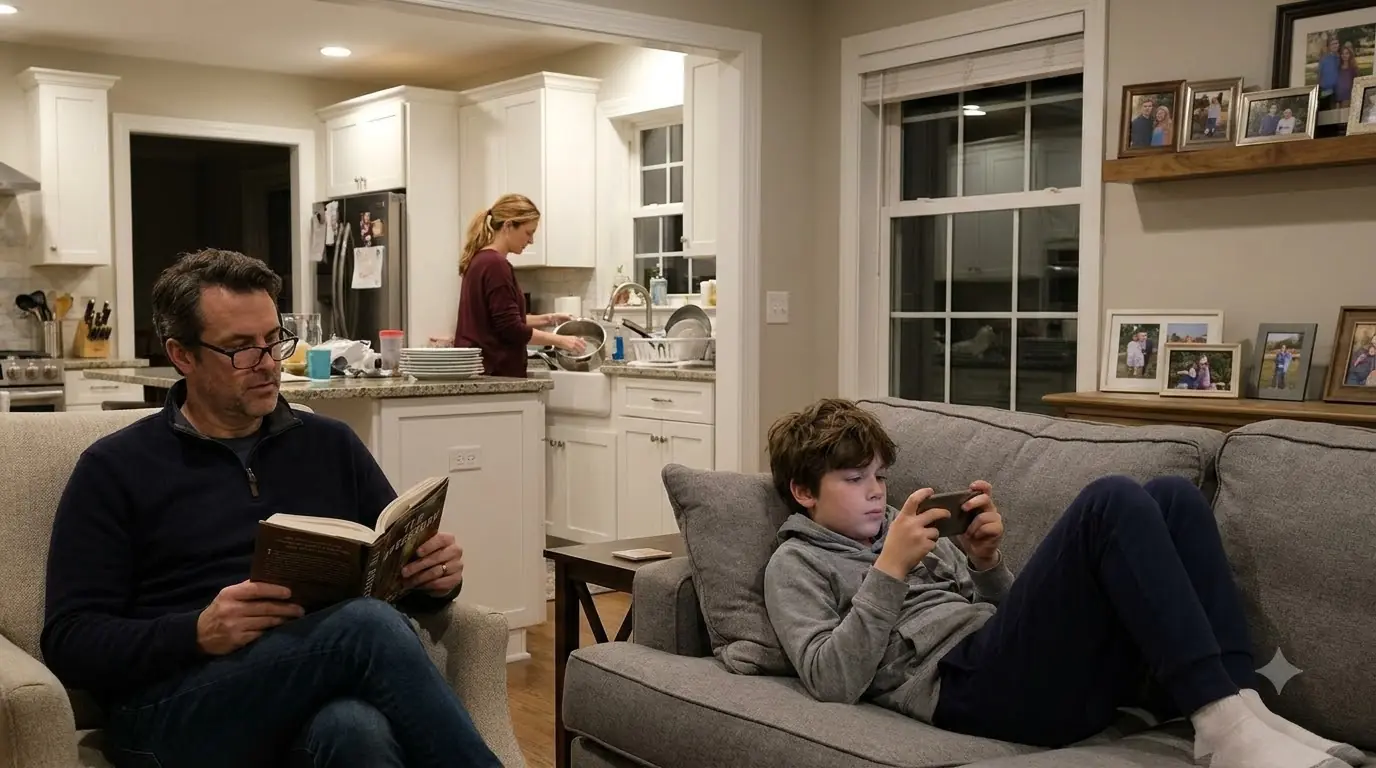
From the front door, the space opened in one continuous view: the living room with its large gray sectional, hardwood floors, and framed family photographs lining the wall near the staircase, then the adjoining kitchen with white shaker cabinets, stone countertops, stainless-steel appliances, and a sink positioned beneath a window that reflected the room at night like a second house floating just outside. A wooden coffee table sat in front of the sofa with old coasters, a stack of library books, and two Lego pieces that seemed to regenerate no matter how often Claire picked them up. The television against the far wall was dark that night, a glossy black rectangle reflecting the floor lamp in the corner. Dinner had ended less than twenty minutes earlier, and the kitchen still wore the evidence of it: a half-filled dish rack, several plates and glasses waiting beside the sink, a saucepan soaking near the stove, and damp counter space where Claire had wiped around everyone else’s retreat from responsibility.
If anyone had paused in the hallway that evening and looked in, they would have seen a family in one of the most ordinary arrangements American domestic life could produce.
Claire stood at the kitchen sink in a soft burgundy long-sleeve top, straight-leg jeans, and well-worn house slippers, washing dinner dishes one at a time with the patient, slightly tired rhythm of someone whose day had already contained too many separate jobs. Her honey-blonde hair was pulled into a practical loose ponytail, wisps escaping near her cheeks from the steam and the long day. In the living room, her eleven-year-old son, Evan, lounged deep in the corner of the sectional with his knees up and a smartphone clutched in both hands, thumbs flicking rapidly across the screen as he chased some urgent victory only he could see. Near the sofa, in an armchair angled toward both the living room and kitchen, Daniel Mercer sat with a hardcover book open on one knee. At forty-two, Daniel had the broad, solid frame of a man who had once played sports seriously and now mostly lifted mulch, furniture, and whatever else family life required. He wore a dark navy quarter-zip sweater over a white T-shirt, jeans, and house socks. He looked relaxed in the way a man looks when he believes the hardest part of the day has passed.
What none of them knew yet was that the next thirty seconds would reveal more about the health of their family than the previous six months had.
The trouble had not begun that night.
Like many domestic ruptures, it had been quietly collecting itself through repetition, convenience, and the little permissions families give one another when nobody is in immediate crisis. Claire had noticed it first in the spring, when Evan started answering requests with a distracted “in a minute” that stretched into “I forgot” and then into something closer to dismissal. Daniel had noticed it later, not because he was unobservant, but because disrespect often disguises itself as mood when it happens gradually enough. Evan was not a cruel child. He was not even, by the standards of late elementary school boys, unusually difficult. He was smart, funny, reasonably affectionate, and capable of being deeply thoughtful at moments that seemed to arrive out of nowhere. He still hugged Claire goodnight most evenings. He still wanted Daniel to watch him try jump shots in the driveway. But something had shifted in the way he treated his mother’s labor—as if the background structure of his life had become so dependable that he no longer felt obliged to see it.
Claire saw it in details.
She saw it in the way Evan would carry his cereal bowl to the counter and leave it there instead of walking the remaining four feet to the sink. She saw it when he called from upstairs to ask where his baseball pants were while she was on a work Zoom, as if laundry were a landscape rather than a task someone performed. She saw it most sharply in the invisible assumption behind those moments: the confidence that whatever he neglected would eventually be absorbed by her. Claire did not resent motherhood. She had wanted Evan fiercely, had loved him before she had even seen his face, and still felt random bursts of tenderness so sharp they startled her. What she resented was becoming, through the habits of everyone around her, the human solution to every unattended thing.
Daniel saw pieces of that burden but not always its cumulative weight.
He worked as a project manager for a commercial roofing company and spent his weekdays juggling subcontractor schedules, bid numbers, weather delays, and clients who wanted impossible timelines. Claire worked as an administrative secretary at the middle school five minutes from their neighborhood, which meant her job officially ended earlier but also seeped everywhere: parent emails, field trip forms, forgotten spirit-week requests, teachers who texted her because they knew she would answer. By the time both parents got home, picked Evan up from basketball practice or math club or a friend’s house, supervised homework, and assembled dinner, the night often felt like a conveyor belt carrying them toward bedtime. In that atmosphere, efficiency frequently won over instruction. If Claire could unload the dishwasher herself in six minutes, asking Evan three times and enduring the delay sometimes felt more exhausting than simply doing it. Daniel understood the logic. What he did not see clearly enough, at least at first, was the cost.
The Mercers had not always been a family running on maintenance.