On May 7, seventy-four-year-old Warren Puit stood at the edge of eighty acres that had been planted with soybeans less than a month earlier and watched the crop disappear beneath two feet of brown water.
It had not rained enough to cause a flood.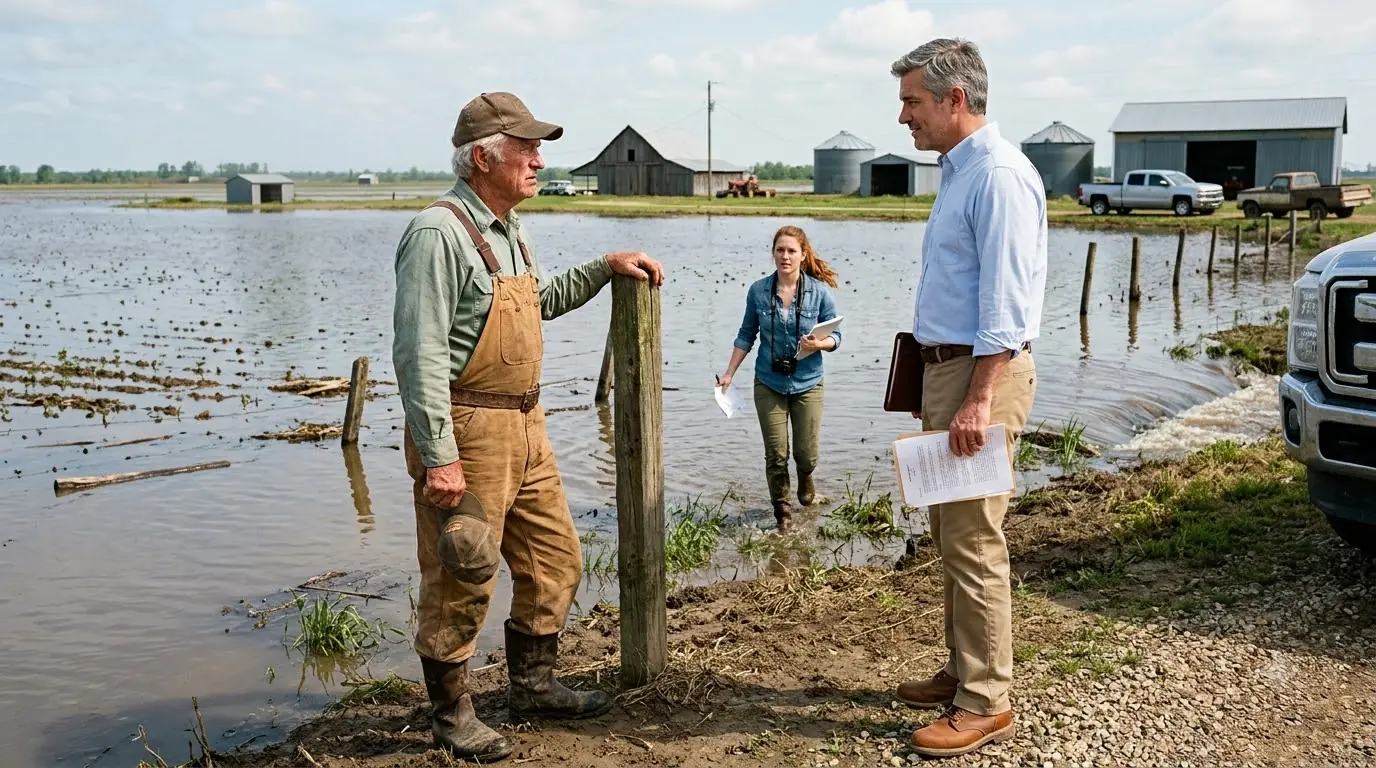
That was the first thing that bothered him.
The second was that the creek along the eastern edge of the property was not even out of its banks.
For almost fifty years, Warren had watched water move across that farm.
He knew what a flood looked like.
He knew the smell of saturated soybean ground after three days of hard rain, knew where the first puddles formed near the lower swale, knew which culvert backed up when branches collected beneath the county road, and knew how long the lowest corner of field twelve usually remained soft after a spring storm.
This was different.
The water was not spreading outward from the creek.
It was coming toward him through a drainage ditch that had always carried water away from the farm.
At 5:18 that Wednesday morning, Warren had stepped onto the porch expecting to see rows of young soybeans beginning to show properly in the early light.
Instead, he stopped halfway down the steps.
A broad sheet of muddy water stretched across the southern bottom ground.
Fence posts stood like short black stakes through the surface.
The highest rows were still visible.
Everything lower had disappeared.
Warren stood there in his work shirt with one hand resting on the porch rail.
He did not move for almost a minute.
The farmhouse sat on the highest part of a six-hundred-acre operation that had belonged to the Puit family for three generations.
From the porch, Warren could normally read the land almost by color.
Dark cultivated soil.
Young crop.
Pasture.
Drainage grass.
The thin green line of creek timber.
That morning, one entire section reflected the gray sky.
He pulled on his boots.
Did not finish his coffee.
By the time he reached the lower field, water was over the tops of his boots in places.
The soybeans had only been planted twenty-three days earlier.
Most stood no more than several inches high.
Their rows disappeared beneath muddy water as if someone had erased them.
Warren crouched and pulled one plant free.
The roots were submerged.
Soil released around them with almost no resistance.
He looked toward the creek.
Normal.
Then toward the old field ditch.
Water moved through it steadily.
Wrong direction.
Warren followed it upstream.
The ditch crossed a brushy strip near the northwestern edge of his property and continued toward a tract that had once been farmland owned by a family named Caldwell.
Three years earlier, the Caldwell property had been sold to a development company.
Trees were cleared.
Survey stakes appeared.
A temporary road was graded.
Then concrete storm structures arrived.
Warren had paid little attention at first.
The work was outside his boundary.
He had his own problems.
Commodity prices.
Diesel.
Fertilizer.
A combine that had required eighteen thousand dollars in repairs at exactly the wrong time.
He had seen construction crews widening a channel the previous fall but assumed county engineers had approved whatever they were doing.
Now he pushed through the brush and saw a structure he had never noticed before.
A wide concrete outlet had been cut into the bank above the old ditch.
Water poured from it.
Not a trickle.
A sustained discharge.
The channel below it had been widened and graded.
Fresh riprap lined part of the bank.
The new alignment directed the flow straight toward Warren’s lowest field.
He stood there with both hands on the top wire of the fence.
For most of his life, Warren had spent money moving water away from those acres.
His father had installed clay drainage tile there in the 1960s.
Warren replaced part of it with perforated plastic line in the 1980s.
They cleaned ditches.
Built shallow field crowns.
Adjusted planting dates.
That ground was never their best.
But in a normal year, it grew soybeans.
Sometimes corn.
Once, wheat.
It produced.
Now somebody had built a concrete mouth above it and pointed water downhill.
Warren walked back toward the farm.
At 6:47, he called Casey.
His granddaughter answered on the fourth ring.
“Grandpa?”
“You awake?”
“I am now.”
“Come out.”
“What happened?”
“Water.”
There was a pause.
“How bad?”
“Come see.”
Casey Puit was twenty-six.
She had returned to the farm the previous winter after six years away.
Four years at college studying natural-resource management.
Two years working seasonal contracts for a conservation nonprofit and a soil-testing company.
She had not come home because of some romantic desire to become a farmer.
At least not initially.
Her mother, Warren’s only daughter, lived three hours away and had built a life outside agriculture.
Casey had grown up spending summers with Warren, then spent most of her early twenties trying to prove that she did not have to stay.