In the morning, Dale Warner arrived with a flatbed truck and a cashier’s check for $87,000. Margaret Foster was standing in the north pasture counting stones.
She had been counting them for three weeks.
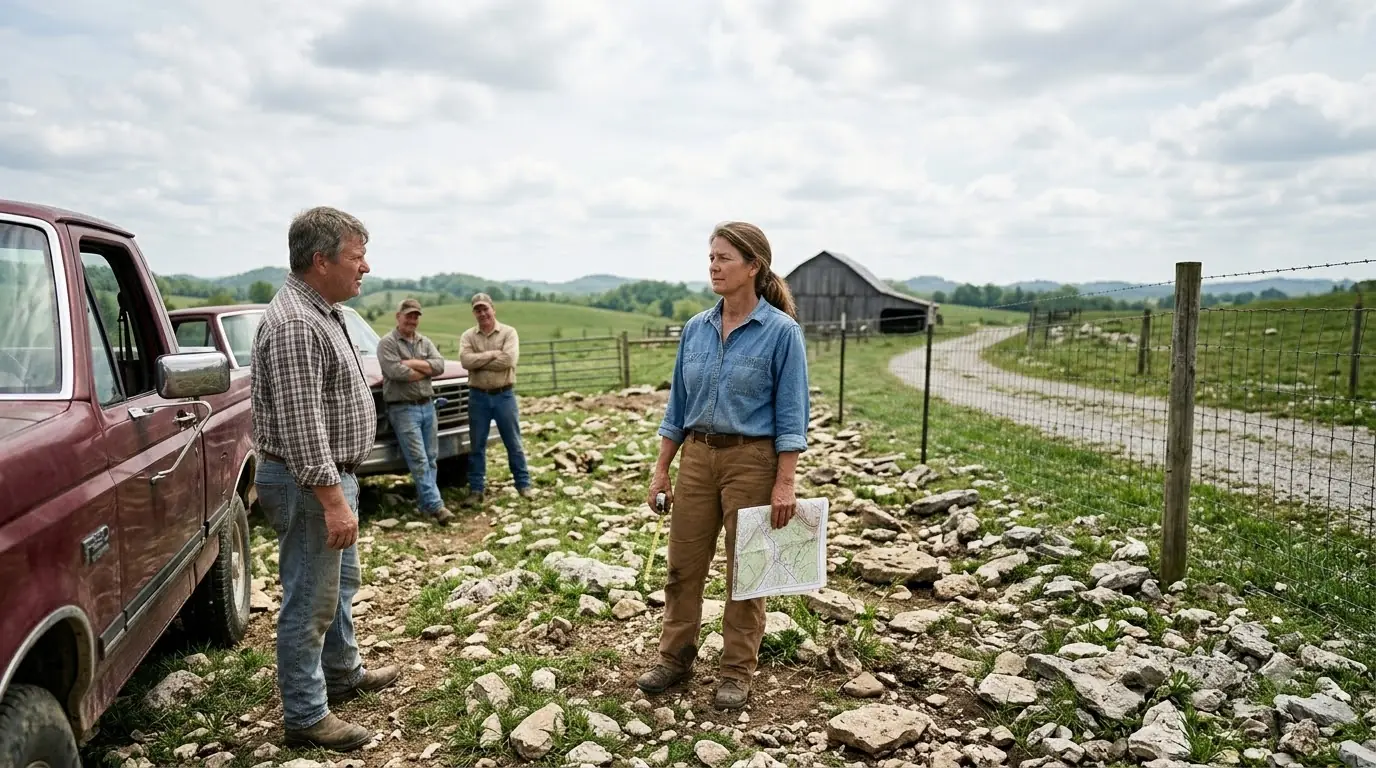
Not because she believed the number itself would save her farm.
There were too many for that.
Thousands lay scattered across forty-two acres of stubborn Kentucky ground, some no larger than baseballs, others broad and flat as wagon wheels. Pale limestone pushed through eight inches of thin topsoil in long gray shelves that had frustrated three generations of the Foster family.
Margaret was measuring those shelves now.
Thirty-two feet along one exposed ridge.
Nine feet across another.
A four-foot vertical face beneath the old cedar tree.
She wrote the dimensions in a spiral notebook, adjusted the tape measure, and moved to the next outcrop.
Behind her came the sound of tires grinding across the gravel drive.
Margaret straightened.
A white Ford flatbed rolled past the barn and stopped beside the pasture gate.
The driver stepped down.
Tall.
Fifty, perhaps.
Work shirt with the sleeves rolled to his elbows.
Sun-darkened arms.
Boots stained pale with limestone dust.
Dale Warner.
The stonemason from Bowling Green.
He leaned against the truck door and called across the field.
“Mrs. Foster?”
Margaret rested both hands on her measuring tape.
“Yes?”
“I’m here about the stones.”
For most of her life, those words would have sounded like a joke.
Six months earlier, the stones were the reason the bank had told her to surrender the farm.
Now a man had driven nearly ninety miles carrying enough money to keep it.
Margaret walked toward him slowly.
Dale reached into the cab and removed a leather document folder.
Then an envelope.
“Before we do anything.”
He said.
“I want you to look at this.”
He handed her the envelope.
Margaret opened it.
Cashier’s check.
Pay to the order of:
MARGARET E. FOSTER.
$87,000.
She read the number twice.
Then a third time.
Her fingers tightened around the paper.
“This clears the bank?”
Dale asked.
“With about five thousand left.”
“Good.”
He nodded toward the pasture.
“My crew starts Monday if you’re still willing.”
Margaret looked past him.
Forty-two acres.
The worst farmland in Harden County.
That was what people called it.
The same ground the Farm Bureau agent said would never pay for itself.
The same ground Richard Foron at First Kentucky Savings had advised her to abandon.
The same ground her late husband, Jim, had spent thirty-five years trying to coax corn, soybeans, tobacco, and hay from without ever admitting how badly the stones were winning.
Margaret looked down at the check again.
“What if the stone isn’t as good as you think?”
Dale smiled.
“We tested seventeen locations.”
“I know.”
“Your daughter made me test three more.”
Margaret almost smiled.
“That sounds like Jessica.”
“Every sample came back Grade A or better for the work I do.”
He pointed toward a limestone shelf visible through the pasture grass.
“That field isn’t worthless, Mrs. Foster.”
“It’s just terrible at being what everybody wanted it to be.”
Six months earlier, Margaret would not have understood that sentence.
In March, she had been sitting across from Richard Foron at the kitchen table when he suggested she surrender the farm.
Richard had known her husband since high school.
That made the conversation worse.
He arrived wearing a navy suit that looked too formal beneath Margaret’s kitchen light.
He placed a folder on the table.
Inside were debt figures, land valuations, agricultural yields, delinquent payments, and projections.
Numbers.
Margaret had always respected numbers.
Her husband had not.
Jim believed a tractor could be kept alive indefinitely with wire, grease, profanity, and enough faith.
Margaret handled bills because somebody needed to know when faith was insufficient.
She had known they were struggling.
She had not understood how close the edge was.
Jim’s death changed that.
He had gone into the barn one February morning two years earlier complaining about indigestion.
Margaret found him forty minutes later beside the workbench.
Heart attack.
Sixty-two years old.
The ambulance arrived quickly.
Not quickly enough.
After the funeral, Margaret discovered what grief does to arithmetic.
Bills do not pause because someone dies.
Property tax continues.
Diesel continues.
Insurance continues.
Seed continues.
Fertilizer continues.
A combine still breaks even when the man who knew how to coax it through harvest is gone.
Jim had carried more debt than Margaret realized.
Not because he had hidden it maliciously.
He simply believed the next season would improve.
Farmers are required to believe that more often than is reasonable.
One more soybean crop.