The engine had defeated three senior engineers over 11 days. It sat dead in the center of the workshop like a curse nobody wanted to inherit, and the biggest race of the year was 72 hours away.
Then Mason arrived. He had not been assigned to it.
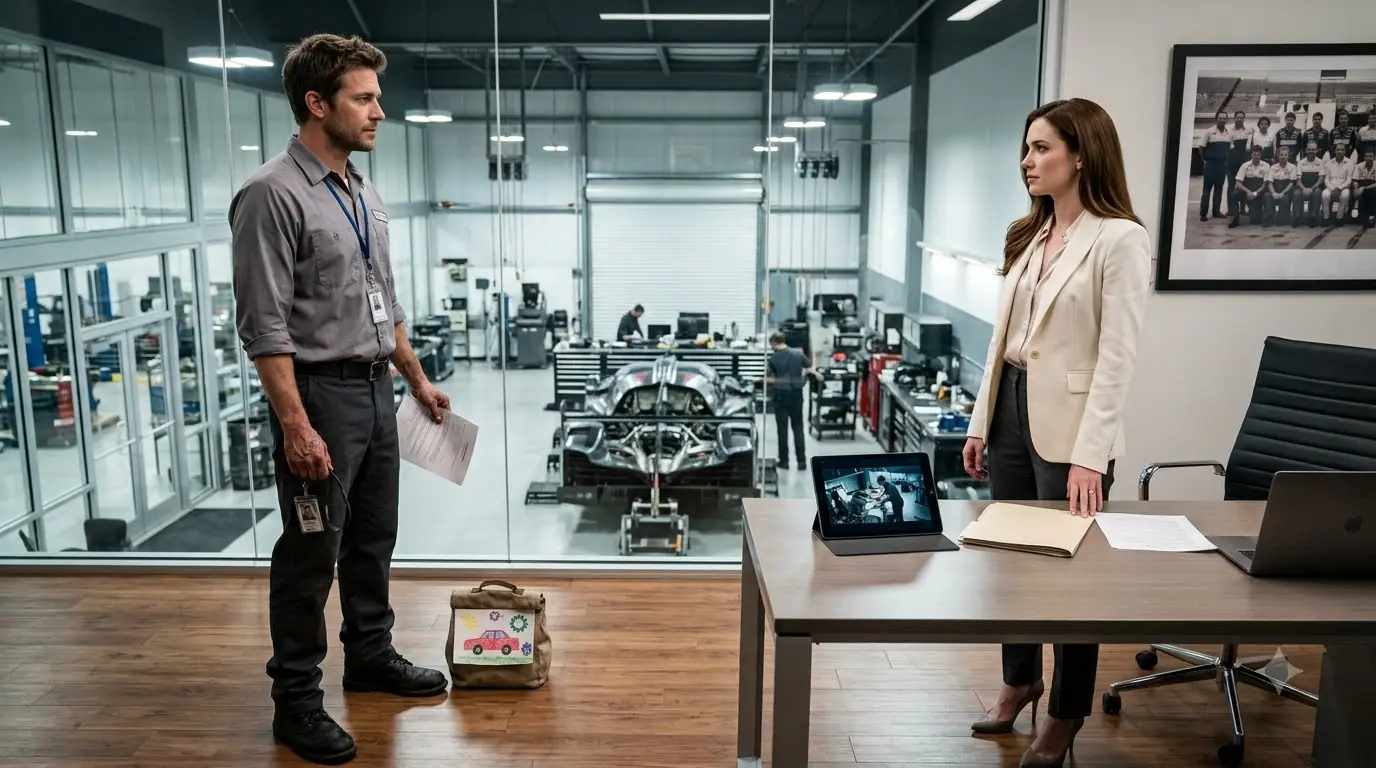
He had no authority to touch it. He was only a general maintenance mechanic, a single father working the floor to keep his 6-year-old daughter fed and sheltered, but he sat down beside that engine in the middle of the night, listened to it the way other men listened to a person they love, and fixed it in 8 hours.
The following morning, CEO Evelyn called him to her office and fired him for unauthorized interference with company property. She did not know that Mason had designed that engine himself.
Mason's apartment was the kind of place that told a story without a single photograph on the wall. It was small, clean, and arranged with a precision that had nothing to do with poverty, and everything to do with a man who had learned to carry only what was necessary.
The kitchen counter held exactly two mugs. The bookshelf held manuals, not novels, and in the corner near the supply closet, pinned with a single thumbtack, was a piece of paper folded into quarters, a technical drawing of some kind.
The lines were too fine and deliberate to be anything casual. Mason never explained it to anyone who came over, and almost nobody came over.
Luna was 6 years old and already accustomed to mornings that moved on a schedule. She sat at the kitchen table with her stuffed bear, a small brown thing shaped like a gear wheel that she had named Cog, propped against her orange juice glass, as though it needed a front row seat to breakfast.
She wore the same pair of star print socks every Monday because she claimed Mondays required lucky socks, and Mason had never once argued with that logic. "Are you coming home early today?" she asked, not looking up from her toast.
Mason set her lunchbox on the counter and thought about the answer with the same care he gave most things. "I'll try," he said.
That was the answer he gave most often. Not a promise, not a dismissal, just an honest acknowledgement that the world between leaving and returning held more variables than any man could fully control.
Luna accepted it the way she accepted most things her father said, with a slow nod and the quiet trust of someone who had never been let down enough to doubt him. He tied her shoes before she left for the neighbor's care, pulling the laces taut with a particular tension.
Not too tight and not loose enough to come undone mid-stride. For a fraction of a second, his mind calculated the friction coefficient of the knot against the material of her laces, then he stopped himself and looked away, the way a man looks away from a mirror he does not want to face too early in the day.