Diego set the toy truck down on its remaining wheels.
“What black car?”
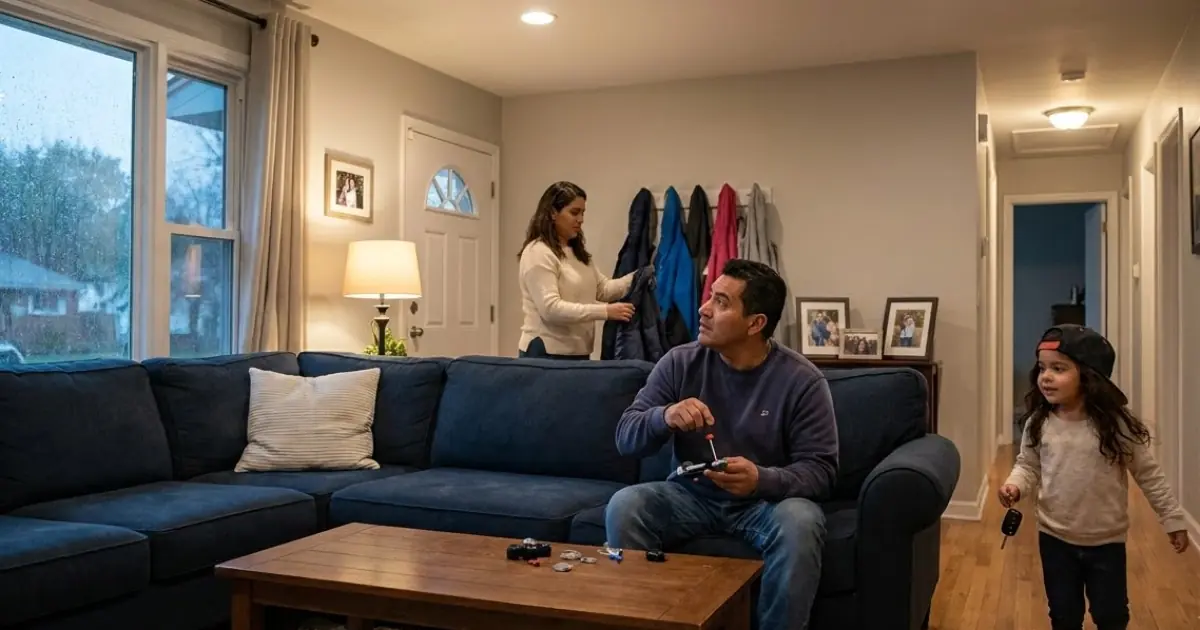
Lila grinned. The cap slid. She pushed it up with the hand that was not holding the fob.
“The one that comes when you’re at work. The man let me wear his hat.”
The almost-smile Diego had been wearing for the broken wheel left his mouth.
Ana’s lips tightened. Her eyes did the same. For a second the coat rack and the rainy glass and the school photos on the wall were all still there, and none of them could help her.
Her mouth opened.
Lila held the fob up like a prize she expected to be praised for.
Ana did not get the sentence out.
They had bought the townhouse when Lila was thirteen months old, a middle unit in a row of beige middle units with a strip of driveway and a shared patch of grass the association mowed on Thursdays. Hardwood showed every crumb. The kitchen opened to the living room on purpose. Ana had said she wanted to see Lila even while she cooked. Diego had said he wanted to see Ana even while he sat. They signed the papers on a Tuesday and slept on an air mattress until the sectional arrived.
Diego worked maintenance at St. Mary’s Hospital, second shift three days a week and days the other two. He liked the work more than people expected a man to like work that did not put his name on an office door. He fixed what broke. He replaced ceiling tiles. He unlocked rooms for nurses who had dropped badges. He came home smelling like wax and cafeteria coffee and sometimes like rain if the lot was open.
Ana kept the books for a dental office in a two-story building with a parking garage underneath. She was good with numbers and with the quiet panic of other people’s insurance. She left the house at seven-forty with Lila if it was a daycare morning, or she left Lila with Mrs. Chen upstairs for the short days. Mrs. Chen was seventy-one and watched television at a volume that leaked through the floor. Lila liked Mrs. Chen because Mrs. Chen kept hard candy in a glass dish and did not make her take off her shoes.
They were not poor. They were not easy. The gold band on Diego’s hand had been paid for in six payments at a store in the plaza. Ana’s band matched. They still looked at the rings sometimes as if the metal might explain something.
Lila collected grown-up objects. A watch left on a dresser. A lipstick. The television remote. She did not steal. She discovered. Discovery was her job in the house. She brought the objects to whoever was sitting and waited to be told the name of the thing. On a rainy evening the object was a key and a hat, and the name of the thing was larger than plastic.
They had met at a cousin’s cookout in July, nine years before the rainy night, when Ana was twenty-eight and Diego was thirty-one.
The cousin lived in a house with a patio that was too small for the number of folding chairs. Diego arrived with two extra chairs in the trunk because someone had texted there would not be enough. He did not make a show of the chairs. He set them down and went to the cooler. Ana was standing near the cooler with a paper plate, deciding whether the chicken was finished. He held the lid for her. She said thank you without looking and then looked and the looking lasted.
“You’re Rosa’s cousin,” he said.
“You’re the one with the chairs.”
“Tonight I am.”