On a Saturday morning in Pennsylvania in 1971, fifteen-year-old Eli Mercer spent every dollar he had saved that summer on eight hundred pounds of rusted steel.
The men standing around him laughed before the auctioneer even brought down the hammer.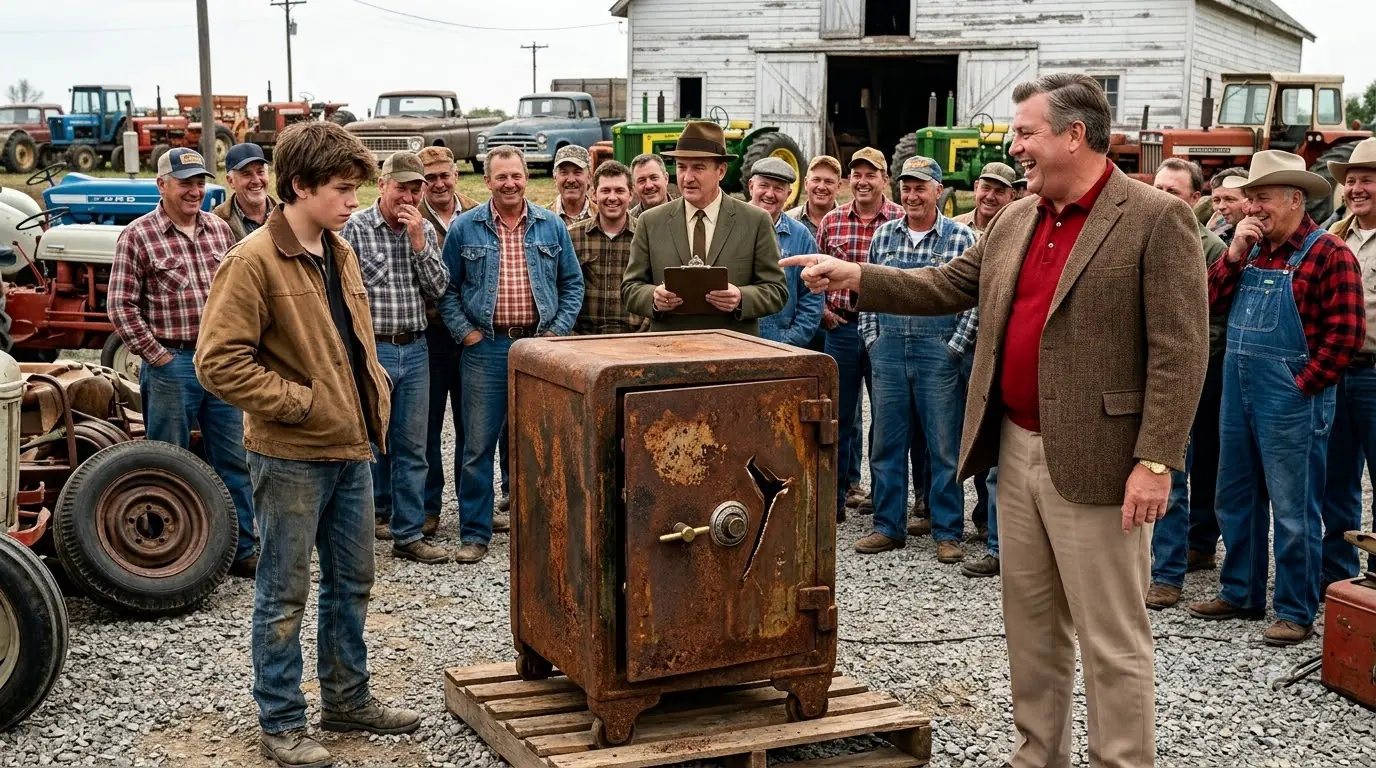
Calvin Rusk laughed loudest.
"Forty dollars?"
Calvin turned toward the crowd as if Eli had just provided the morning's best entertainment.
"Boy, you could've bought yourself a good bicycle for that."
Several farmers chuckled.
Calvin slapped one hand against the side of the corroded safe.
A shower of reddish flakes fell into the gravel.
"This thing wouldn't make a decent chicken feeder."
More laughter.
Eli said nothing.
He simply stared at the blackened scar near the lower left side of the safe's door.
That scar was why he had raised his hand.
Not because he thought the safe held money.
Not because he imagined gold bars, old coins, or some forgotten fortune waiting inside.
He had noticed something that did not make sense.
And Eli Mercer had inherited from his grandfather one habit that often made adults impatient with him.
When something didn't make sense, he had trouble walking away.
The auction was being held at the abandoned Harland Feed and Machine Works outside Bellwood, Pennsylvania, where a collection of corrugated sheds, grain bins, repair buildings, and machinery lots stretched across several acres beside the county road.
For almost half a century, Harland Feed had been one of the busiest agricultural businesses in the valley.
Farmers had once brought grain there.
Ordered feed.
Bought belts, bearings, pumps, chain, fasteners, hydraulic hoses, and tractor parts.
The machine shop repaired balers, combines, manure spreaders, and anything else that could be dragged through the big steel doors.
Then newer dealerships opened closer to the interstate.
Feed production consolidated.
The Harland family lost contracts.
The machine shop became less profitable.
One building closed.
Then another.
By the summer of 1970, the entire operation was finished.
For nearly a year, everything sat untouched.
Dust settled.
Rain entered through broken roof panels.
Weeds grew around machinery.
Then the bank ordered the property liquidated.
That was why half the agricultural community seemed to have arrived before sunrise on that Saturday in June.
Pickup trucks lined both sides of the gravel lot.
Flatbed trailers were backed between rows of used equipment.
Men in work shirts walked slowly from machine to machine, kicking tires, lifting hoods, studying bearings, and estimating how much life remained in things other people no longer wanted.
The auctioneer started at seven.
By nine, Eli and his grandfather, Ellis Mercer, had already watched half a dozen items sell for more money than they could afford.
They had not come for a safe.
They had come looking for a hydraulic pump.
The pump on the Mercers' older diesel tractor had started whining during planting.
By early June, the three-point hitch lifted slowly after the machine warmed.
Ellis knew what that meant.
Wear.
Internal leakage.
Maybe a pump nearing the end of its life.
A rebuilt replacement cost more than the family wanted to spend.
A new one was out of the question.
The Mercer farm covered only sixty acres.
Forty-two were workable.
The rest consisted of woodland, a small creek, the farmhouse, barn, and sloped ground that had never been worth clearing.
It was enough land to make farming possible.
Not enough to make bad years comfortable.
And 1971 had already become a bad year.
Spring rain delayed corn planting.
Then the weather turned suddenly hot.
The shallow fields dried hard.
Corn on the upper ground curled early.
One of their tractor's connecting rod bearings had failed in May.
Ellis repaired the engine himself with parts salvaged from another model, but the job consumed nearly all the money he and Eli's mother, Margaret, had set aside for repairs.
Then the hydraulic problem began.
Ellis never complained in front of Eli.
But the boy had seen the numbers in the kitchen.
Seed bill.
Fuel.
Fertilizer.
Property tax.
Machinery parts.
He had heard Margaret say quietly one evening:
"We can make it if nothing else breaks."
Ellis had answered:
"Then nothing else is allowed to break."
The tractor ignored him.
Eli spent that summer earning whatever he could.
He cleaned calf pens for Harold Keene.
Loaded feed sacks at Patterson's mill.
Fixed fence for a widow named Mrs. Reeves.
Spent two Saturdays cleaning grease from a neighbor's hay equipment.
Nobody paid much.
Two dollars.
Three.
Sometimes five.
Eli folded every bill and kept it inside an old tobacco tin beneath his bed.
By auction morning, he had forty dollars.
He intended to use it toward the hydraulic pump.
Ellis had told him the money was his.
"You earned it."
"It's for the farm."
"The farm existed before your forty dollars."
"And it'll exist better after."
Ellis had smiled.
"Your father would've argued exactly like that."
Eli's father, Thomas Mercer, had died when Eli was eight after an infection that should have been simple became something much worse.
It had happened quickly enough that Eli remembered the confusion more clearly than the illness itself.
The farm afterward became a three-person operation.
Margaret handled the accounts, garden, chickens, and whatever else demanded attention.
Ellis handled the heavy mechanical work and most of the farming.
Eli learned to fill whatever gaps remained.
By fifteen, he could change bearings, set cultivator depth, weld a basic repair, sharpen a mower knife, and rebuild a carburetor if someone patient stood nearby when he got stuck.
Ellis had taught him most of it.
More importantly, Ellis had taught him not to begin with assumptions.
"Metal tells you what happened to it."