“All right,” Elias Mercer whispered to himself as he lifted the last wooden box from the back of his old station wagon. “One more Saturday.”
The box was small enough to fit beneath one arm.
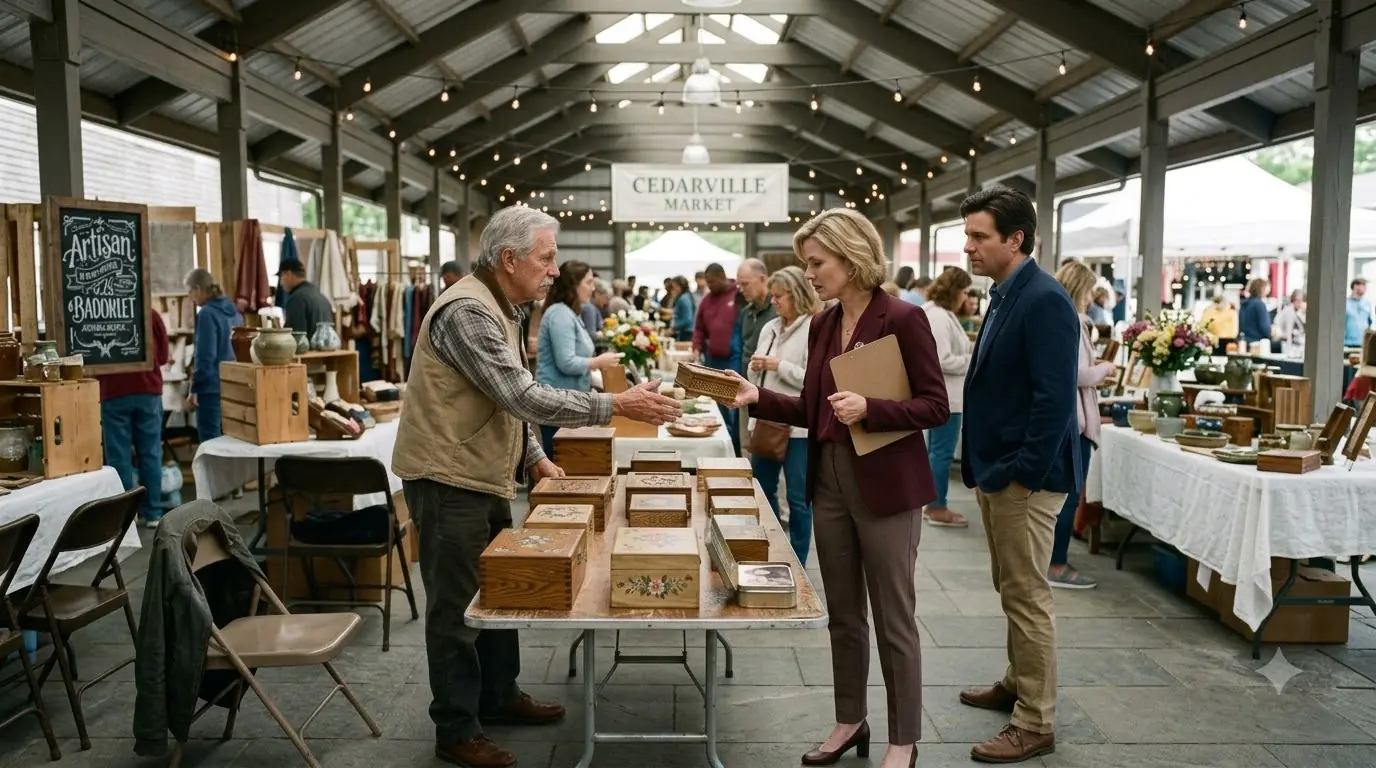
Walnut lid.
Maple sides.
Hand-painted blue wildflowers curling around one corner.
Elias ran his thumb over the lid before setting it inside a plastic storage crate with the others.
“I never know which piece is going to find the person it was meant for.”
The parking lot behind Briarwood Saturday Market was still mostly empty.
It was 6:18 in the morning, early enough that the eastern sky had only begun changing from charcoal to blue.
Vendors moved between vans and folding tables carrying baskets of bread, jars of honey, ceramic mugs, knitted scarves, old records, candles, vegetables, soaps, and secondhand furniture.
The market occupied an old brick community hall and the paved courtyard surrounding it.
Every Saturday from March through November, more than forty sellers filled the place.
Some had been coming for years.
Some came once and disappeared.
Elias was still trying to figure out which kind he would become.
He was seventy-one years old.
Five feet ten, though age had taken almost an inch from him.
Thin white hair.
Gray mustache.
Hands permanently marked by forty-seven years of carpentry.
His knuckles were enlarged from arthritis.
The nail on his left thumb had a deep vertical ridge from an accident with a table saw in 1987.
Most mornings, his hands hurt until he had been moving for twenty minutes.
He worked anyway.
Not because he needed the money desperately.
He needed something else more.
A reason to open the workshop door.
A reason to turn on the lights.
A reason to hear tools running in the room where silence had become almost unbearable.
Six months earlier, his wife Ruth had died.
Forty-eight years married.
Fifty-one years knowing each other.
Elias still sometimes woke and turned toward her side of the bed before memory arrived.
Those were the worst seconds.
Not the grief itself.
The small space before grief returned.
For half a breath, his life still existed the way it always had.
Then it didn't.
The market had been his daughter Hannah’s idea.
“You can't spend every day in that workshop alone.”
“I spent forty years in that workshop.”
“With Mom.”
Elias had no answer to that.
Hannah lived three hours away in Pittsburgh with her husband and two children.
She called every evening.
Sometimes twice.
Elias loved her for it.
He also hated making her worry.
So when she suggested selling some of his boxes at Briarwood Market, he agreed mostly because it gave him something positive to report.
The first Saturday he sold one box.
The second, none.
The third, two.
Today was his fifth.
He had fifteen pieces.
Not enough to look like a business.
Too many to call an experiment.
Elias unfolded his six-foot table in the corner he had been assigned near the back wall.
The location was not good.
Far from the main entrance.
Beside a vendor selling used books for one dollar each.
Across from an emergency exit people rarely used.
But the rent was cheap.
Thirty dollars for the day.
He spread a faded cream tablecloth across the surface.
Then began unpacking.
Jewelry boxes.
Letter boxes.
A tea chest.
Two keepsake boxes with sliding trays.
Three small flower-pattern boxes.
One larger walnut chest with hand-cut dovetail joints.
Every piece was different.
That mattered to Elias.
Ruth had hated repetition.
“If you're going to make two exactly alike,” she once told him, “you may as well work in a factory.”
“I do work in a factory.”
“You work in a cabinet shop.”
“Close enough.”
“It isn't.”
She had been right.
Ruth was often right in irritatingly calm ways.
Elias placed the walnut chest in the center.
Then stepped back.
Something was wrong.
Too much empty table.
He rearranged.
Small boxes forward.
Larger pieces behind.
He opened several lids so people could see the interiors.
He placed a folded linen cloth beneath one piece.
Then removed it.
Too fancy.
Ruth would have laughed.
“You're selling boxes, Elias. Not presenting the crown jewels.”
He smiled at the memory.
Then the smile disappeared almost immediately.
He opened a small metal tin beneath the table.
Inside was a photograph.
Ruth, age sixty-eight, standing in their workshop with a paintbrush tucked behind one ear.
Blue apron.
Hair tied back.
Paint on her cheek.
She was holding one of the first flower boxes they ever made together.
Elias looked at the photograph.
Then placed it beside his cash tin under the table.
Not on display.
He did not want to sell the story.
Only the work.
At 7:02, vendors were still setting up when Marlene Whitaker arrived.