People in Harlow called Isaac Merritt the junk mechanic because he fixed things respectable shops had already decided were dead.
Cracked engine blocks.
Stripped cylinder-head threads.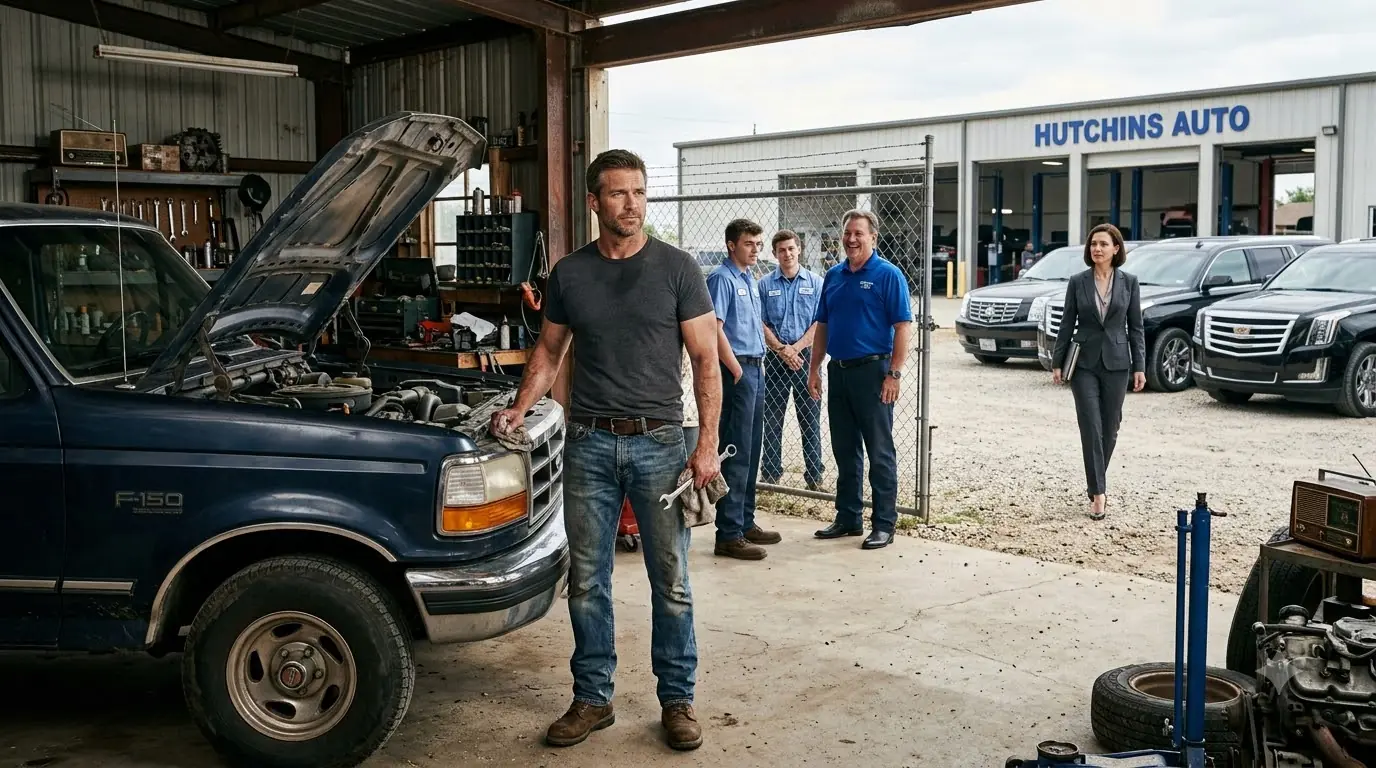
Farm trucks with three hundred thousand miles on them.
Diesel pumps filled with rust.
Generators older than the men who owned them.
Old motorcycles delivered in milk crates.
If Harlow Premier Auto put a red X on the estimate and wrote REPLACEMENT RECOMMENDED across the top, there was a good chance the owner would eventually find his way to the faded metal building at the edge of Route 12 where a hand-painted sign simply read:
MERRITT REPAIR.
Isaac rarely replaced an entire assembly if one failed piece could be understood, repaired, and returned to service.
That irritated people who believed expensive machinery became obsolete as soon as a manufacturer stopped supporting it.
Isaac did not believe machines understood the concept of obsolete.
To him, something either worked or it did not.
If it did not, there was a reason.
Reasons could be found.
That philosophy made him useful in Harlow.
It had once made him dangerous somewhere else.
Six years earlier, Isaac had been a senior propulsion systems engineer at Nexora Aerospace, one of the largest defense and space contractors in the United States.
He had twelve patents attached to his name.
He had led failure-analysis teams.
Designed pressure-control assemblies.
Worked on propulsion hardware destined for missions most people would never hear about.
Then he told eleven executives sitting around a glass conference table that one of their flagship propulsion systems contained a hidden design interaction that would eventually destroy itself in orbit.
Nexora told him his analysis was unvalidated.
Isaac refused to sign the final approval.
Two weeks later, he was fired.
By sunset that same day, thirteen years of aerospace work fit inside one cardboard box.
A coffee mug.
Two technical textbooks.
A framed photograph of his father standing in the doorway of the Harlow garage.
A mechanical pencil set.
And a small aluminum impeller Isaac had machined during college.
He drove six hours south.
Never filed a lawsuit.
Never went to reporters.
Never tried to become a whistleblower celebrity.
He signed the separation documents, complied with the nondisclosure agreement, and disappeared into the garage his father had left him.
For six years, almost nobody came looking.
Then, on a Tuesday morning in September, three black Chevrolet Suburbans rolled into Harlow in formation.
They stopped outside Merritt Repair.
No ordinary license plates.
Dark glass.
Government fleet markings small enough that most people would miss them.
Isaac was beneath a 1995 Ford F-150 when the first door opened.
He did not see the woman step out.
He heard her shoes on gravel.
Then the jazz station playing softly above his parts shelf disappeared when somebody near the garage entrance turned off the radio.
Isaac rolled out from under the truck.
A woman in a charcoal-gray suit stood beside the open bay.
Early forties.
Dark hair cut cleanly at her jaw.
No sunglasses.
No dramatic security detail.
She simply had the posture of someone accustomed to being answered when she asked a question.
Across the neighboring lot, Dale Hutchins had already stopped pretending to inspect a customer’s SUV.
Dale owned Harlow Premier Auto.
He had spent years using Isaac as free entertainment.
“Junk mechanic.”
“Scrap-yard surgeon.”
“Professor Rust.”
Today, Dale said nothing.
The woman walked toward Isaac and opened a credentials wallet.
Blue government seal.
Photograph.
Name.
DR. ELEANOR VOSS.
DIRECTOR, SYSTEMS ENGINEERING.
OFFICE OF LAUNCH AND ORBITAL PROGRAMS.
Isaac looked at the identification.
Then at her.
“You drove three SUVs to tell me my taxes are late?”
Eleanor closed the wallet.
“Mr. Merritt.”
“I need ten minutes.”
Isaac glanced at the vehicles.
“You brought a lot of engineers for ten minutes.”
“They are waiting because I asked them to.”
“You always arrive at repair shops like an invading country?”
“Only when the repair shop contains someone we have spent three weeks trying to locate.”
That changed something.
Not much.
Isaac wiped grease from his hands with a red shop rag.
“If this involves Nexora.”
He said.
“I signed an NDA.”
“It does not involve asking you to disclose commercial information.”
“Then what does it involve?”
Eleanor removed a thick manila folder from beneath her arm.
A diagonal red stripe crossed the cover.
No title visible.
She placed it on the hood of Raymond Foster’s truck.
Raymond was a retired high-school history teacher whose pension could not absorb the four-thousand-dollar estimate Dale’s shop had given him for replacing an entire exhaust-side cylinder head.
Isaac had repaired the stripped threads for one hundred eighty-seven dollars.
Now a classified government folder sat on Raymond’s hood.
Eleanor rested one hand on it.
“OBSIDIAN-7.”
Isaac’s face changed.
Only for a second.
Eleanor saw it.
“That means something to you.”
“No.”
“You’re a terrible liar.”
“I’ve been out of aerospace six years.”
“I know.”
“So whatever you think I remember.”
“I think you remember a pressure regulation assembly called Prometheus.”
Isaac stopped wiping his hands.